
7 Transformative Ways: How Indian Universities Support Mental Well-Being through Campus Wellness Initiatives
The Indian higher education context has also witnessed a paradigm shift, where it is realized that the mental well-being of students is important. Indian university responses to mental well-being have been a question that is relevant as campuses turn into holistic environments that value psychological well-being, in addition to academic achievement. The coming together of Indian universities’ campus well-being initiatives is a step in the direction of tackling the pandemic of mental health that has been threatening the students for long.
Mental health in schools is no longer optional, especially considering global challenges and growing academic pressure.
Knowing the Mental Health Landscape in Indian Higher Education
The campus mental health crisis in India has become an epidemic. There is a whopping percentage of students well known to develop psychological distress as a result of academic pressures, social issues, and accommodations to independent living, according to research studies. The University Grants Commission (UGC) guidelines require higher education institutions to ensure student counseling mechanisms but uneven implementation in the country.
Organized Campus Wellness Programs: The Building Blocks of Support
Content and organization of Indian institutions in constructing mental well-being begins with establishing a structured campus wellness model. Premier universities, the Indian Institutes of Technology (IITs), Indian Institutes of Management (IIMs), and the National Institute of Mental Health and Neurosciences (NIMHANS) have established formal mental health models that others have emulated.
The Ashoka Centre for Wellbeing is one of the most groundbreaking campus wellbeing projects. The centre combines preventative, promotive, and curative actions for mental health and offers a collective space in which discussion of wellbeing is encouraged and made normal. The centre offers free, non-judgmental, and confidential counselling, emphasizing that mental health care has to be universally accessible without regard to the socio-economic circumstances of students.
Professional Counselling Services and Support Systems
Professional counseling services are the pillars of Indian University mental well-being programs. Professional services provide students with professional counselors, mental health professionals, and psychologists with evidence-based therapy interventions. Cognitive behavior therapy has been especially useful in the treatment of college student symptoms of mild to moderate depression and anxiety.
The presence of counseling on campus helps to remove the point of access barrier that results in most students being discouraged from accessing help. Numerous institutions of higher education now provide walk-in visits, scheduled visits, and emergency treatment. Some institutions have also integrated mental health services into university health clinics to facilitate whole-person care coordination.
Tele-counseling centers have provided greater access to mental health care for many, especially for distant students or those who want to maintain anonymity through online consultations. The Tele MANAS helpline (14416) and the government scheme MANODARPAN offer 24/7 mental support in 20 Indian languages, an example of how technology is being utilized to address student mental health.
Peer Support Networks and Paraprofessional Training
In the understanding of professional mental health care remaining as a rare commodity in India, higher education institutions have launched novel peer support initiatives. These initiatives educate students as first responders in being able to recognize warning signs of distress, offer initial support, and refer peers to the relevant professional sources.
The paraprofessional model has the faith that with good training and an honest heart, anybody can become a good listener and an asset. There are groups such as Ashoka, which have implemented rigorous training for ambassadors, teaching assistants, and resident advisors who can be welcoming points of contact for students with mental illness.
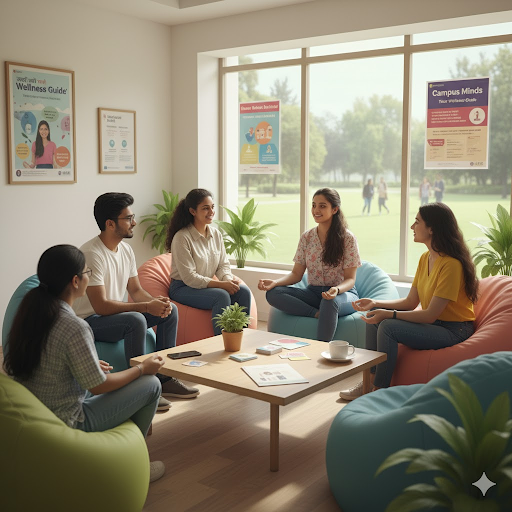
Peer counseling groups provide the students with a safe environment where they can speak to someone else who recognizes the distinct stress of university life. The groups eliminate stigma regarding mental health conversation and create support networks beyond the official counseling. Students will instead come in to discuss things with their peers first, and these networks therefore become very important points of entry into the official mental health system.
Mental Health Education and Awareness Campaigns
Psychoeducational processes educate students with effective mental health management skills. Healthy living, time management skills, study skills, relationship skills, and drug abuse prevention are some of the problems that are covered. The skills enable the students to make healthy choices regarding their health and build coping mechanisms against future stress.
College wellness programs recognize that mental health is intertwined with physical health, social connections, and the environment. Universities encourage healthy lifestyles through physical education courses, approved athletics, and recreation activities, which have been found to have the benefit of alleviating anxiety and depression.
Relaxation interventions have been said to share special effectiveness in that they are among universal prevention interventions in mental health. Colleges offer yoga classes, meditation, and mindfulness training to students, which are taught to manage stress independently.
Handling Academic Stressors and Providing Accommodations
The way Indian universities promote mental well-being is through finding out and addressing the reasons for learning pressures among students. Administrative staff training in mental health enables teachers to recognize distressed students and refer students to respective support staff.
University accommodations for students who are faced with mental illness prevent transient psychological disability from structurally undermining educational objectives. These accommodations are present in the form of longer time frames, providing alternative testing options, or lighter course loads for bad times. This kind of accommodation identifies that issues with mental health are legitimate medical conditions worthy of the same respect as bodily sickness.
Universities are also investigating course structure and modes of assessment to minimize unnecessary stress. Continuous assessment, project work, and multiple forms of assessment can minimize the high-stakes test stress to contribute to student stress.
Government Initiatives and Policy Frameworks
Political resolve to the mental health of students has come through numerous country-level programmes. The National Mental Health Programme has certified 25 Centers of Excellence to offer postgraduate students and advanced care with mental health training. Forty-seven postgraduate mental health departments have been added or enhanced in government medical colleges, turning around the shortage of mental health professionals.
The Mental Health and Wellness scheme is about enhancing learning for mental health at the school and collegiate level with an additional emphasis on early intervention processes. Mainstreaming of mental health services by integrating services into Ayushman Bharat Health & Wellness Centers means psychological care is included in mainstream healthcare delivery.
The National Education Policy 2019 draft supports student guidance systems and strongly suggests psychological counseling in the higher education sector. The policy design is the foundation upon which the university can implement broad mental well-being programs consistent with national priorities.
State governments have also responded with innovative solutions. The Kerala state college mental health program illustrates how system-wide implementation can reach students from all types of institutions, not only in highly ranked universities. The model is excellent to be replicated elsewhere in states with similar problems.
Conclusion
The most compelling development among higher education institutions is the way Indian universities are leading on mental health by launching campus wellness initiatives. From crisis intervention to proactive, comprehensive wellness promotion, this is a sea change in the way colleges approach the issue.
Ashoka University experiments, Kerala’s JEEVANI program, and the remaining IITs set examples for others to follow based on their own capacity and circumstances. Through effective models, avoiding implementation pitfalls, and being steadfast on student well-being, Indian higher education can make transformative campus life where all students are able to excel intellectually, emotionally, and mentally.
FAQs:-
Q1: What is the primary shift happening in Indian Universities Mental Health focus?
A: The shift is a paradigm change toward recognizing that Student Mental Well-being is equally as important as academic achievement, moving campuses toward holistic environments.
Q2: What do the UGC guidelines require higher education institutions to provide for Mental Health in Indian Higher Education?
A: The UGC guidelines require institutions to establish student counseling mechanisms, though implementation of these Campus Wellness Initiatives is currently uneven.
Q3: What types of institutions have established strong models for Indian Universities Mental Health support?
A: Premier institutions, including IITs, IIMs, and NIMHANS, have established formal mental health models that serve as benchmarks for other Campus Wellness Initiatives.
Q4: What is the core offering of Professional Counselling Services in Indian universities?
A: They offer students access to professional counselors and psychologists who provide evidence-based therapy interventions like Cognitive Behavioral Therapy (CBT).
Q5: How do universities address the accessibility challenge for Student Mental Well-being?
A: They remove the access barrier by offering walk-in visits, emergency treatment, and integrating Professional Counselling Services into university health clinics.
Q6: What is the role of Tele-counseling in improving Mental Health in Indian Higher Education?
A: Tele-counseling, including services like the Tele MANAS helpline, increases access to care, maintains anonymity, and offers 24/7 support, especially for distant students.
Q7: What is the function of peer support networks in Indian Universities Mental Health programs?
A: Peer support networks educate students as first responders, helping them recognize distress signs, offer initial support, and refer peers to Professional Counselling Services.
Q8: What key skills are taught in psychoeducational programs for Student Mental Well-being?
A: These programs teach effective mental health management skills, including healthy living, time management, study skills, and effective coping mechanisms against future stress.
Q9: How do Campus Wellness Initiatives integrate physical health into mental support?
A: They encourage healthy lifestyles through physical education, athletics, and activities like yoga and mindfulness training, recognizing the link between physical and Student Mental Well-being.
Q10: What kind of accommodations do Indian Universities Mental Health programs provide for academic stressors?
A: They provide accommodations like longer timeframes, alternative testing, or lighter course loads for students experiencing mental illness, respecting it as a legitimate medical condition.
Q11: How do universities minimize stress associated with high-stakes exams for Mental Health in Indian Higher Education?
A: They investigate course structures and modes of assessment, moving toward continuous assessment and project work to minimize dependence on single, high-stakes tests.
Q12: What governmental policy supports the expansion of Professional Counselling Services?
A: The National Education Policy (NEP) 2019 draft strongly suggests psychological counseling and supports student guidance systems in the higher education sector.
Q13: What is the significance of the Ashoka Centre for Wellbeing as a model for Campus Wellness Initiatives?
A: It is groundbreaking because it combines preventative, promotive, and curative actions for mental health and offers free, non-judgmental, and confidential counselling.
Q14: What are state-level examples of successful Indian Universities Mental Health programs?
A: The Kerala state college mental health program (JEEVANI) is an example of a system-wide implementation model that successfully reaches students across various institutions.
Q15: Why is the focus on Student Mental Well-being considered a sea change in Mental Health in Indian Higher Education?
A: It represents a transformative shift from purely academic achievement to a comprehensive approach that includes crisis intervention and proactive wellness promotion.
References
[1] S. Mehrotra et al., “Indian higher education and youth mental health: Challenges and opportunities,” Journal of Global Health, vol. 10, no. 2, 2020. [online].
Available: https://www.ncbi.nlm.nih.gov/pmc/articles/PMC7535075/
[2] T. S. Jaisoorya et al., “Framework and Overview of a State-Wide College Mental Health Program in Kerala, India,” Indian Journal of Psychological Medicine, vol. 45, no. 5, pp. 526–532, 2022. [online].
Available: https://journals.sagepub.com/doi/full/10.1177/02537176221122407
[3] “Mental Health and Strategies Adopted by Indian Universities,” LinkedIn, Feb. 11, 2021. [online].
Available: https://www.linkedin.com/pulse/mental-health-strategies-adopted-indian-universities-neha-mondal
Penned by Manobal
Edited by Disha Thakral, Research Analyst
For any feedback mail us at [email protected]
Transform Your Brand's Engagement with India's Youth
Drive massive brand engagement with 10 million+ college students across 3,000+ premier institutions, both online and offline. EvePaper is India’s leading youth marketing consultancy, connecting brands with the next generation of consumers through innovative, engagement-driven campaigns. Know More.
Mail us at [email protected]