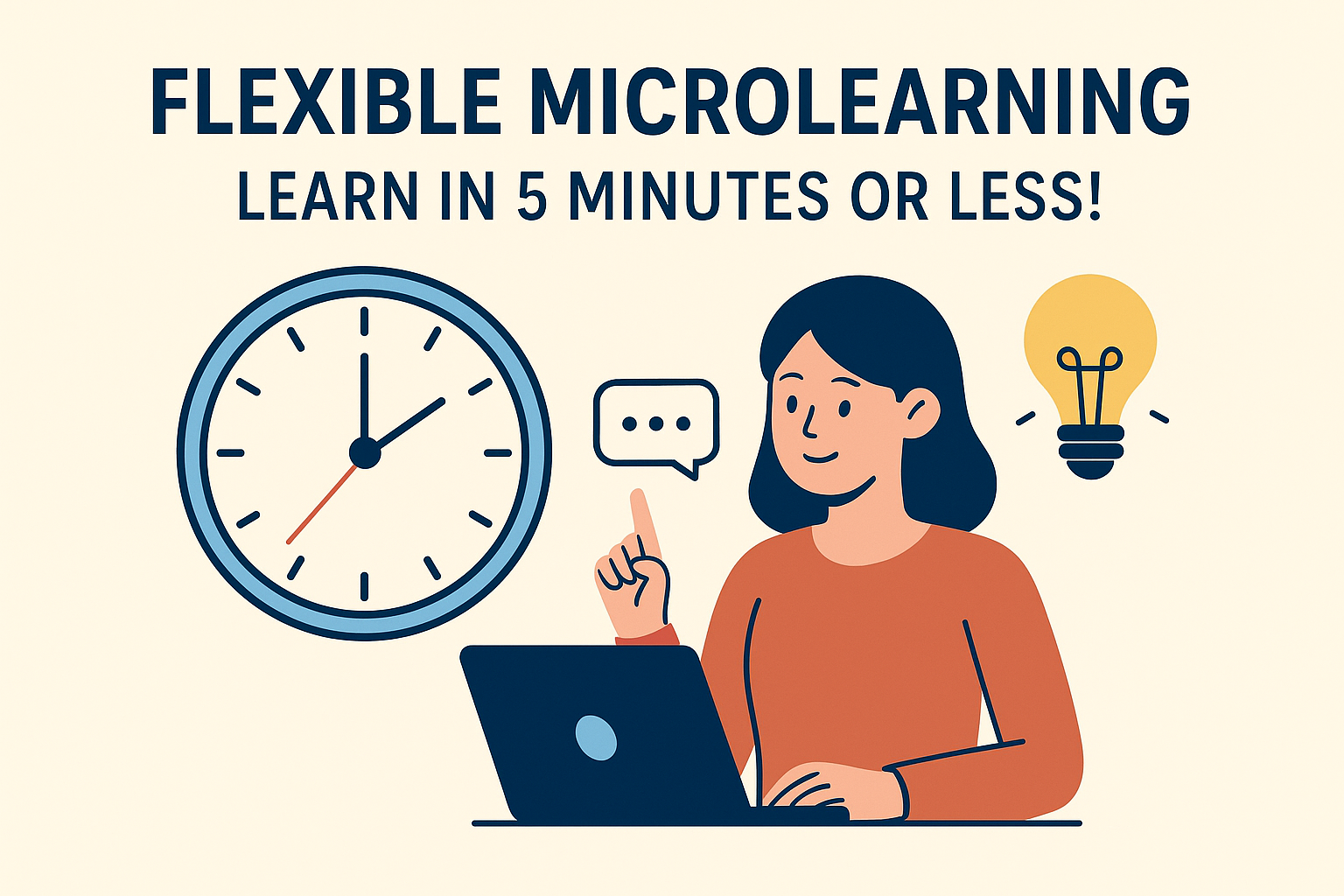
Nowadays, everything is fast-paced. We want everything as fast and efficient as humanly possible. The education scene is no different. Gone are the days of long hours of rote-learning and mugging up paragraphs. Today’s youth wants to learn effectively and quickly. In order to do so, learners must adapt to the changing landscape and integrate immediate learning techniques into their routines. This is where microlearning short-form approaches come in. These are concise and targeted bursts of information that fit into busy schedules. It’s quite intuitive – breaking long study spans into instant study sessions, which makes a small duration incredibly high impact, making 5 minutes more powerful than ever before.
7 Important Insights You Must Know About Microlearning
What is microlearning?
It’s all in the name. Microlearning is simply a learning strategy built on the premise of breaking content into small, manageable chunks on a topic. Learners use short videos, infographics, flashcards, and even interactive quizzes. The key is to design these tools such that each focuses on one core concept of skill. This makes it easier to retain information and learn how to apply it immediately.
How does microlearning work?
Microlearning short-form strategies use researched principles of cognitive science. Using methods such as chunking and spaced repetition helps facilitate not only understanding in the moment but also actively improves memory retention. Research suggests that these small learning modules are less overwhelming and thereby more engaging. It is also a less daunting task, so the learner is more likely to complete it as compared to traditional long-form lessons.
How does one apply it in real life?
There are many scenarios where a 5-minute study session becomes crucial. Say you’re a student preparing for an upcoming exam. Maybe you’re an employee training on new software. You could already be a professional who needs to brush up on industry updates. We are all constantly learning. We are all also constantly busy with our fast-paced lives. So instead of carving out long spaces, dedicating a mere 5 minutes is a lot more accessible across the board.
Where can I fit in microlearning?
5 minutes go underutilized in many mundane day-to-day chores. Waiting in a line for your coffee, between important tasks, during a commute. Microlearning encourages consistency, and multiple instant study sessions can be fit across a day without having to actively dedicate time to it. This results in significant learning on a cumulative level.
What are the tools or applications used for microlearning?
- Students may use tools like flash cards or quick quizzes to reinforce classroom concepts.
- Modules published on mobile apps can be used by employees to learn safety procedures or office compliance rules.
- Apps like Duolingo rely on short-form lessons to effectively teach vocabulary and grammar.
- Upskilling becomes easy for learning through mini podcasts and infographics.
What are the benefits of microlearning through short-form content?
- Microlearning makes learning accessible to everyone, no matter how busy they are, as anyone can find little pockets of time in their schedules
- The shorter the lesson, the less intimidating the content, the higher the engagement.
- Retention is improved through micro-units, reinforcing long-term memory.
- Learners can personalise their modules by picking and choosing relevant topics.
Microlearning: here to stay?
AI has already established itself as a powerful tool in the educational space, and microlearning is not exempt from the same. These systems can analyse learners’ behaviour, evaluate strengths, and curate each instant study session to match their cognitive abilities. With personalised instant study sessions, microlearning is on its way to becoming the default model of learning in today’s digital age.
Conclusion
Microlearning short-form strategies drastically alter how we used to approach education. Packaging knowledge into instant study sessions allows learners to continuously upskill and stay engaged, all while adapting to the fast-paced demands of their lives. Flexible microlearning is indeed the future of learning as we know it.
References
[1] Elucidat, “Microlearning: An introduction with 6 examples and tips,” Blog, Elucidat, published approximately 2.2 years ago. [Online]. Available: https://www.elucidat.com/blog/microlearning-examples/
FAQs
Q1. What is an instant study session?
An instant study session is a quick, focused learning period designed to maximize productivity in less time. Students use it to revise key topics effectively.
Q2. How long should an instant study session last?
An instant study session usually lasts between 25–45 minutes. This time frame allows you to stay sharp, concentrate better, and avoid burnout.
Q3. Who can benefit from an instant study session?
Anyone can benefit from an instant study session, especially students preparing for exams, professionals revising skills, or learners managing busy schedules.
Q4. How do I start an instant study session?
To begin an instant study session, choose a distraction-free space, set a timer, keep your notes ready, and focus only on the most important concepts.
Q5. Can an instant study session replace long study hours?
An instant study session cannot completely replace long hours, but it works well for revision, quick concept checks, and last-minute preparation.
Q6. What tools help in an instant study session?
Digital flashcards, timers, sticky notes, and summarization apps are great tools to support an instant study session for quick and effective learning.
Q7. Is an instant study session effective for exams?
Yes, an instant study session is effective for exams because it helps you recall information faster and improves memory retention under time pressure.
Q8. How many instant study sessions should I do per day?
You can do 2–4 instant study sessions per day, depending on your workload. Balancing short breaks between sessions is crucial for better results.
Q9. What subjects are best for an instant study session?
Subjects like vocabulary, formulas, quick revisions, or theory summaries are perfect for an instant study session because they require short bursts of focus.
Q10. Can I use the Pomodoro technique in an instant study session?
Yes, the Pomodoro method fits perfectly with an instant study session, as it divides learning into manageable chunks with built-in breaks.
Penned by Tapasmi Ray Chaudhuri
Edited by Shashank Khandelwal, Research Analyst
For any feedback mail us at [email protected]
Transform Your Brand's Engagement with India's Youth
Drive massive brand engagement with 10 million+ college students across 3,000+ premier institutions, both online and offline. EvePaper is India’s leading youth marketing consultancy, connecting brands with the next generation of consumers through innovative, engagement-driven campaigns. Know More.
Mail us at [email protected]