7 Game-Changing Ways to Master Specialized AI Skills and Future-Proof Your Career in 2026
Topics: Specialized AI Skills, Future-Proof your Career
Introduction
Remember 2023? That was the year everyone first tried ChatGPT. We asked it to write funny limericks, draft simple emails, and summarize articles while amazed by the magic of the “generalist” bot.
Fast forward to 2026. The novelty has worn off, and the landscape has changed completely.
Today, saying “familiar with AI” on your resume is like claiming you know how to use Microsoft Word. It has become the new standard. Companies hiring now want people who can use AI like a scalpel—precisely, ethically, and in specific situations.
We have shifted from the era of “General AI” to one of Specialized AI.
This change has created great opportunities but also a significant gap. Many professionals are stuck in the past, believing that basic prompting is enough. Meanwhile, the top 1% are quickly learning niche areas that barely existed recently.
To stand out in this crowded market, you must go beyond the basics. Here’s how to build strong AI skills and become essential in 2026.
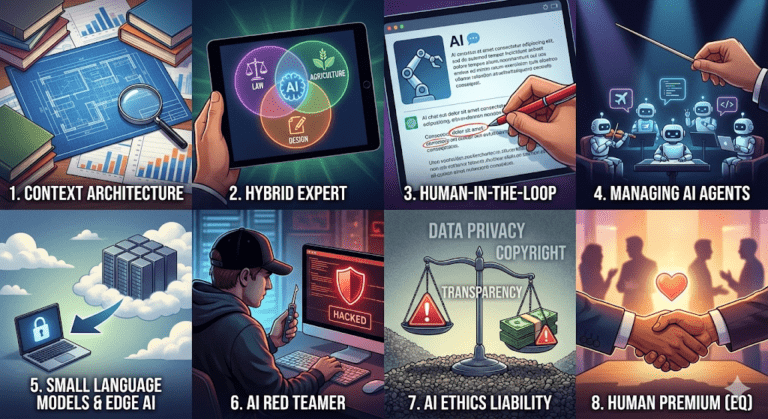
1.Beyond the Prompt: Why Context Management is the New Gold Standard
A few years ago, “Prompt Engineering” seemed like the job of the future. The idea was that knowing the right words to enter into a box was a high-paying skill.
By 2026, that idea had mostly faded. AI models can now understand natural language without needing special phrases. The real skill now is Context Architecture.
This means knowing how to provide AI with the specific data it needs to tackle complex problems without errors.
The Amateur: Asks an AI to “write a marketing plan.”
The Pro: Provides the AI with three years of customer sales data, the transcript of the last board meeting, and the brand’s specific tone guidelines, then asks it to “simulate three strategic scenarios based on these constraints.”
To stand out, you need to learn to organize and present data effectively. You must recognize that an AI’s intelligence is limited to the context you offer. This requires understanding your industry deeply—what is important, what is noise, and how to structure that information for machine processing.
2. Become a “Hybrid Expert” (The X + AI Model)
Many people think they need to return to school to become computer scientists to improve their skills. Unless you want to build models from scratch, that isn’t necessary.
The most valuable professionals in 2026 are Hybrid Experts. These individuals combine their deep knowledge of a specific field with AI skills.
Law + AI: A paralegal who knows which AI tools can summarize case law accurately.
HR + AI: A recruiter who uses AI agents to screen candidates for soft skills while personally handling cultural fit interviews.
Agriculture + AI: A farmer who uses computer vision to spot crop diseases before they become visible to the human eye.
This is where true AI knowledge shines. It is not about understanding how the code works; it is about knowing where the code fits into your specific workflow. Stop trying to be an “AI expert” in isolation. Be the best “Accountant who uses AI” or the best “Graphic Designer who uses AI.” Your specific field is your advantage.
3. Mastering the “Human-in-the-Loop” Workflow
As AI improves, a lot of average work is being automated. Basic copywriting, coding, and data entry are disappearing.
However, high-stakes work still needs a human touch. The future skill is knowing when to let AI take over and when to step in. This is the Human-in-the-Loop (HITL) workflow.
To stand out, you must show you have the judgment to monitor the machine.
Can you identify when an AI generates false information?
Can you spot bias in an AI’s output?
Can you take a “good enough” AI draft and enhance it with human insight and emotional understanding?
Employers are wary of employees who simply copy and paste AI output without review. If you can show that you are a careful editor and a critical thinker who uses AI as a tool, you become the safety net every company needs.
4. The New Soft Skill: Managing AI Agents
We are seeing the rise of “Agentic AI”—software that communicates and performs tasks. These agents can book flights, negotiate schedules, and even write and deploy code.
In 2026, being a manager involves more than just overseeing people. It means managing a team of digital agents.
Think of it like being a conductor of an orchestra with some musicians being robots. You need to know how to assign tasks effectively and connect agents together (e.g., “Agent A, research this topic; Agent B, summarize Agent A’s research; Agent C, format it for a presentation”).
This requires a specific kind of logic and organization. It’s project management, but at a much faster pace. Improving your skills in agent coordination—using tools like AutoGPT or company-specific agent platforms—is one of the smartest moves you can make right now.
5. The Pivot to “Small” Language Models (SLMs) and Edge AI
For years, the focus was on “Big”—trillions of parameters, large data centers, and cloud-based giants like GPT-5. But in 2026, smart investments have shifted to “Small.”
Companies realize that managing large models is costly, slow, and raises privacy concerns. They don’t need a model that knows the capital of every country to summarize a confidential legal document; they need a small, specialized model that works on a secure laptop and is inexpensive to run.
Improving your skills here means becoming proficient in “Local AI.”
The Skill: Learning to fine-tune open-source Small Language Models (like Llama or Mistral variants from 2026) on a specific, private dataset.
The Edge: You become the person who can build an AI tool that functions offline, keeps data safe, and operates instantly. This is crucial for finance, healthcare, and legal industries where privacy matters.
6. Become a “Red Teamer”: The Art of Breaking Things
As AI becomes essential to business, security is no longer an afterthought; it is crucial. “Prompt Injection” attacks—where hackers trick an AI into revealing sensitive information or producing faulty code—are a new threat.
This has led to a profitable field: AI Red Teaming.
A Red Teamer is essentially an ethical hacker focused on algorithms. Their job is to test a model before it launches. They try to trick, break, and manipulate AI to find its weaknesses.
Why it matters: If you can show you know how to break a model, you are qualified to secure it.
The Role: You don’t just look for bugs; you check for behavioral issues. Can you prompt the customer service bot to offer a 99% discount? If so, you could save the company millions.
7. Ethics is No Longer Theoretical; It’s a Liability
In the past, “AI Ethics” was a topic for academic debate. By 2026, it will have become a significant legal and financial risk for companies.
Copyright lawsuits, data privacy breaches, and algorithmic bias scandals are costing organizations billions.
This has created a niche for professionals who understand the rules.
Data Privacy: Knowing what data cannot be included in a public model (like patient records or trade secrets).
Copyright Knowledge: Understanding the legal gray areas of AI-generated content.
Transparency: Being able to explain why an AI made a specific decision (important in finance and healthcare).
If you can speak the language of “Responsible AI,” you aren’t just an employee; you are a risk manager. You protect the company from potential harm. This is a rare and valuable form of AI knowledge.
The Future Belongs to the Centaurs
In chess, a “Centaur” is a human player partnered with an AI. For years, Centaurs have been able to outperform both top human players and the best standalone computers.
That idea applies to the job market in 2026.
The winners will not be those who reject AI or those who blindly trust it. The successful individuals will be the Centaurs—humans who have mastered the specialized skills to combine their creativity and judgment with the machine’s processing power.
References
[1] World Economic Forum, “The Future of Jobs Report 2025,” WEF, Geneva, Switzerland, Rep., May 2025. [Online]. Available: https://www.weforum.org/reports.
[2] K. Roose, “The New AI Workforce: How Specialized Skills Are Replacing Generalists,” The New York Times, Nov. 12, 2025. [Online]. Available: https://www.nytimes.com.
[3] IBM Institute for Business Value, “Augmented Work for an Automated, AI-Driven World,” IBM, Armonk, NY, USA, Aug. 2023. [Online]. Available: https://www.ibm.com/thought-leadership/institute-business-value/en-us/report/augmented-workforce.
FAQs
Q1. What are specialized AI skills?
Specialized AI skills refer to practical, domain-specific abilities that help professionals apply AI tools effectively within real-world workflows instead of using AI only at a basic level.
Q2. How are specialized AI skills different from basic AI knowledge?
Basic AI knowledge focuses on general tools, while specialized AI skills involve applying AI strategically in areas like finance, HR, healthcare, or marketing for better decision-making.
Q3. Why are specialized AI skills important for careers in 2026?
As AI becomes standard in workplaces, specialized AI skills help professionals stand out by showing they can solve complex, industry-specific problems efficiently.
Q4. Who should learn specialized AI skills?
Students, working professionals, managers, and freelancers can all benefit from specialized AI skills to remain competitive in rapidly evolving job markets.
Q5. Do you need coding experience to develop specialized AI skills?
No, many specialized AI skills focus on context management, decision-making, and ethical use rather than deep programming or model development.
Q6. How do specialized AI skills improve job security?
Specialized AI skills reduce the risk of automation by positioning professionals as critical decision-makers who guide, evaluate, and enhance AI outputs.
Q7. Which industries benefit most from specialized AI skills?
Industries like finance, tech, healthcare, HR, marketing, and legal services gain the most from specialized AI skills due to automation and data-driven processes.
Q8. How long does it take to build specialized AI skills?
With consistent practice and real-world application, professionals can start developing useful specialized AI skills within a few months.
Q9. Are specialized AI skills relevant for non-technical roles?
Yes, specialized AI skills are highly valuable for non-technical roles such as HR, content, operations, and management where AI supports daily workflows.
Q10. How can someone start learning specialized AI skills today?
You can begin by identifying your industry needs, learning AI tools relevant to your role, and practicing specialized AI skills through real-world projects.
Penned by Sanskriti
Edited by Pranjali, Research Analyst
For any feedback mail us at [email protected]
Transform Your Brand's Engagement with India's Youth
Drive massive brand engagement with 10 million+ college students across 3,000+ premier institutions, both online and offline. EvePaper is India’s leading youth marketing consultancy, connecting brands with the next generation of consumers through innovative, engagement-driven campaigns. Know More.
Mail us at [email protected]