
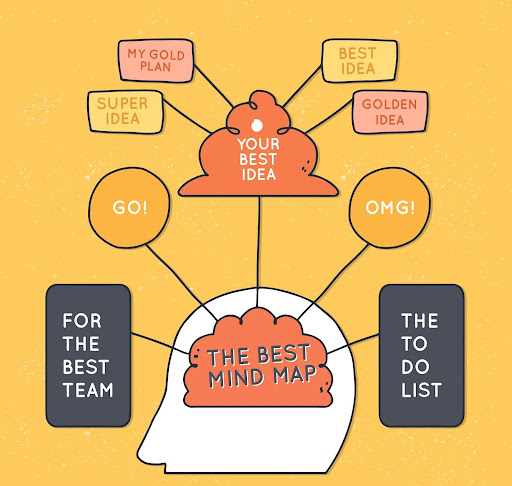
Mind maps – what are they, why are they useful, and how do they work? In this article, you will find the answers to all of these questions and be left with the knowledge of an essential tool that will aid your learning journey by enhancing cognitive processes and supporting alternative learning techniques.
Why Use Mind Mapping for Study Success?
Mind maps are essentially visual learning tools that help you learn. It usually involves making a sort of diagram to organise information in a way that condenses complex topics and relationships into an easy-to-understand format that can explain a lot of information at just a glance. Mind maps can look different, but often follow a similar concept – where a main central concept has branches emerging from it that further get split up into sub-branches, thus forming a diagrammatic network that displays how ideas connect with each other.
Benefits of Mind Maps in Learning and Memory
But why create mind maps? This tool has stood the test of time and consistently remains a deeply effective technique in not only absorbing information but retaining it. The output, or the map itself, gives you a simplified representation of complex ideas that can be easily revisited and understood. In addition to that, the active process itself – that is, creating the mindmap, absorbing information and deciphering how its concepts connect with each other, also encourages active engagement and learning in a manner that you are able to retain information effectively before you even finish your map. This way, you are enhancing your ability to consolidate and retain knowledge in one go, increasing efficiency and saving time.
How Mind Maps Outperform Traditional Note-Taking
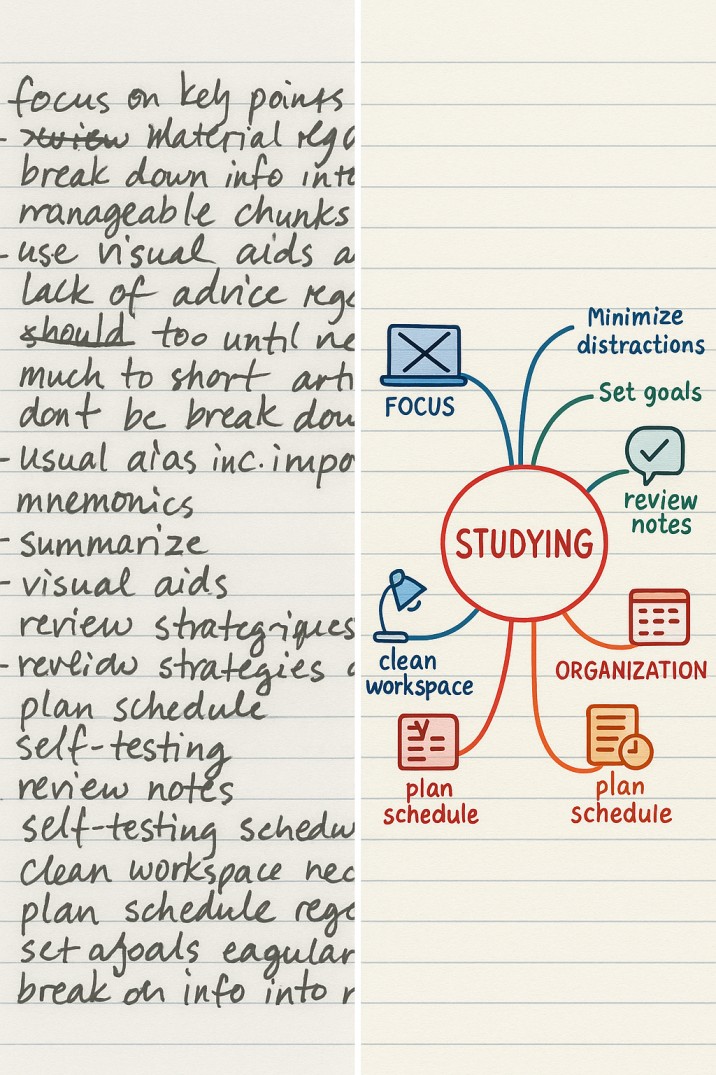
The simple, diagrammatic aspect of this technique also gives it an edge over other traditional methods, such as simply writing down long, drawn sentences in note-taking, as this engages different cognitive processes by replacing the linear structure with a more intuitive and engaging method that emphasises the importance of making connections.
Compare several pages of run-on sentences with a concise, colourful, and structured network that fits into one page – your brain is attracted to these shapes and structures and is able to process information through that visual representation in a way that far exceeds what is possible via just text. This tool is universally applicable to students and professionals alike, and is especially useful for individuals whose minds grasp information better through alternative learning techniques, which is supported by decades of research on variation in comprehension techniques.
Guide to Creating a Mind Map
Now you know what a mind-map is, so let’s put that into practice and see how to actually create one. Imagine you have read a complex chapter in a textbook for an upcoming exam. You now wish to consolidate that information into a mind-map. The first step: identify the main subject. On a blank page, write down the primary concept that the chapter is about, thus forming the basic foundation for the mind map, which may be the subject of the title of the chapter.
Next, you can begin to create major branches. These are essentially subtopics that branch outwards from the central idea. Make these branches as structures radiating from the (both literally and figuratively) central topic, which could be subheadings in the chapter or major subtopics that stood out to you while understanding it.
Now come the sub-branches. Within each subtopic, it is likely that there are various elements that are encompassed by it. This is where the sub-branches allow you to capture key ideas and facts. Ensure brevity by sticking to using keywords or short phrases. Avoid using long sentences. Use bullet points if required. The simpler the map is, the easier it is to revisit and remember.
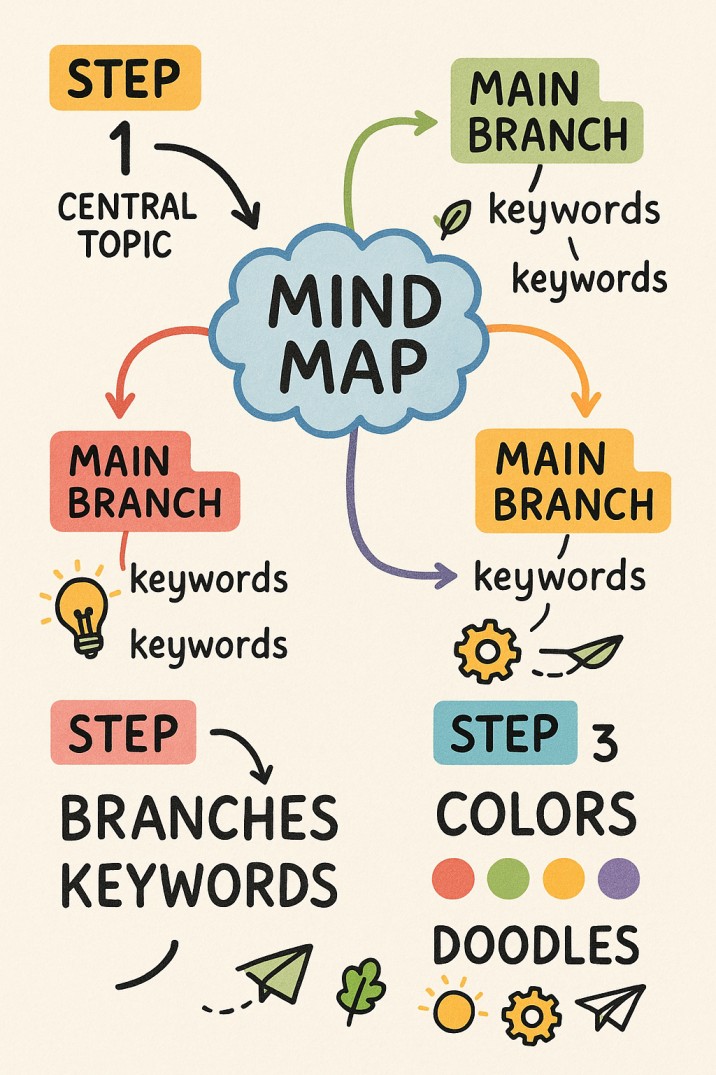
Finally, if you respond well to color-coding or aesthetic variation, you can incorporate visual elements as a categorising or memory aid. This could be done by boxing topics under a specific shape or colour, marking branches in different inks or patterns depending on their relationship to the central topic. Incorporate images or symbols as applicable, making the final mind map more visually appealing and thus enhancing both readability and recall.
Throughout the process, prioritise simplifying information. Stick to concise writing, lay it out in a spaced-out manner, and avoid overcrowding the mind map with too many words.
Digital Mind Mapping Tools and Software
On the off chance that you are acutely familiar with technology and still think that creative maps must be drawn with a pen and paper, it would be false. There are quite a few digital instruments that people find more convenient when they are dealt with via a digital interface, and that is precisely why they use them to be able to harness the same learning tool. Just using the default MS Word, Google Docs or Notion, you can easily create mind maps with the help of shapes, colours and symbols that are widely available in the toolbox. To add a more dynamic feature, you can also employ software like Miro.
Usually, software and applications are already prepared with well-designed templates to accomplish the task quickly. The digital version of a mindmap also comes with more features, for example, being able to locate it in different places, as well as chatting with other people if you want to work together on it.
Conclusion
Mind-mapping will be a huge plus to your study routine since it puts forth a vast array of advantages. As far as the whole cognitive processes of reading, learning, and retaining are concerned, this easy technique can be a real miracle. It is quite elementary in its execution, and still, it leaves a major impact on turning one into a more active and efficient learner, especially for those who benefit from alternative learning techniques.
References
[1] M. Davies, “7 science-backed benefits of mind mapping,” MeisterTask Blog, 2021. [Online]. Available: Referencing a study showing mind mapping can boost retention by 10–15% and enhance engagement through active learning, MeisterTask.
[2] P. Farrand, R. Hussain, and G. Hennessy, “The efficacy of the mind map study technique,” Medical Education, 2002. [Online]. Available: Reporting that spider diagrams improved memory recall by about 10% over baseline Wikipedia.
[3] TechRadar, “Best mind map software of 2025,” TechRadar, Jul. 30, 2025. [Online]. Available: A review ranking top mind-mapping software like Ayoa, MindMeister, XMind, and EdrawMind based on usability, features, collaboration, and pricing Tech
FAQs on Mind Maps for Better Learning
1. What are mind maps in simple terms?
Mind maps are visual diagrams that place a central idea in the middle and branch out with related topics. They help learners organize information, spot connections, and recall details faster than traditional notes.
2. How do mind maps improve learning efficiency?
Mind maps improve learning by turning complex subjects into structured visuals. Instead of long sentences, they use keywords and images, which makes studying quicker and easier to revise.
3. Why are mind maps better than traditional note-taking?
Traditional notes are linear, while mind maps are dynamic. They allow you to connect ideas in a non-linear way, which mirrors how the brain processes information, making retention stronger.
4. Can mind maps really help with exam preparation?
Yes, mind maps help students prepare by condensing an entire chapter or subject into one page. This makes revision faster and reduces exam stress while boosting memory recall.
5. What role do colors and symbols play in mind maps?
Colors and symbols make mind maps engaging and memorable. They act as visual cues that trigger recall, helping learners distinguish between different concepts easily.
6. Are mind maps only for students?
Not at all. Mind maps are used by professionals for project planning, brainstorming, meeting notes, and creative problem-solving. They are useful for anyone who needs to organize ideas.
7. How can I create my first mind map?
Start with a central topic in the middle of a blank page. Draw branches for main ideas, then smaller branches for details. Keep it short with keywords, colors, or icons.
8. Do digital tools make better mind maps?
Digital mind maps can be more flexible, especially with software like Miro or XMind. They allow collaboration, easy editing, and templates, but handwritten maps feel more personal.
9. Can mind maps improve memory retention?
Yes, because mind maps encourage active engagement. Creating branches forces the brain to process information deeply, which improves both short-term and long-term memory.
10. Are mind maps useful for group projects?
Absolutely. Teams can use mind maps to brainstorm ideas, allocate tasks, and visualize project timelines. Shared mind maps keep everyone aligned and improve communication.
11. What mistakes should I avoid when making mind maps?
Overcrowding with too much text, ignoring visuals, and skipping structure are common mistakes. A good mind map is clear, concise, and visually appealing.
12. Do mind maps work for technical subjects like math or science?
Yes, mind maps simplify complex subjects. In math, they can outline formulas and problem types. In science, they help organize concepts like processes or classifications.
13. How do mind maps support alternative learning styles?
Mind maps are ideal for visual and kinesthetic learners. The combination of images, keywords, and connections provides multiple ways to understand and retain information.
14. Can mind maps replace normal study notes?
Not entirely. Mind maps work best as a supplement to notes. They are powerful for summarizing, revising, and connecting ideas, but detailed explanations may still need text.
15. What is the future of mind maps in education?
With AI and digital tools, mind maps are becoming smarter and more interactive. They will play a bigger role in personalized learning and collaborative study environments.
Penned by Tapasmi Ray Chaudhuri
Edited by Shashank Khandelwal, Research Analyst
For any feedback mail us at [email protected]
Transform Your Brand's Engagement with India's Youth
Drive massive brand engagement with 10 million+ college students across 3,000+ premier institutions, both online and offline. EvePaper is India’s leading youth marketing consultancy, connecting brands with the next generation of consumers through innovative, engagement-driven campaigns. Know More.
Mail us at [email protected]