Let’s face it for a minute: we are drowning in perfection.
Look through your feed right now. It’s a constant stream of perfect skin, perfect relationships that look like previews for romantic comedies, and professional updates that make you feel like you’re falling further behind. We live in the era of “the edit.” Every picture is filtered, every message is perfected, and every video is cut to remove awkward silences.
It looks amazing, but it feels tiresome.
“The pressure to show a perfect version of yourself is crushing. We’re all connected, but it often feels like we’re not even seeing each other. We’re just seeing self-promotion.”
That’s why a raw, beautiful, and wonderful thing is happening in the back rooms of dive bars, community center basements, and coffee shops. These are “Raw Talent” nights. There are no looping tracks, no Auto-Tuned edits, and no retakes. There’s a singer, a mic, and a real chance of messing up.
These evenings are not just entertainment. They are a vital gasp for air. Here are 9 reasons why we need to embrace the unedited, raw, pure show to keep our sanity intact.
1. “Highlight Reel” – A Source of Unhappiness
To understand why we need raw talent, we should recognize what the polished content is doing to us. Sherry Turkle, an MIT professor, describes it well in her book:
“We edit ourselves to avoid being vulnerable. We cut ourselves to protect against vulnerability. We cut ourselves to avoid being hurt.”
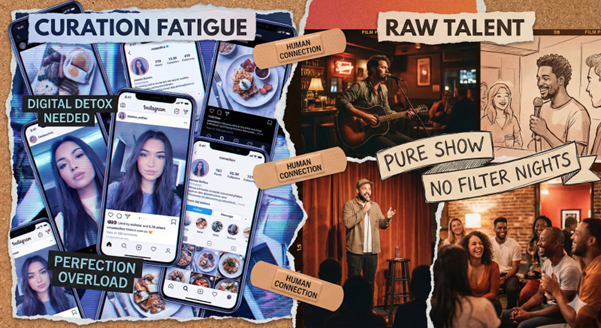
“When you realize you are spending your day watching other people’s ‘Best of Clips,’ your own ordinary Tuesday starts to feel like a failure. That is curating fatigue. We are exhausted with the gloss.”
“Raw Talent Nights change that. Stepping onto a small stage with trembling hands and slightly out-of-tune guitars makes everything feel real. There’s no idol worship; instead, it’s a neighbor looking back at you. It’s a relief; you can finally stop holding your breath.”
2. The Adrenaline of the Pure Show
There’s a unique thrill when a performer has no safety net.
A “Raw Talent” night is about what isn’t there. No fancy lights to hide flaws. No pre-recorded vocals for extra support. This is a pure show. A person is trying to share a message with a crowd of strangers.
“Oh, yeah, I’m going to sing this song in front of everyone.” That’s terrifying. But for the audience, it’s addictive. They’re engaged. Unlike watching a polished music video, which is predictable and flawless, a live performance could fall apart. That’s where the magic is. When they hit that high note or deliver that perfect line, you feel it deeply, as if you’re right there with them, sharing the struggle. It’s like the difference between watching Iron Man battle an alien for the hundredth time and seeing your neighbor’s 12-year-old try a kickflip for the first time.
3. A Digital Detox that Actually Works
“You can’t experience raw talent with your eyes glued to your lap. Those two things simply don’t mix.”
Many of these venues realize that for vulnerability to happen, we need to put our phones away. So, if someone is sharing their heart on stage, we should at least pay attention. This is how the evening becomes a sort of digital detox.
Some places literally lock your phone in a pouch, while others are set up so you know you’ll get scolded if you text. Yes, that initial discomfort lasts about fifteen minutes. You might feel a “phantom vibration” in your pocket and be unsure where to look. But then your anxiety fades. You start to absorb everything: the smell of stale beer, the scuff marks on the stage, and the way the person in front of you laughs.
4. The Science of the “Cringe” (and the Triumph)
Why do you physically cringe when a comedian bombs? Why do you tear up when a nervous singer gets a standing ovation?
That’s your mirror neurons firing. “When we watch someone take a risk, our brains picture that experience. We’re not just observing; we feel it too.”
So, when you sit down to watch a perfectly choreographed TikTok video, your mirror neurons can get bored. It’s so flawless that it doesn’t feel real. But in a raw talent show, you witness all their struggles. You feel their sweaty hands, their shaky voice. Since you share their struggle, you also share their joy and relief when they succeed. That intense experience you get in the audience is something you just can’t get from a screen.
5. Reclaiming the Right to Be “Cringey.”
We are now afraid of looking foolish. The internet never forgets. A clumsy performance might just entertain twenty people in a bar, but now we worry it might end up in a “fail” video. This has made us bored.
“No Filter” nights try to recreate the experience of “the unrecorded moment.” There’s safety in moments without a filter, where being present creates a safe space for risk. “If a joke fails, it dies in that room. It won’t haunt you forever.”
This creative freedom allows for many odd and unfinished approaches. They aren’t always good, but they are always interesting. Honestly, I’d rather sit through a brilliant, intriguing failure than a mediocre, market-approved success.
6. Breaking the Algorithm’s Spell
If platforms like Spotify or TikTok dictate your preferences, you’re feeding yourself a “Same-ness” diet.
Kyle Chayka’s book, Filterworld, describes how these algorithms smooth over the edges. They serve up easy-to-digest content, creating a bland, uniform culture, where all music sounds like “Lo-Fi Beats to Study To.”
Raw Talent Nights stand in contrast to the algorithm. You never know what will happen next. There might be a sad folk song, an angry slam poet, and a guy playing spoons. It’s jarring and unexpected. That’s the point. It wakes you up. Raw Talent Nights push your ears to embrace something different instead of lulling you to sleep with what you already know.
7. A Real “Third Place” (Not a Group Chat)
Sociologists discuss the idea of a “Third Place,” a community space that isn’t home or work. It’s where community thrives. Think of it like a pub, barbershop, or park. Our Third Places are fading out in 2024. Instead, we’ve replaced them with Discord servers and group chats. But you can’t hug a Discord server. Raw talent nights reclaim physical space. They make you sit with others at community tables. You find yourself chatting with people while a guitarist tunes his strings. They create a physical community where you can interact with those outside your usual bubble, a promise of the internet that is rarely fulfilled.
8. Finding Beauty in the Mess (Wabi-Sabi)
There’s a Japanese philosophy called Wabi-Sabi. It focuses on finding beauty in the imperfect, fleeting, and unfinished. It celebrates flaws, like the crack in a bowl or the moss on a stone. Raw talent nights embody Wabi-Sabi. They remind us that a quiver in a voice can be more powerful than a perfect tone. They show us that forgetting a lyric can lead to a hilarious moment between the singer and the audience. In a world that screams at us to optimize, be efficient, and perfect, raw talent nights encourage us to embrace our flaws.
The Beautiful Mess
We do not crave more polish. We are bright enough. We are shiny enough. We are starved for texture, for grit, for the messiness of life. A “digital detox” goes beyond just turning off your phone; it’s about waking up in the space around you. A “pure show” is an act of rebellion. “I don’t want an edit; I want the real thing” is what this means. It reminds us that the most beautiful moments in life are often those left untouched.
References
[1] S. Turkle, Reclaiming Conversation: The Power of Talk in a Digital Age. New York, NY, USA: Penguin Press, 2015. [Online].
Available: https://sts-program.mit.edu/book/reclaiming-conversation-power-talk-digital-age/
[2] M. Iacoboni, “Mirroring others’ emotions relates to empathy and interpersonal competence in children,” NeuroImage, vol. 18, no. 3, pp. 196–208, 2009. [Online].
Available: https://pmc.ncbi.nlm.nih.gov/articles/PMC3840169/ (Note: While focusing on children, this seminal work established the core link between mirror neurons, observation of struggle/emotion, and empathy)
[3] K. Chayka, Filterworld: How Algorithms Flattened Culture. New York, NY, USA: Doubleday, 2024. [Online].
Available: https://www.kylechayka.com/filterworld
[4] R. Oldenburg, “Third Places in Culture – Ray Oldenburg Q&A,” Steelcase 360 Magazine. [Online].
Available: https://www.steelcase.com/asia-en/research/articles/topics/design/q-ray-oldenburg/ (This interview covers his core theory from his 1989 book “The Great Good Place” and its relevance to modern isolation)
[5] A. K. Saito, “Wabi-Sabi: The Japanese Art of Impermanence,” Tuttle Publishing, 2017. [Online].
Available: https://laboostudio.com/blogs/news/wabi-sabi-embrace-imperfection-and-find-beauty-in-simplicity
FAQs: No Filter (Raw Talent) Nights
1. What are “No Filter” nights?
No Filter nights are live events where performers share music, poetry, comedy, or storytelling without editing, auto-tune, or digital enhancements.
2. Why are No Filter nights becoming popular?
They are gaining popularity as people grow tired of curated social media perfection and seek authentic, real-life experiences.
3. How are No Filter nights different from regular performances?
Unlike polished shows, No Filter nights embrace imperfections, live mistakes, and unedited expression, creating a more genuine connection.
4. What is curation fatigue?
Curation fatigue is the emotional exhaustion caused by constantly consuming highly edited and idealized content online.
5. How do No Filter nights help with digital burnout?
They encourage phone-free presence, direct human interaction, and full attention, offering a meaningful digital detox.
6. Why do audiences connect emotionally with raw performances?
Because the brain mirrors risk and vulnerability, audiences feel the performer’s struggle and success more deeply.
7. Are No Filter nights safe spaces for beginners?
Yes. These events focus on expression rather than perfection, making them welcoming for first-time performers.
8. How do No Filter nights build real community?
They create physical “third places” where people meet, share space, and connect beyond screens and group chats.
9. What role does imperfection play in No Filter nights?
Imperfection makes performances relatable and memorable, aligning with the idea that beauty exists in honesty and flaws.
10. Why are No Filter nights seen as cultural resistance?
They challenge algorithm-driven culture by valuing originality, unpredictability, and human presence over viral polish.
Penned by Sanskriti
Edited by Prannjali, Research Analyst
For any feedback mail us at [email protected]
Transform Your Brand's Engagement with India's Youth
Drive massive brand engagement with 10 million+ college students across 3,000+ premier institutions, both online and offline. EvePaper is India’s leading youth marketing consultancy, connecting brands with the next generation of consumers through innovative, engagement-driven campaigns. Know More.
Mail us at [email protected]