
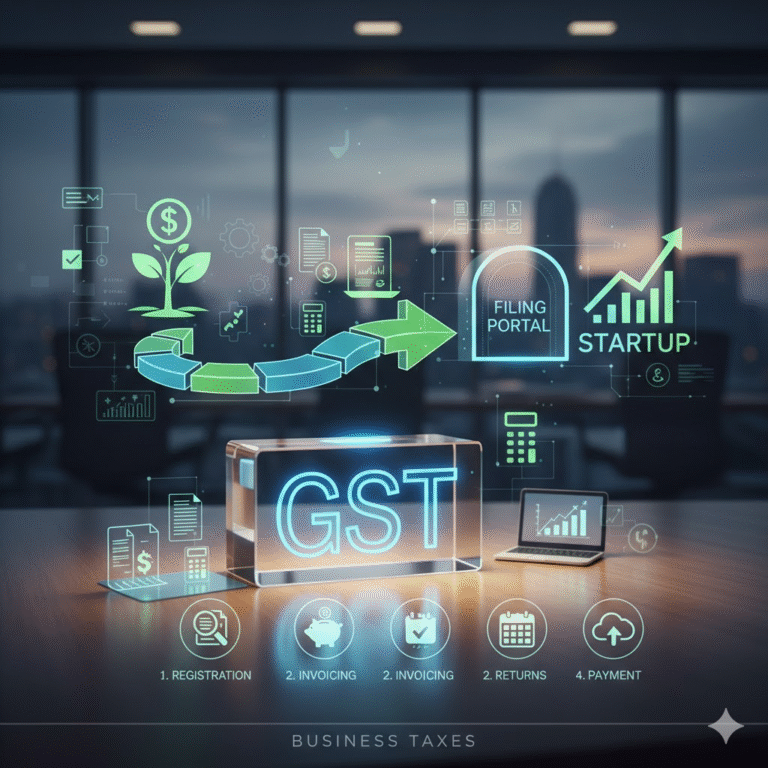
Topics: GST filing, GST registration for startups
Introduction
For a startup, clean books and timely GST filing are as important as product–market fit. Getting your GST returns right protects you from penalties, unlocks input tax credits, and keeps your financial records investor-ready.
Below is a practical step-by-step guide that walks a new business owner through the filing lifecycle — from knowing whether you need to register to filing returns and staying compliant.
Step 1: Check if Your Startup Needs GST Registration
Start by checking if your annual turnover exceeds the statutory threshold.
For businesses selling goods, the limit is ₹40 lakh (lower in special-category states).
For service providers, it’s ₹20 lakh (again, lower in some states).
If your turnover exceeds these limits, GST registration is mandatory. However, you can still register voluntarily to claim input tax credit and deal with larger clients seamlessly.
Step 2: Gather the Required Documents
Before registering or filing, gather all necessary documents to streamline the process:
PAN and Aadhaar of the proprietor/partners/directors
Business incorporation or registration proof
Bank account details
Address proof of principal place of business
Having scanned copies ready simplifies both registration and future reconciliations. You can verify document requirements directly on the GST Portal.
Step 3: Complete Registration on the GST Portal (TRN → ARN)
Visit the official GST portal and create a Temporary Reference Number (TRN) to begin the registration.
Fill in your business details, upload documents, and submit the application to receive an Application Reference Number (ARN) — which you can use to track your registration status.
Once approved, you’ll get a GSTIN (Goods and Services Tax Identification Number) and access to the Returns Dashboard for filing.
Step 4: Understand Your Return Types and Due Dates
Most startups need to file:
GSTR-3B (monthly) – a self-declared summary return, due by the 20th of the following month.
GSTR-1 (monthly/quarterly) – for reporting outward supplies (sales).
Small taxpayers enrolled under QRMP (Quarterly Return Monthly Payment) can file GSTR-1 quarterly while making monthly tax payments. Mark these due dates on your compliance calendar to avoid penalties.
Step 5: Choose Between Regular and Composition Schemes
If your turnover is below the threshold, you may qualify for the Composition Scheme, which offers lower tax rates and simpler filing.
However, composition dealers cannot claim input tax credit and face restrictions on inter-state trade.
Choose based on your business model — simplified compliance versus flexibility.
Step 6: Reconcile, File, and Pay on Time
Maintain an updated invoice register and reconcile outward supplies (GSTR-1) with buyer-accepted invoices and inward supplies (GSTR-2B).
Use the GST portal Returns Dashboard or affordable accounting/GST software to prepare and file GSTR-3B and GSTR-1. Automation reduces manual errors and improves accuracy.
Step 7: Build a Compliance Routine and Seek Professional Help
Set monthly reminders for return filing, reconciliation, and record maintenance.
In the early stages, consulting a CA or GST expert can help avoid misclassification, missed credits, or late fees. A compliance-first mindset early on ensures smooth scaling as your startup grows.
Conclusion
GST filing may look complex initially, but with the right checklist, digital tools, and filing discipline, it becomes a manageable routine. Integrate GST filing into your startup’s workflow to keep taxes transparent and your financials investor-ready.
References
Razorpay – GST Registration Limits
GST Portal – Create and Submit GSTR-3B
ClearTax – GSTR-3B: Due Date, Format, Return Filing
ClearTax – GSTR-1: Due Date, Format, Eligibility
FAQs
Q1. Who needs to register for GST in India?
Any business with an annual turnover exceeding ₹40 lakh for goods or ₹20 lakh for services must complete GST registration and begin GST filing regularly as per government norms.
Q2. Can startups register for GST voluntarily?
Yes, even if your turnover is below the threshold, you can register voluntarily for GST filing. This helps claim input tax credit and build credibility with larger clients.
Q3. What happens if a startup files GST returns late?
Delayed GST filing attracts penalties and interest. Staying consistent with monthly or quarterly filings helps startups maintain compliance and avoid financial setbacks.
Q4. What are the key GST returns a startup must file?
Under GST filing, startups generally file GSTR-3B (summary return) and GSTR-1 (sales return) either monthly or quarterly, depending on their turnover and chosen scheme.
Q5. What is the Composition Scheme under GST?
The GST Composition Scheme simplifies GST filing for small businesses by allowing lower tax rates and reduced compliance requirements. However, it restricts inter-state trade and input tax credits.
Q6. Can GST filing be automated?
Yes, GST filing can be automated using accounting or tax software that reconciles invoices and prepares returns efficiently. Automation reduces manual errors and ensures timely submissions.
Q7. How can startups stay compliant with GST filing?
To stay compliant with GST filing, startups should set monthly reminders, maintain accurate invoices, reconcile regularly, and consult professionals when needed.
Q8. Can a startup claim input tax credit on all purchases?
Yes, startups can claim input tax credit during GST filing, provided the supplier has filed corresponding returns and the purchases are used for business purposes.
Q9. How do I know if my startup falls under the QRMP scheme?
Businesses with turnover up to ₹5 crore can choose the QRMP scheme, which allows quarterly GST filing with monthly tax payments for better cash flow management.
Q10. Where can I file my GST returns?
All GST filing and return submissions are done online through the official GST portal. Ensure you use your GSTIN and login credentials for secure access.
Penned by Akshita
Edited by Sushmita Halder, Research Analyst
For any feedback mail us at [email protected]
Transform Your Brand's Engagement with India's Youth
Drive massive brand engagement with 10 million+ college students across 3,000+ premier institutions, both online and offline. EvePaper is India’s leading youth marketing consultancy, connecting brands with the next generation of consumers through innovative, engagement-driven campaigns. Know More.
Mail us at [email protected]