
Unbreakable 7: The Blue-Collar Shield - Why Skilled Trades Stand Strong in the Age of AI?
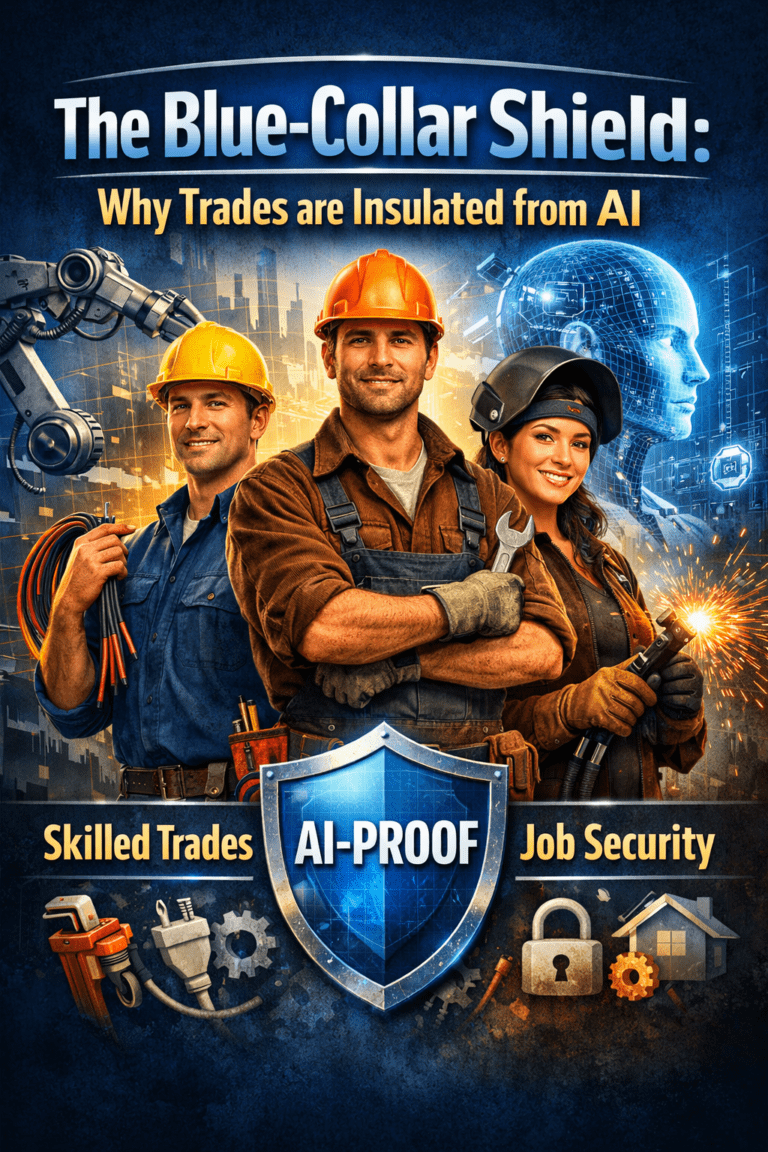
Topics: Skilled Trades, Blue-Collar Shield
Introduction
When the Future Knocks, Some Jobs Don’t Flinch
Artificial Intelligence is transforming the way we work, think and plan our future careers. From automating email writing by a chatbot to analysing a legal document using an algorithm, one can’t remain unnoticed amidst this digital tide. This sudden phase of change is causing excitement along with a sense of fear for many working individuals. “Will my job be relevant tomorrow?” is a silent question being raised in every office and class.
While white-collar jobs are being automated, another part of the workforce is unwavering. Workers like plumbers, electricians, welders, mechanics, carpenters and technicians continue to punch in time while performing jobs that are just not automated. The blue-collar shield is a powerful buffer zone that depends on human intelligence and problem-solving skills.
The article highlights the future of the trade industry in a world where artificial intelligence is becoming smarter and quicker every day. However, while the world is in a race to automate, the trade industry brings a reminder that not all work can be digitised.
The Blue-Collar Shield: An Explanation
“Blue-collar shield” does not connote immunity from technology. Rather, it expresses hardness. Trades are protected from AI technology not because of a distaste for innovation, but because their nature requires the presence of human beings, malleability and common sense in uncertain environments.
It takes more than just following instructions to replace a dripping pipe in an old building, rewire a factory floor or fix a large machine. It entails perceiving, adjusting and reacting to particular circumstances. Such areas remain where AI finds it difficult to perform its tasks.
Thus, the shield is a function of the inherent humanity that the work contains.
Inexplicably, the skilled trades are inherently AI-proof
AI does the data processing, pattern recognition, and repetitive digital tasks very well. Trade skills exist in the real world. This is significant for the following reasons:
Every workplace is distinct since no two machines, structures, or environments are alike.
The working environments are constantly changing. Numerous factors, including weather, materials, wear and tear, and usage, could be to blame.
It requires hands-on judgment: Tradesmen work on instincts and practical experience.
It could be used for planning and/or for diagnosis, but the actual implementation requires skilled human hands.
7 Reasons Skilled Trades Offer Strong Job Security
1. Physical Presence Can’t Be Automated
Robots are capable of manufacturing automobiles inside a factory, but they cannot readily enter tight areas, ladder up to a second-story home with a skinny ladder, or work through a construction site filled with rubble. This makes it difficult for a professional.
2. Real-Time Problem Solving
When a machine breaks or when a system acts strangely, it’s usually not a textbook fix that’s called upon to solve it. Experts fix problems by observing and often thinking of a fix right then and there, without any prior knowledge that it works. A computer program or an AI usually has data programmed into it in advance.
3. High Cost of Full Automation
It would be very expensive to build robots with human-level mobility, flexibility, and decision-making abilities in challenging situations. In most sectors, it would be more manageable and affordable to employ qualified personnel.
4. Trust and Accountability
Consumers trust a human when things go wrong. The customer needing the plumber wants someone who can communicate the problem and give them some reassurance. There will always be a need for human interaction that the artificial intelligence system lacks.
5. Rising Infrastructure Needs
The expansion of urban areas, renewable power technologies, transportation and housing are all major users of trade skills. The more infrastructure, the more trained professionals needed.
6. In Ageing Workforce Presents an Opportunity
There are few enough qualified workers in the skilled trades close to retirement. This talent gap affords job security and the opportunity for younger workers to enter meaningful and well-paying professions.
7. AI as a Tool, not a Replacement
In trades, AI is commonly a supportive technology – it might enhance safety or scheduling and help diagnose. It adds value to productivity and doesn’t replace it.
What to Do to Create a Secure Career in Skilled Trades?
Job security may be a concern for you, and in that case, the skilled trade fields are a direct and viable option. These are the steps to improve your position in the blue-collar club:
Step 1: Pick a Trade with Long-Term Demand
Electricians, HVAC technicians, plumbers, welders and renewable energy technicians are always in demand. Investigate the need in your community and in the world at large before you enter the trade.
Step 2: Invest In Formal Training
Enrolment in vocational schools, ITIs, apprenticeships, and certification courses. Systematic training is always a good credential booster.
Step 3: Learn Safety and Compliance Standards
Knowledge and awareness about regulations, safety procedures and industry best practices will make you indispensable and invaluable.
Step 4: Adopt Technology, Don’t Be Afraid
Employ AI-assisted tools for diagnostic, scheduling, and/or design purposes. Individuals who possess hands-on skills and understand technology remain at an advantageous point.
Step 5: Building Experience through Apprenticeships
Practical experience is the best teacher and boosts judgment and problem-solving ability, which AI has no capacity to produce.
Step 6: Create a Reputation of Reliability
Skills expand due to new materials, technologies, and sources of energy. Continuing education helps keep you current. Skills can be acquired through experience.
Step 7: Keep Learning
Trades change with new materials, technologies and energy resources. Continuous education ensures that you stay up-to-date. Skills can be developed through experience. Experience is a function.
The Emotional Value of Trade Work
But there’s more to the trades and automation than simple dollars and cents. For one, the trades give people something that has nothing to do with money or machines, and that is visibility. At the end of the day, tradespeople can look back and say, “Hey, we fixed that, we built that, or we restored that.”
A sense of purpose in an increasingly virtual world. It connects workers’ activities to the physical world, reminding workers of the power and importance of physical labour.
Reconsidering the Concept of Success in the Era of AI
Years ago, there was a certain standard of success that the world had established. It was a degree, a desk and a digital job. But with the changes implemented by AI technology on office work, the skilled trades are making a comeback.
Job security in the modern age is no longer a matter of resisting technology. Job security is a matter of selecting a line of work that technology can’t easily replicate. Trades qualify on this basis because they combine human intelligence and versatility.
Conclusion: A Quiet Strength That Persists
The advent of AI should not be viewed as the end of human work. It merely indicates and underlines human work and its primary concern. The blue-collar shield remains robust because skilled trades offer real-world solutions to real people, and it happens in real time.
But for those looking for stability, respect and long-term job security, the skilled trades have much to offer. They serve as an important reminder of the fact that while computers think rapidly, humans still construct, repair and maintain the planet.
In the age of automation, it means skilled trades are no longer old, but are actually unbreakable.
References:
[1] T. Willems et al., “Assessing Employment and Labour Issues Implicated by Using AI,” in Global Perspectives on AI Impact Assessment, Oxford Univ. Press, 2025. [Online]. Available: https://arxiv.org/pdf/2504.06322.pdf
[2] D. Marguerit, “Augmenting or Automating Labor? The Effect of AI Development on New Work, Employment, and Wages,” Mar. 2025. [Online]. Available: https://arxiv.org/pdf/2503.19159.pdf
[3] K. Tomlinson, “Measuring the Occupational Implications of Generative AI,” Microsoft, Jul. 2025. [Online]. Available: https://www.alphaxiv.org/overview/2507.07935v1
[4] J. P. Nelson et al., “Applications and Societal Implications of AI in Manufacturing: A Systematic Review,” Jul. 25, 2023. [Online]. Available: https://arxiv.org/abs/2308.02025
[5] India Skills Report 2026, Wheebox, Confederation of Indian Industry & AICTE, 2025. [Online]. Available: https://wheebox.com/assets/pdf/ISR_Report_2026.pdf
[6] Skills for the Future: Transforming India’s Workforce Landscape, Competitiveness, Jun. 2025. [Online]. Available: https://competitiveness.in/wp-content/uploads/2025/06/Report_Skill_Roadmap_Final_Compressed.pdf
[7] Emerging technologies and the future of work in India, ILO & Skills for Employment, 2017. [Online]. Available: https://www.skillsforemployment.org/sites/default/files/2024-01/edmsp1_217825.pdf
[8] India Employment Report 2024, ILO, Apr. 2024. [Online]. Available: https://www.ilo.org/sites/default/files/2024-08/India%20Employment%20-%20web_8%20April.pdf
[9] IIM Ahmedabad & BCG Centre for Data Science and AI, “Labour-force perception about AI: Final version,” 2024. [Online]. Available: https://www.iima.ac.in/sites/default/files/2024-09/Labour-force%20perception%20about%20AI%20Final%20version%20(1).pdf
[10] India’s Services Sector: Insights from Employment Trends, NITI Aayog, Oct. 2025. [Online]. Available: https://niti.gov.in/sites/default/files/2025-10/Indias_Services_Sector_Insights_from_Employment_Trends_State_level_Dynamics.pdf
FAQs
Q1. What are skilled trades and why are they important today?
Skilled trades include hands-on professions like electricians, plumbers, welders, and technicians that rely on human judgment, making them vital in today’s economy.
Q2. What does the term “blue-collar shield” mean?
The blue-collar shield refers to the natural protection skilled trades have against automation due to their physical, real-world problem-solving nature.
Q3. Are skilled trades really safe from AI automation?
While AI can assist with planning and diagnostics, skilled trades remain protected by the blue-collar shield because physical execution still requires humans.
Q4. Why can’t AI replace skilled trade workers easily?
Skilled trades involve unpredictable environments, manual precision, and real-time decisions—areas where AI struggles to perform independently.
Q5. How does the blue-collar shield provide job security?
The blue-collar shield ensures job security by limiting full automation, increasing demand for skilled trades as infrastructure and maintenance needs grow.
Q6. Which skilled trades are most in demand right now?
Electricians, HVAC technicians, plumbers, welders, and renewable energy technicians are among the most in-demand skilled trades globally.
Q7. Can AI be useful in skilled trades instead of replacing them?
Yes. In skilled trades, AI strengthens the blue-collar shield by acting as a support tool for safety checks, diagnostics, and scheduling.
Q8. Are skilled trades good career options for young professionals?
Absolutely. Skilled trades offer stable income, faster entry into the workforce, and long-term security backed by the blue-collar shield.
Q9. Do skilled trades require formal education or degrees?
Most skilled trades require vocational training, apprenticeships, or certifications rather than traditional four-year degrees.
Q10. Will skilled trades remain relevant in the future?
Yes. As automation grows, the blue-collar shield ensures skilled trades remain essential, relevant, and resistant to full AI replacement.
Penned by Tanuja
Edited by Pranjali, Research Analyst
For any feedback mail us at [email protected]
Transform Your Brand's Engagement with India's Youth
Drive massive brand engagement with 10 million+ college students across 3,000+ premier institutions, both online and offline. EvePaper is India’s leading youth marketing consultancy, connecting brands with the next generation of consumers through innovative, engagement-driven campaigns. Know More.
Mail us at [email protected]