
Topics: Career Pipelines, Finance and Tech
Introduction
For nearly a decade, the career route for ambitious graduates was quite simple. If you wanted stability, prestige, and a quick path to a six-figure salary, you focused on two areas: high finance or big tech.
These industries were the main drivers of modern white-collar jobs. They had a strong demand for talent. Computer science majors received competing offers before their senior year began. Business school graduates could count on competitive analyst roles at top investment banks. The pipeline was wide, and the flow was fast.
Today, that pipeline has not only narrowed; in many cases, it has completely stopped up.
A major shift has happened over the last eighteen months, creating a silent crisis among professionals. We are currently experiencing a significant hiring slowdown that has impacted these two prime sectors worse than almost any other. While news outlets report massive layoffs at Google, Meta, Goldman Sachs, and Citigroup, the deeper issue lies in what is happening to the roles that remain and the painfully slow process of trying to secure one.
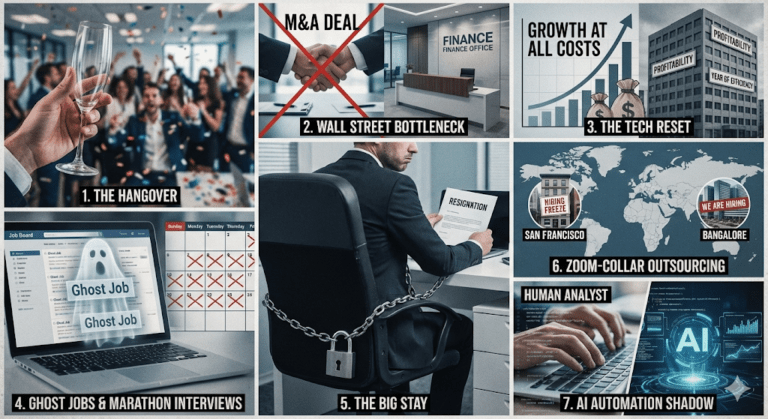
The time of easy entry and quick advancement is over. It has been replaced by a tough, uncertain landscape that is changing what it means to build a career in the top tiers of the corporate world. Here are seven harsh realities of these stalled pipelines and what they mean for workers today.
1. The Hangover from the “Everything Boom.”
To understand the current stagnation, we need to remember the party that came before it. During the pandemic recovery, tech and finance embarked on an unprecedented hiring spree. Interest rates were low, money was nearly free to borrow, and digital adoption was surging.
Companies began hoarding talent. Tech firms hired engineers not because they had immediate projects for them, but to prevent competitors from getting them. Finance firms increased their staff to handle a record number of mergers, acquisitions, and IPOs.
Then, the music stopped. Inflation rose, central banks raised interest rates, and the free money disappeared. Suddenly, those large headcounts looked like huge liabilities.
What we see now is a serious correction. The hiring slowdown is not just a pause; it is a deep unwinding of the pandemic excess. Companies are focusing on “efficiency,” a corporate term for doing more with fewer people. Until those pandemic-era hires are fully utilized or let go, the pipeline for new talent will remain a trickle.
2. The Wall Street Bottleneck: No Deals, No Hires
The situation in finance is especially stark because it follows cycles. Investment banks depend on deal flow. When companies are merging, buying each other, or going public, banks need many junior analysts to crunch numbers and create pitch decks at all hours.
But economic uncertainty disrupts deal-making. When CEOs worry about a recession or geopolitical issues, they hesitate to act. Mergers and acquisitions activity dropped in 2023 and has not completely recovered.
When there are no deals, the need for entry-level white-collar jobs in banking disappears. The pipeline has slowed because the top level has stopped moving. Senior bankers are staying in place because there are fewer opportunities to move to private equity or venture capital, causing a backup that trickles down to recent college graduates hoping for an interview.
3. The Tech Reset: From “Growth at All Costs” to Profit
The shift in Silicon Valley’s atmosphere has been shocking. For years, the motto was growth at all costs. Investors rewarded companies that gained market share, even if they lost money while doing so. That model required continuous, aggressive hiring.
Now, investors demand profitability. The “Year of Efficiency,” a term popularized by Meta’s Mark Zuckerberg, has become the industry standard. Tech companies are realizing they don’t need multiple layers of management to launch a product.
This shift has been disastrous for the hiring pipeline. The roles being eliminated—and the roles that aren’t being filled—are often those mid-level project managers, recruiters, and junior developers that once formed the backbone of the tech middle class. The pipeline isn’t just slower; the opportunities at the end of it are diminishing.
4. The Rise of the “Ghost Job” and the Marathon Interview
One of the most frustrating aspects of this crisis for job seekers is the illusion of activity. If you scroll through LinkedIn, it appears that many white-collar jobs are available.
However, candidates are facing a frustrating new reality: the “ghost job.” These are job postings that companies keep active for months without the intention of filling them soon. They do this to gather resumes for a potential future need or to give the impression of growth to investors.
Furthermore, when a genuine role is available, the hiring process has become painfully long. Because companies are now so risk-averse and budget-conscious, everyone fears making a bad hire. What used to be a three-interview process over two weeks has turned into seven rounds over three months, often involving take-home assignments and panel presentations. The pipeline has become a slow crawl, leaving talented professionals in a constant state of limbo.
5. The “Big Stay” is Blocking Upward Mobility
We often discuss layoffs, but we talk less about the other side of the issue: resignation rates. During the “Great Resignation” of 2021, many people were quitting their jobs, creating openings for others. This movement led to a fluid labor market.
Now, we are in the “Big Stay.” Professionals in finance and tech, scared by the hiring slowdown, are holding tightly to their current jobs. Even if they dislike their jobs, they are unwilling to leave, knowing the job market is cold.
This lack of movement is terrible for the pipeline. If the Senior Vice President does not leave for a competitor, the Vice President below cannot get promoted. If the VP doesn’t get promoted, the Senior Associate is stuck. The ladder is frozen. This stagnation creates a ceiling that prevents new talent from entering at the bottom since there is simply nowhere for them to go.
6. The “Zoom-Collar” Outsourcing Shift
The remote work boom was initially seen as a win for workers seeking flexibility. However, finance and tech companies have discovered a double-edged truth: if a job can be done from a living room in San Francisco or New York, it can also be done from a living room in Poland, India, or Brazil at a much lower cost.
We are observing a quiet migration of entry-level white-collar jobs abroad. Unlike the manufacturing outsourcing of the 90s, this impacts “knowledge workers.” Major banks and tech giants are expanding their capability centers in low-cost regions while halting hiring in high-cost cities.
This means the domestic pipeline is not just slow; it is being redirected. The entry-level coding or data analysis roles that used to be training grounds for U.S.-based graduates are now increasingly likely to be filled by talented, English-speaking graduates in Bangalore or Warsaw, leaving the domestic pipeline missing a rung on the ladder.
7. The Shadow of Automation at the Entry Level
Lastly, looming over this entire slowdown is the threat of Generative AI. While AI isn’t taking over senior investment bankers or lead software architects yet, it is becoming increasingly capable of handling tasks that once defined entry-level white-collar work.
In finance, AI can summarize earnings reports and create basic financial models. In tech, it can write elementary code and debug software.
If a bank used to hire ten junior analysts for routine tasks, maybe now they only need three supervising analysts to review the AI’s output. This change means that the base of the career pyramid is shrinking. The pipeline for entering these industries is narrowing permanently because the entry-level tasks are being automated away.
The New Reality
The white-collar crisis in finance and tech won’t resolve itself quickly with a small adjustment in interest rates. We are seeing a structural reset. The intense demand for talent that characterized the last decade was an exception, not the norm.
For workers, navigating this new environment requires a shift in mindset. The clear, predictable route from a good university to a high-paying job at a top company is broken. Success now demands more resilience, flexibility to consider smaller or non-traditional companies outside the “Big Tech” and “Wall Street” realms, and an understanding that the hiring pipeline is no longer a rushing stream but a resource that must be approached with patience and strategy.
References
[1] N. Irwin, “The White-Collar Recession: How Interest Rates Are Reshaping the Job Market,” Axios, Jan. 12, 2024. [Online]. Available: https://www.axios.com.
[2] Challenger, Gray & Christmas, Inc., “Challenger Report: 71,321 Job Cuts on Restructurings, Closings, Economy,” Challenger, Gray & Christmas Blog, Dec. 4, 2025. [Online]. Available: https://www.challengergray.com/blog/challenger-report-71321-job-cuts-on-restructurings-closings-economy/.
[3] M. Zuckerberg, “Update on Meta’s Year of Efficiency,” Meta Newsroom, Mar. 14, 2023. [Online]. Available: https://about.fb.com/news/2023/03/mark-zuckerberg-meta-year-of-efficiency/.
[4] T. Chen, “How ‘Ghost Jobs’ Are Haunting Job Seekers,” The Wall Street Journal, Jan. 12, 2025. [Online]. Available: https://www.wsj.com/lifestyle/careers/ghost-jobs-2c0dcd4e.
[5] N. Richardson, “The Big Stay is Sticking,” ADP Research Institute, Oct. 14, 2025. [Online]. Available: https://www.adpresearch.com/the-big-stay-is-sticking/.
FAQs
Q1. What are career pipelines in finance and tech?
Career pipelines refer to the structured progression from entry-level roles to senior positions in industries like finance and tech. These career pipelines traditionally included internships, analyst roles, promotions, and leadership tracks.
Q2. Why are career pipelines currently stalled in finance and tech?
Career pipelines are stalled due to hiring slowdowns, layoffs, reduced deal activity, and companies prioritizing efficiency over expansion, limiting new job creation.
Q3. How has the hiring slowdown affected career pipelines for fresh graduates?
The hiring slowdown has narrowed career pipelines, reducing entry-level opportunities and making it harder for graduates to enter finance and tech roles.
Q4. What role do ghost jobs play in blocking career pipelines?
Ghost jobs create false hope. Companies post roles without immediate intent to hire, slowing career pipelines and wasting time for job seekers.
Q5. How does automation impact entry-level career pipelines?
Automation replaces routine tasks once done by juniors, shrinking the base of career pipelines and reducing the number of starter roles available.
Q6. What is the “Big Stay” and how does it affect career pipelines?
The “Big Stay” refers to professionals holding onto jobs due to fear of layoffs. This freezes promotions and clogs career pipelines from the top down.
Q7. Is outsourcing weakening domestic career pipelines?
Yes. Remote work has enabled companies to shift entry-level roles abroad, redirecting career pipelines away from high-cost domestic markets.
Q8. Are career pipelines permanently broken or temporarily paused?
Career pipelines are undergoing a structural reset. While not broken forever, they are unlikely to return to the fast-growth model of the past decade.
Q9. How can professionals adapt to stalled career pipelines?
To survive stalled career pipelines, professionals must upskill, explore non-traditional roles, consider smaller firms, and build long-term career resilience.
Q10. What does the future look like for career pipelines in finance and tech?
Future career pipelines will be narrower, skill-driven, and slower, rewarding adaptability, specialization, and strategic career planning over linear growth.
Penned by Sanskriti
Edited by Pranjali, Research Analyst
For any feedback mail us at [email protected]
Transform Your Brand's Engagement with India's Youth
Drive massive brand engagement with 10 million+ college students across 3,000+ premier institutions, both online and offline. EvePaper is India’s leading youth marketing consultancy, connecting brands with the next generation of consumers through innovative, engagement-driven campaigns. Know More.
Mail us at [email protected]