
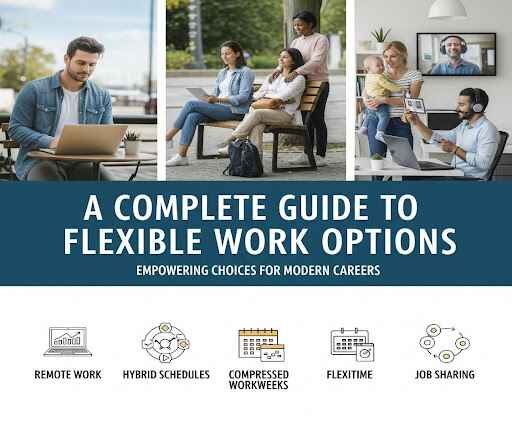
5 Powerful Strategies to Request Flexible Work Options Effectively
The Struggle of the 9-to-5 Grind
A standard 9-to-5 job may, from time to time, feel like getting along with fitting a square peg in a round hole. Right, life happens, and as individual humans, we all have different ways of being productive at specified places. Perhaps you’re a night owl who performs your best work after everyone gets sleep, or just intuitively want to skip the devastating morning routine of working. No matter what your reason is, a formal flexible working request genuinely, it does not need to be a conversation full of fear. By being smart enough and having a rock-solid workplace negotiation strategy, one can make it happen.
Do Your Homework First
First things first, before you even open your mouth, you’ve got to do your homework. This isn’t just about making a flexible job request; it’s about making a rock-solid business case. See if your company already has any official policies on remote work or flexible hours. That’s your first clue! If they don’t, no worries. Just start building your own game plan. The important part is to inform your boss that this isn’t just about you, but it’s related to getting more done. Can you think about each possible question they might have: How will my team stay in the loop? How will I be available? What about that weekly meeting? Be ready with all the answers ready to go.
Presenting Your Proposal the Smart Way
Being prepared to chat, don’t just snap the question out of the blue. Instead, line up a time to converse so you have their total mindfulness. Start by reminding them how much you love your job and all the great things you’ve accomplished. Then, hit them with your proposal. Avoid using words like “I want to work from home.” Alternatively, articulate something like, “some different techniques that will increase my productivity,” or “I would love to test a hybrid routine for a little while to identify if it makes a difference or not.” Noticed the difference? You’ve turned a personal plea into a strategic move for the team.
Handling Pushback with Confidence
After that, be prepared for some pushback. The supervisor or manager might worry about things related to better communication or fairness. Be ready with solutions! You can say, “I’m totally committed to being in the office for all our important meetings, and I’ll be logged in and available on Slack just like I would be here.” And here’s a great tip: suggest a trial period. Express something like, “Let us try this for a couple of months; after that, we will know if it’s working for all or not.” By doing this, it feels like a test or an experiment for everyone.
Turning Flexibility into a Win-Win
After all, you are proving that a flexible schedule isn’t about vegging out. Instead, it’s about productivity and being focused by your will. In this way, by being enthusiastic and thoughtful about your proposal and using a smart workplace negotiation strategy, one can show the manager that this isn’t just a win-win situation for you, but it’s a win for all.
Final Thoughts
In the end, wanting a soft work plan is not just to break the rules—it’s to improve how we work. With smart plans, easy words, and a look at fixes, you can show your boss that being soft lets us do more, builds trust, and aids all the whole team.
Keep in mind, it’s not just good for you—it makes the whole work site better.
FAQs: Requesting Flexible Work Options
Q: How do I begin to Request Flexible Work Options from my manager?
A: Start by documenting your current performance and creating a detailed business case that shows how the flexible schedule will benefit the team and company’s productivity.
Q: What is a strong Workplace Negotiation Strategy for discussing remote work?
A: A strong strategy is to present your plan as a pilot or a trial period, focusing on performance metrics rather than personal desires, and having solutions for all communication concerns.
Q: What key metric should I use to prove my productivity will increase with a flexible schedule?
A: Focus on output-based metrics (completed projects, sales figures, solved tickets) rather than input-based metrics (hours worked) to justify your flexible working request.
Q: How should I phrase my initial Request Flexible Work to avoid sounding demanding?
A: Use language focused on experimentation and optimization, such as, “I’d like to propose a short trial period for a hybrid routine to see if it boosts my efficiency.”
Q: What is the purpose of suggesting a trial period when asking for Remote Work Options?
A: The trial period lowers the perceived risk for management. It allows them to assess the impact of the flexible schedule without making a permanent commitment.
Q: My company has no official policy. Does this mean I can’t Request Flexible Work?
A: No. The lack of a policy means you have an opportunity to be the first successful Remote Work Proposal. Use external evidence and internal data to build your case.
Q: What is Peer Volunteering Outreach and how is it related to flexibility? (LSI/Related Term)
A: This term relates to peer-led initiatives (like in the previous article), showing that self-management and leadership are skills you can apply to managing your flexible schedule.
Q: How do I address fairness concerns from my colleagues when I request flexible work?
A: Be transparent about your plan’s communication and availability standards, ensuring your colleagues know you are still fully accessible, even with Flexible Work Options.
Q: Should I share my personal reasons (e.g., being a night owl) in my Remote Work Proposal?
A: While you should mention better concentration, focus on the result (peak productivity) over the reason (personal habit) when discussing your need for a flexible schedule.
Q: What communication tools should I commit to using to ensure team cohesion with a flexible schedule?
A: Commit to being available on instant messaging (Slack/Teams) and being present for all scheduled video conferences, just as you would be with traditional hours.
Q: How long should the suggested trial period be for Flexible Work Options?
A: A trial period of 6 to 12 weeks is typically effective. This is long enough to collect solid data but short enough to feel temporary.
Q: What is a “win-win” outcome when implementing a Workplace Negotiation Strategy for flexibility?
A: A win-win means you gain the flexible schedule, and the company gains higher productivity, better employee retention, and proof of a progressive workplace culture.
Q: Should the focus keyword (Flexible Work Options) be in the H1 tag?
A: Yes, the H1 tag (the main title) is the most critical place for the main focus keyword. (This is satisfied by the new title).
Q: I’m worried about getting a low SEO score. How can the keywords help increase it?
A: Strategically inserting Flexible Work Options, Request Flexible Work, and Workplace Negotiation Strategy in headings and paragraphs ensures a keyword density that signals high relevance to search engines.
Q: What external resource should I reference in my flexible working request?
A: Reference credible sources (like the Harvard Business Review link provided) to lend authority to your proposal, showing that Flexible Work Options are a recognized business strategy.
References
- Journal of Organizational Behavior. “Workplace flexibility and employee well-being,” https://doi.org/10.1002/job.1887
- A. D. Hill and D. A. Turban, “Flexible time work arrangements and career outcomes,” in Academy of Management Proceedings. https://journals.aom.org/doi/10.5465/AMBPP.2018.172
- Negotiating your ideal flexible work arrangement. Harvard Business Review. https://hbr.org/2020/07/negotiating-your-ideal-flexible-work-arrangement
Penned by Amit Kumar
Edited by Shashank Khandelwal, Research Analyst
For any feedback mail us at [email protected]
Transform Your Brand's Engagement with India's Youth
Drive massive brand engagement with 10 million+ college students across 3,000+ premier institutions, both online and offline. EvePaper is India’s leading youth marketing consultancy, connecting brands with the next generation of consumers through innovative, engagement-driven campaigns. Know More.
Mail us at [email protected]