
Why VR in Skill Labs Is Getting Attention
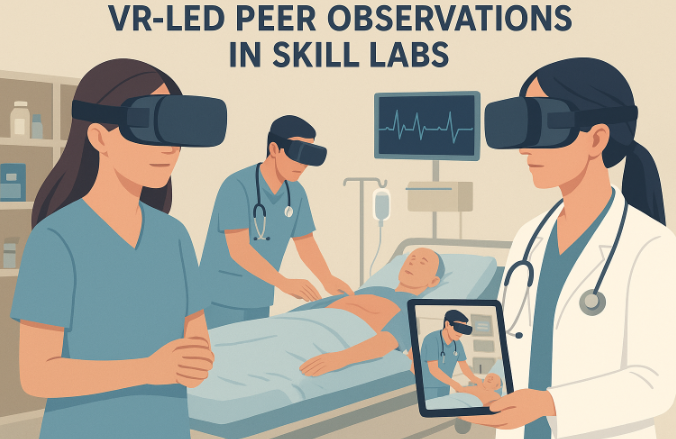
Skill labs are where students practice, learn, and receive feedback — nursing, engineering, and even business simulations. Usually, you watch a demo, then try it yourself while others observe. But now something new is being tested: VR peer observation lab setups. Basically, you put on a headset and suddenly you’re not just watching from a chair, you are inside the action. You see angles you’d never notice in real life. That’s why people are excited — VR adds a layer of depth to practice learning.
What VR Peer Observation Really Means
Think of peer observation normally. Your classmates watch you perform, then give feedback. Sometimes it’s useful, sometimes it’s just surface-level. Now imagine the same thing, but in VR. With VR peer observation lab tools, students can “stand” virtually inside the skill space, replay moments, zoom in on details, and even swap perspectives. The observation becomes richer and less awkward. People can focus on the actual steps instead of just trying not to miss something.
Practice Learning in a Different Way
The big advantage is in practice, learning, and feedback. Instead of a one-time performance, VR allows replay and repetition. If a nursing student inserts an IV incorrectly, peers can watch again, slow it down, and provide practice learning feedback on the exact step. In mechanical labs, VR can highlight how tools are handled. The idea is simple: practice → observe → reflect → practice again. Feedback becomes concrete. Students start to see mistakes not as failure but as chances to improve through practice, learning, and feedback.
How Feedback Changes
Feedback is often vague — “you did okay” or “that looked wrong.” In a VR peer observation lab, feedback can be tied to specific clips. “Look at minute 2:15, your hand shifted too early.” This makes the process less personal and more about the task. Peer comments feel constructive, not judgmental. Teachers also benefit. They don’t need to be everywhere at once; VR recordings give them another layer of review.
Benefits and Limits
Benefits: immersive observation, more detailed feedback, safe practice space, and higher student engagement. Students get more confident when they can see progress across multiple trials. Institutions save resources, too, since not every practice needs a live supervisor.
Limits: VR gear is expensive, heavy use can cause fatigue, and not all labs translate well to VR. Some people also feel disconnected — the headset can create isolation. And if the software is buggy, it interrupts the learning flow. So it’s promising, but not magic.
Small Example Story
At one medical college, students used VR to practice patient interactions. One student acted as the “doctor” in VR while others observed through shared headsets. After the role-play, peers gave feedback like “your tone was too fast” or “you missed the step of asking about allergies.” Normally, those details are forgotten, but VR captured it. The student re-watched, practised again, and improved quickly. That’s practice learning in action — observation plus feedback, amplified by VR.
Conclusion
VR peer observation lab methods are reshaping how students practice and learn skills. By combining immersive observation, structured peer review, and replay options, they create a stronger cycle of practice learning and feedback. The technology is not perfect and costs are real, but the direction is clear: VR is moving from gaming into education. For skill labs, it might be one of the most effective bridges between practice, learning, and feedback toward mastery.
References
[1] J. Radianti, T. A. Majchrzak, J. Fromm, and I. Wohlgenannt, “A systematic review of immersive virtual reality applications for higher education: Design elements, lessons learned, and research agenda,” Computers & Education, vol. 147, 2020.
[2] H. M. Huang, U. Rauch, and S. S. Liaw, “Investigating learners’ attitudes toward virtual reality learning environments: Based on a constructivist approach,” Computers & Education, vol. 55, no. 3, pp. 1171–1182, 2010.
[3] J. Fowler, “Experiential learning and its facilitation,” Nurse Education Today, vol. 28, no. 4, pp. 427–433, 2008.
[4] C. Anthes, R. J. García-Hernández, M. Wiedemann, and D. Kranzlmüller, “State of the art of virtual reality technology,” in Proc. IEEE Aerospace Conference, 2016.
[5] S. Merchant, E. Goetz, L. Cifuentes, W. Keeney-Kennicutt, and T. J. Davis, “Effectiveness of virtual reality-based instruction on students’ learning outcomes in K-12 and higher education: A meta-analysis,” Computers & Education, vol. 70, pp. 29–40, 2014.
FAQ
Q1. What are peer observation labs in education?
Peer observation labs are spaces where students perform practical tasks while classmates observe, provide feedback, and learn from each other’s performance. With immersive technology, this process becomes more interactive and detailed.
Q2. How do immersive labs improve learning compared to traditional methods?
They allow students to replay actions, change perspectives, zoom in on details, and analyze specific steps. This creates deeper reflection and stronger feedback than one-time demonstrations in a classroom.
Q3. Can simulation-based tools replace real practice completely?
Not entirely. While they provide safe, repeatable environments, hands-on physical practice is still essential in fields like nursing or engineering. Immersive labs are best used as preparation and reinforcement for real-world practice.
Q4. How does feedback change in headset-based observation setups?
Feedback becomes more precise. Instead of vague comments, peers and instructors can point to exact moments in a recording, making critiques task-focused rather than personal.
Q5. What are the main benefits of 3D practice environments?
Safer practice with no risk of harm
Richer peer-to-peer feedback
Increased student confidence through repetition
Resource savings for institutions
Stronger engagement and motivation
Q6. Are there any limitations?
Yes. Headsets can be costly, prolonged use may cause fatigue, and not all skills translate smoothly into a simulated environment. Technical glitches can also disrupt the learning flow.
Q7. What subjects benefit most from immersive peer observation?
Nursing, medicine, engineering, and business simulations see major benefits, as students can rehearse procedures, analyze mistakes, and refine their approaches without high risk or resource waste.
Q8. How does immersive peer observation help teachers?
It reduces the pressure on instructors to observe every student in real time. Recorded sessions allow teachers to review later, give structured feedback, and even use clips as teaching examples.
Q9. Can immersive tools make peer feedback less awkward?
Yes. Since comments are tied to recordings, feedback feels more constructive and less judgmental. Students critique the performance, not the person.
Q10. What’s an example of these labs in action?
In one medical college, students practiced patient interactions in a headset-based setup. Observers noticed details like tone of voice and missing steps. The recorded session allowed the student to rewatch, improve, and retry until mastery.
Q11. Are these tools only for higher education?
No. While widely tested in universities, immersive labs are gradually entering professional training programs, technical institutes, and even advanced high school labs.
Q12. What’s the future of immersive peer observation?
Expect greater use of AI-driven feedback, more affordable equipment, and integration with personalized learning dashboards. Over time, these labs may become a standard bridge between practice, observation, and mastery.
Penned by Apeksha S
Edited by Shashank Khandelwal, Research Analyst
For any feedback mail us at [email protected]
Transform Your Brand's Engagement with India's Youth
Drive massive brand engagement with 10 million+ college students across 3,000+ premier institutions, both online and offline. EvePaper is India’s leading youth marketing consultancy, connecting brands with the next generation of consumers through innovative, engagement-driven campaigns. Know More.
Mail us at [email protected]