
Advances in Selective Catalysis Through Single-Atom Engineering
Published: June 20, 2026
Key Strategy Takeaways
- Single-Atom Engineering maximises catalyst efficiency by utilising every active metal atom.
- Single-atom catalysts improve reaction selectivity and reduce material waste.
- The technology supports cleaner industrial processes and sustainable chemical production.
- SACs enhance hydrogen production, fuel-cell efficiency, and carbon dioxide conversion.
- Single-Atom Engineering improves the performance and lifespan of zinc-air batteries.
- The technology reduces dependence on expensive platinum-group metals.
- Single-atom catalysts are driving innovation in renewable energy and advanced energy storage.
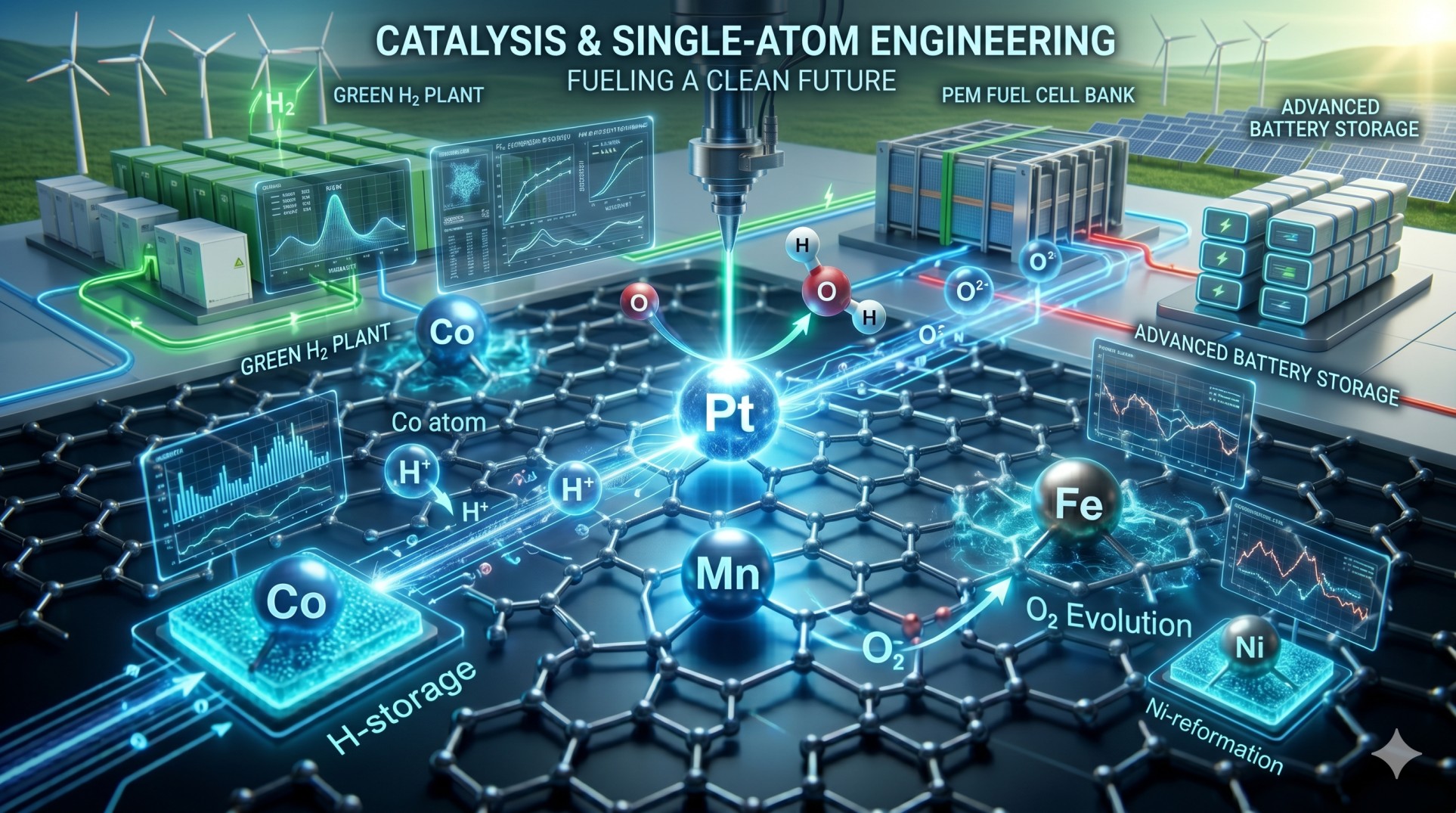
Catalysis plays a vital role in modern industry, even though it often goes unnoticed. Catalysts help convert crude oil into fuel, produce fertilisers for agriculture, and support the development of advanced energy technologies.
In recent years, significant attention has been given to Single-Atom Engineering, a process that uses individual metal atoms dispersed on specially designed support materials to accelerate chemical reactions. Unlike traditional catalysts, where metal atoms are clustered together, single-atom catalysts distribute atoms individually across a surface, maximising their efficiency.
This breakthrough is transforming selective catalysis and creating new opportunities in renewable energy, advanced batteries, and sustainable chemical manufacturing. As a result, Single-Atom Engineering is helping industries develop cleaner, more efficient, and environmentally friendly technologies.
Why Move from Nanoparticles to Single Atoms?
Traditional catalysts typically use clusters of metal atoms or large nanoparticles. While effective, these catalysts often suffer from wasted atoms, fewer active reaction sites, and unwanted side reactions that reduce efficiency.
Single-atom catalysts address these limitations by ensuring that every active metal atom participates directly in the reaction process. This maximises atom utilisation, improves reaction selectivity, and enhances overall catalytic performance. Consequently, single-atom catalysts represent a major advancement in catalyst design.
What Exactly Is Single-Atom Engineering?
Single-Atom Engineering involves placing individual metal atoms, such as platinum, iron, cobalt, nickel, or copper, onto support materials including graphene, metal oxides, or carbon frameworks.
Unlike conventional catalysts, where many atoms remain buried inside particles and cannot participate in reactions, single-atom catalysts expose every metal atom to the reaction environment. This level of precision is particularly valuable for industries seeking greater purity, improved energy efficiency, and reduced environmental impact.
Recent advances in scientific instrumentation, including electron microscopy and X-ray spectroscopy, have enabled researchers to observe individual atoms and optimise catalyst structures with remarkable accuracy. These technological developments have accelerated progress in Single-Atom Engineering and expanded its industrial applications.
Helping Renewable Energy Take Off
The transition to renewable energy depends heavily on efficient chemical reactions that can store and convert energy. Single-Atom Catalysts (SACs) are playing an increasingly important role in achieving these goals.
One major application is hydrogen production through water splitting, where water molecules are separated into hydrogen and oxygen. SACs improve the efficiency of this process, making hydrogen production more practical and cost-effective.
Fuel cells also benefit from Single-Atom Catalysts. SACs accelerate the oxygen reduction reaction, one of the primary bottlenecks limiting fuel-cell performance. Improved efficiency can lower costs and support wider adoption of fuel-cell vehicles and energy systems.
Additionally, SACs contribute to carbon dioxide reduction technologies by facilitating chemical reactions that convert CO₂ into useful products. These capabilities make Single-Atom Engineering an important component of future renewable energy solutions.
Making Zinc Batteries Better
Among emerging energy-storage technologies, zinc-based batteries are receiving considerable attention due to their safety, affordability, and environmental benefits.
Unlike lithium-ion batteries, which rely on scarce materials and can present safety risks, zinc batteries offer a more sustainable alternative. However, zinc batteries face challenges such as dendrite formation, slow reaction kinetics, and limited cycle life.
Researchers are using Single-Atom Engineering to overcome these limitations. Single iron, cobalt, and nickel atoms have been incorporated into catalyst structures to improve oxygen-related reactions in zinc-air batteries.
As a result, zinc-air batteries demonstrate higher efficiency, longer operating life, and improved stability. Single-atom catalysts create highly active and durable reaction sites that reduce energy losses and accelerate ion transport.
In many cases, these catalysts are beginning to replace expensive platinum-group metals while delivering comparable performance. This advancement could significantly reduce battery costs and support large-scale energy storage for renewable energy systems.
Frequently Asked Questions (FAQs)
1. What is Single-Atom Engineering?
Single-Atom Engineering is a technique that places individual metal atoms on support materials to improve catalytic efficiency and reaction selectivity.
2. Why are Single-Atom Catalysts important?
Single-Atom Catalysts maximise the use of metal atoms, reduce waste, and improve performance in energy, chemical, and environmental applications.
3. How does Single-Atom Engineering help renewable energy?
It improves hydrogen production, fuel-cell efficiency, and carbon dioxide conversion processes, supporting cleaner energy technologies.
4. What role do Single-Atom Catalysts play in zinc-air batteries?
They improve battery efficiency, stability, and durability while reducing reliance on expensive platinum-group metals.
5. How does Single-Atom Engineering improve Zinc Batteries?
Single-Atom Engineering improves Zinc Batteries by creating highly active and stable reaction sites, resulting in better efficiency, longer battery life, and improved energy storage performance.
6. Why are Zinc Batteries considered safer than lithium-ion batteries?
Zinc Batteries are considered safer because they use more stable materials and have a lower risk of overheating or catching fire compared to lithium-ion batteries.
7. How does Catalysis improve industrial efficiency?
Catalysis improves industrial efficiency by accelerating chemical reactions, reducing energy consumption, and increasing production output across multiple industries.
8. Why is Catalysis important for clean energy technologies?
Catalysis plays a critical role in clean energy technologies by supporting hydrogen production, fuel-cell performance, and carbon dioxide conversion processes.
9. What is the future of Catalysis in sustainable development?
The future of Catalysis is closely linked to sustainable development, as advanced catalytic systems can improve energy efficiency, reduce emissions, and support renewable energy adoption.
Citations & References
1. J. Liu, “Catalysis by Supported Single Metal Atoms,” ACS Catalysis, 2016. https://pubs.acs.org/doi/10.1021/acscatal.6b01534
2. B. Qiao et al., “Single-atom catalysis of CO oxidation using Pt₁/FeOx,” Nature Chemistry, 2011.https://www.nature.com/articles/nchem.1095
3. Y. Chen et al., “Single-Atom Catalysts: Synthetic Strategies and Electrochemical Applications,” Advanced Materials, 2018.https://onlinelibrary.wiley.com/doi/10.1002/adma.201706279
4. H. Wei et al., “Fe–N–C single-atom catalysts for oxygen reduction in zinc–air batteries,” Nature Communications, 2019. https://www.nature.com/articles/s41467-019-08667-6
5. X. Li et al., “Single-Atom Catalysts for Renewable Energy Conversion and Storage,” Chemical Society Reviews, 2020. https://pubs.rsc.org/en/content/articlelanding/2020/cs/d0cs00182f
Transform Your Brand’s Engagement with India’s Youth
Drive massive brand engagement with 10 million+ college students across 3,000+ premier institutions, both online and offline. EvePaper is India’s leading youth marketing consultancy, connecting brands with the next generation of consumers through innovative, engagement-driven campaigns. Know More.
Mail us at [email protected]
Connect Your Brand with Gen-Z
Unlock high-impact youth marketing strategies with EvePaper.
Book Strategy Call