
Full-Proof Computer-Based Test Trends across Competitive Examinations in India
Published: August 30, 2026
Key Strategy Takeaways
- Familiarize yourself with digital interfaces and adaptive testing algorithms.
- Utilize CBT-specific mock exams to improve on-screen reading and time management.
- Understand the latest AI-driven proctoring and evaluation protocols.
Key Strategy Takeaways
- Familiarize yourself with digital interfaces and adaptive testing algorithms.
- Utilize CBT-specific mock exams to improve on-screen reading and time management.
- Understand the latest AI-driven proctoring and evaluation protocols.
Full-Proof Computer-Based Test Trends across Competitive Examinations in India
Abstract
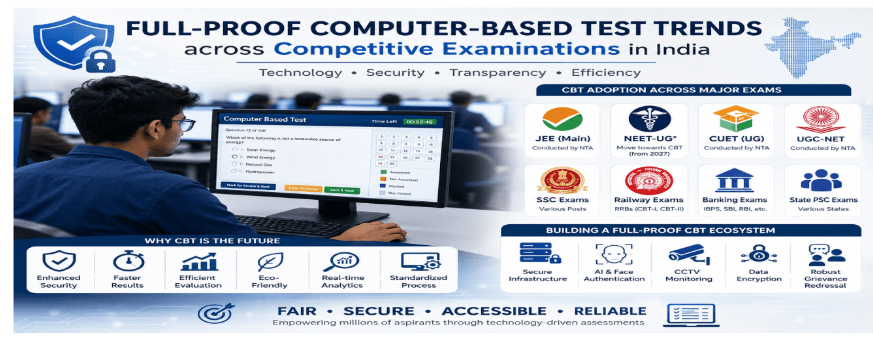
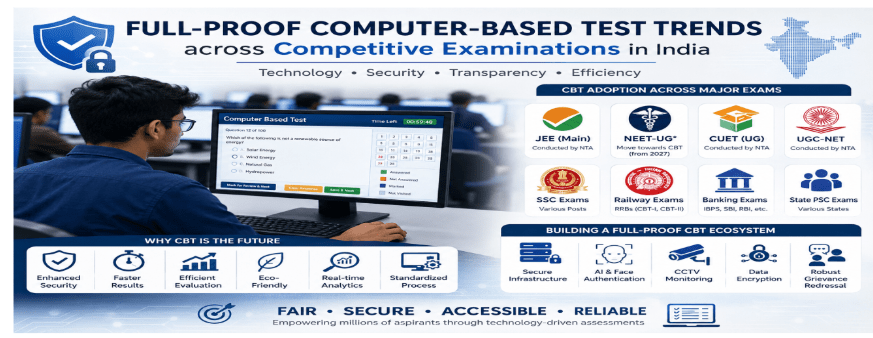
Computer-Based Testing (CBT), commonly known as CBT exams is becoming an important part of India’s competitive examination system. The increasing use of technology in examinations has changed how large-scale tests are conducted, evaluated, and monitored. Examinations such as JEE (Main), CUET, UGC-NET, and several Railway and Staff Selection Commission examinations already use computer-based formats. Recent developments surrounding NEET-UG have further strengthened the national discussion about moving major examinations from paper-based testing to CBT. This article analyses the emerging CBT trend, its advantages, challenges, and likely direction in India.
Keywords: CBT Exams, Computer-Based Testing, Competitive Examinations, Digital Assessment, Examination Security, and Online Testing.
- Introduction
Competitive examinations in India involve millions of candidates and require systems that can deliver assessments efficiently, consistently, and securely. Traditional pen-and-paper examinations depend heavily on printing, transportation, physical storage, and manual handling of question papers and answer sheets. These stages can create logistical and security challenges.
CBT exam reduces dependence on physical examination material by presenting questions digitally and recording responses electronically. The National Testing Agency (NTA) already conducts several major examinations, including JEE (Main), CUET, and UGC-NET, through technology-driven examination systems.
The debate around CBT has become stronger following concerns about examination integrity. In May 2026, the government announced that NEET-UG would move towards CBT from 2027, although subsequent developments indicate that the final implementation decision remains under consideration pending recommendations from the relevant task force.
- Research Analysis
The current examinat
Killer Study Strategies for Multiple Overlapping Exams: A Dual-Preparation Approachion landscape shows three major trends.
First expansion of CBT exam across examinations.
Railway recruitment provides a clear example. Railway Recruitment Boards continue to conduct multiple recruitment stages through CBT, including CBT-I and CBT-II examinations. Recent official notices also show scheduled CBT examinations and mock-test facilities for candidates.
Similarly, the Staff Selection Commission introduced a CBT mock test to familiarize candidates with the computer-based examination environment. This indicates that digital examination is not only changing the examination authority’s operations but also requiring candidates to develop computer-navigation skills.
Second a stronger emphasis on examination security.
CBT can reduce several risks associated with printing, transporting, and physically distributing question papers. However, it does not make examinations completely risk-free. Cyber security, system reliability, impersonation, server failures, and data protection remain important concerns. The discussion surrounding NEET illustrates that technology can strengthen examination security but cannot independently solve every integrity problem.
Third greater use of digital monitoring and authentication.
NTA’s current procurement and examination-related activities include CBT services, face authentication, and CCTV-related arrangements. This suggests that the future of CBT is likely to involve a broader technology ecosystem rather than simply replacing paper with computers.
For candidates, the transition also changes preparation strategies. Speed, keyboard and mouse familiarity, screen reading, question navigation, and time management become increasingly relevant. Therefore, examination preparation should include regular computer-based mock tests rather than relying exclusively on printed practice papers.
III. Conclusion
CBT exam is gradually becoming a central component of competitive examinations in India. Its advantages include faster processing, reduced dependence on physical examination material, digital response recording, and opportunities for stronger monitoring. Nevertheless, CBT should not be viewed as a completely “full-proof” solution. Cyber security, accessibility, technical infrastructure, and candidate readiness must receive equal attention.
The future examination model is therefore likely to combine CBT with stronger authentication, surveillance, secure digital infrastructure, and transparent grievance mechanisms. The objective should not simply be to conduct examinations digitally but to create an examination system that is secure, accessible, reliable, and fair.
- Key Takeaways
- CBT exam is expanding across major Indian competitive examinations.
- JEE (Main), CUET, UGC-NET, and Railway examinations demonstrate the growing adoption of digital testing.
- NEET-UG has become a major focus of the national CBT transition debate.
- CBT exam can reduce several physical-paper security risks but does not eliminate cyber security threats.
- Candidates increasingly need computer-based mock-test practice.
- Future examination systems are likely to integrate CBT with digital authentication, CCTV, and other security technologies.
Resources
- National Testing Agency (NTA)
- Indian Express — NEET-UG and the shift toward CBT
- Times of India — NEET-UG CBT decision and latest developments
- Railway Recruitment Board official notices
- Staff Selection Commission — CBT Mock Test Notice
- NDTV — Railway examinations and CBT expansion
Table of Contents
Frequently Asked Questions
What is CBT and how is it changing competitive exams in India?
CBT stands for Computer-Based Testing. It replaces traditional pen-and-paper exams by presenting questions digitally and recording responses electronically, which reduces the logistical and security challenges associated with physical papers.
Which major competitive examinations in India currently use the CBT format?
Major exams like JEE (Main), CUET, UGC-NET, and several Railway and Staff Selection Commission recruitment exams already utilize the computer-based testing format.
Are there plans to transition NEET-UG to a computer-based test?
Yes, there have been government announcements indicating a move towards CBT for NEET-UG from 2027, though the final implementation decision remains under consideration pending task force recommendations.
What are the main advantages of CBT over traditional pen-and-paper exams?
CBT offers faster processing, reduced dependence on physical examination materials, digital response recording, and opportunities for stronger monitoring.
Does moving to CBT completely eliminate examination security risks?
No, while it reduces physical-paper risks (like printing and transporting), it introduces new challenges such as cyber security threats, system reliability issues, server failures, and data protection concerns.
How should candidates change their preparation strategies for CBT exams?
Candidates need to focus on improving their speed, keyboard and mouse familiarity, on-screen reading, question navigation, and time management by taking regular computer-based mock tests.
Why are organizations like the Staff Selection Commission (SSC) introducing CBT mock tests?
They introduce these mock tests to help candidates familiarize themselves with the computer-based examination environment and develop necessary computer-navigation skills before the actual test.
What technologies are likely to be integrated with future CBT systems?
Future CBT models are likely to incorporate a broader technology ecosystem, including face authentication, CCTV surveillance, and secure digital infrastructure to enhance examination integrity.
What logistical challenges of traditional exams does CBT solve?
CBT eliminates the heavy dependence on printing, physical transportation, manual handling, and physical storage of question papers and answer sheets.
Can CBT independently solve all examination integrity problems?
No, CBT is not a completely “full-proof” solution on its own. It must be combined with stronger authentication, transparent grievance mechanisms, and robust technical infrastructure to create a secure and fair system.
Citations & References
National Testing Agency (NTA)
Indian Express — NEET-UG and the shift toward CBT
Times of India — NEET-UG CBT decision and latest developments
Railway Recruitment Board official notices
Staff Selection Commission — CBT Mock Test Notice
NDTV — Railway examinations and CBT expansion
Connect Your Brand with Gen-Z
Unlock high-impact youth marketing strategies with EvePaper.
Book Strategy Call