
WEAPONISING ENERGY
Published: June 20, 2026
Key Strategy Takeaways
- India must diversify energy routes, not just energy suppliers.
- Expand strategic petroleum reserves to withstand prolonged supply disruptions.
- Accelerate renewable energy adoption as a hedge against geopolitical risks.
- Strengthen alternative energy infrastructure such as the India–Oman gas pipeline.
- Integrate energy security into national security and foreign policy planning.
- Reduce dependence on critical chokepoints like the Strait of Hormuz.
- Develop a formal geoeconomic doctrine linking energy, trade, and strategic interests.
- Enhance supply chain resilience through long-term partnerships and route diversification.
- Maintain strategic autonomy while preparing for energy-based geopolitical coercion.
- Shift from reactive crisis management to proactive energy security planning.
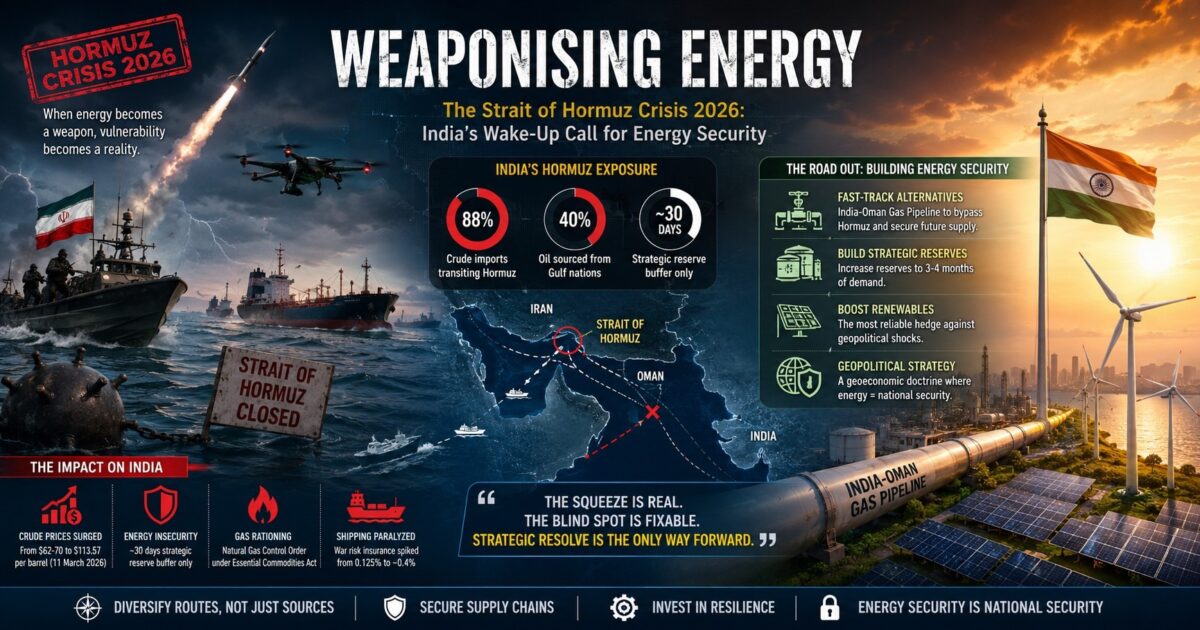
On February 28, 2026, humanity was awakened by a familiar nightmare, painted in entirely new hues. The Strait of Hormuz, a mere 33 kilometres of ocean that separates Iran from Oman, had effectively been closed off, causing the worst global energy crisis since the oil shocks of the 1970s. India, which consumes close to five and a half million barrels of crude oil per day, found itself directly under threat.
It became painfully apparent that although there had been talk of diversification for decades, India’s dependency on a single point of energy delivery was still very much in place. And when energy is used as a political weapon, points of delivery are points of vulnerability.
INDIA’S HORMUZ EXPOSURE — BY THE NUMBERS
| 88% Crude import stransiting Hormuz | 40% Oil sourced from Gulf nations | ~30 days Strategic reserve buffer only |
The Anatomy of Energy Weaponisation
Energy weaponization is an old idea; what is new about it is the precision. The Iranian attack plan in 2026 included conventional methods of attack using boats, missiles, and drones as well as non-conventional methods of satellite attacks and GNSS interference, rendering the passage insured yet commercially unviable. War risk insurance rates shot up dramatically from 0.125 percent to almost 0.4 percent of vessel valuation per passage, shutting down shipping traffic.
In India’s case, the impact was felt within days. While the basket price of Indian crude oil had been stable at $62 to $70 per barrel until most of FY 2025-26, prices shot up to as much as $113.57 per barrel on 11 March 2026. In response, the government set up a 24-hour petroleum monitoring control center and issued the Natural Gas Control Order under the Essential Commodities Act, and gas rationing started.
Asia’s Achilles’ Heel – and India’s Particular Vulnerability
It is estimated by the IEA that roughly 80% of oil and oil products being transported from Hormuz to its destinations in 2025 would be directed to Asian destinations. China, India, Japan, and South Korea constitute roughly 69% of all Hormuz crude flows. In essence, the Asian miracle was constructed on a fault line.
However, the crisis unveiled the fact that there was a wide gap in terms of oil stockpiling capacity between India and China. China had reserves for 3-4 months’ worth of demand, whereas India only had reserves to meet the needs for 30 days. The Chinese government ensured that state-owned entities secured Russian oil before the situation worsened. Meanwhile, Indian oil demand from Russia, which fell to around 1.04 million barrels per day by February 2026 – possibly out of consideration when negotiating with the US – was now struggling to make up for lost ground.
Additionally, Saudi Arabia has become increasingly interested in directing additional Gulf supplies to China, where it has invested heavily in refineries.
India’s Geoeconomic Blind Spot – Dependency Without Deterrence
India’s vulnerability is not in its ignorance but in its structure. It has import partners from almost 40 countries, which would count as a diversification of its origin. However, there lies a fundamental difference between origin diversification and route diversification. Almost all of the 40 partners still transport their goods through Hormuz. Diversification in the number of suppliers and lack of diversification in the routes is the equivalent of widening tributaries without touching the dam.
The geoeconomic blind spot here is that diversification alone is energy security. The selection made by Iran in 2026 to allow only Chinese and Turk fleets and disallow any of the western-friendly partners to pass through the straits made it clear how energy flow can be used for retaliation against a strategic position rather than mere market disruption.
India’s strategy for strategic autonomy proved meaningless in the face of Iran’s move. The project for Chabahar port meant to act as an alternate trading route bypassing Pakistan to Afghanistan and beyond was affected directly by the crisis in Hormuz.
The Road Out: From Reactive Crisis to Proactive Geoeconomy
What the Modi government did was interesting. In a matter of months, the Rs 40,000 crore India-Oman gas pipeline project was put on fast track. The gas pipelines would connect Oman’s gasfields directly to Gujarat through a submarine pipeline system, and thus avoid Hormuz completely. Two-thirds of India’s imports of LNG from Hormuz had come from there in 2025, so this is another geoeconomic move.
India will have to increase its energy reserves substantially — especially since its current reserves are lower in comparison with any other country in the world. Moreover, it should increase its energy production from renewable sources, not only because of the commitments towards climate change but because it can become the most efficient geoeconomic hedge against global tensions.
Finally, India needs to improve its geopolitical strategy, particularly regarding the role energy plays within it. Being able to work with countries on both ends of the spectrum is impressive. However, it also requires creating additional reserves, securing the pipelines and increasing production from renewables and, most importantly, having an official geoeconomic doctrine that considers energy a matter of national security.
Conclusion
The Hormuz crisis of 2026 is no anomaly. It is merely a foreshadowing. As climate concerns, great-power competition, and regional disputes escalate in the years ahead, energy warfare will undoubtedly emerge as an evermore frequent tactic of geopolitical blackmail. For India, the world’s third-largest consumer of imported oil and a rapidly ascending economic power, any geoeconomic approach founded on the assumption of optimism is unsustainable.The squeeze is real. The blind spot is fixable. All that is left for India is to summon the strategic resolve to make up for lost time.
Frequently Asked Questions
What is Energy Weaponisation?
Energy weaponisation refers to the use of energy resources, supply routes, or energy infrastructure as tools of political pressure, economic coercion, or strategic influence against other countries.
Why is the Strait of Hormuz important for global energy security?
The Strait of Hormuz is one of the world’s most critical oil transit chokepoints, through which a significant portion of global crude oil and liquefied natural gas (LNG) supplies pass every day.
How did the 2026 Hormuz crisis demonstrate energy weaponisation?
The crisis showed how a nation could disrupt energy flows through military, cyber, and navigational interference, causing oil prices to surge and threatening the energy security of dependent countries
Why is India vulnerable to energy weaponisation?
India imports a large share of its crude oil requirements, with a substantial portion passing through the Strait of Hormuz, making it vulnerable to disruptions in this critical route.
What is the difference between supplier diversification and route diversification?
Supplier diversification involves purchasing energy from multiple countries, while route diversification focuses on ensuring energy can reach its destination through multiple transport corridors.
How can energy weaponisation affect a country’s economy?
Energy weaponisation can increase fuel prices, raise transportation costs, trigger inflation, disrupt industries, and slow economic growth.
What role do strategic petroleum reserves play in energy security?
Strategic petroleum reserves act as emergency stockpiles that help countries maintain energy supplies during geopolitical crises, conflicts, or supply disruptions.
How does energy weaponisation impact global oil prices?
Even the threat of disruptions can create market uncertainty, causing oil prices to rise sharply due to fears of supply shortages.Many Asian economies, including India, China, Japan, and South Korea, rely heavily on oil and gas shipments that transit through the Strait of Hormuz.
Why are Asian countries particularly exposed to Hormuz-related disruptions?
Many Asian economies, including India, China, Japan, and South Korea, rely heavily on oil and gas shipments that transit through the Strait of Hormuz.
Can renewable energy reduce the risk of energy weaponisation?
Yes. Expanding renewable energy sources such as solar and wind power reduces dependence on imported fossil fuels and strengthens national energy security.
What is geoeconomics and how does it relate to energy weaponisation?
Geoeconomics is the use of economic tools to achieve strategic objectives. Energy weaponisation is a form of geoeconomic leverage where energy supply becomes a strategic instrument.
How can India strengthen its resilience against energy weaponisation?
India can strengthen resilience by expanding strategic reserves, diversifying supply routes, investing in renewable energy, and developing alternative energy infrastructure
What are energy chokepoints?
Energy chokepoints are narrow geographic passages through which significant volumes of energy resources are transported, making them vulnerable to disruption.
Why is energy security considered a national security issue?
Reliable access to energy is essential for economic stability, industrial production, transportation, and military readiness, making it a critical national security concern.
What lessons can India learn from the 2026 Hormuz crisis?
The crisis highlights the need for proactive energy planning, stronger strategic reserves, route diversification, renewable energy expansion, and a comprehensive geoeconomic strategy.
Citations & References
[1] International Energy Agency (IEA), Oil Market Report 2025, Paris, France: IEA Publications, 2025.
[2] U.S. Energy Information Administration, “The Strait of Hormuz is the world’s most important oil transit chokepoint,” U.S. Department of Energy, Washington, DC, USA, 2025.
[3] Ministry of Petroleum and Natural Gas, Government of India, Indian Petroleum and Natural Gas Statistics 2025-26, New Delhi, India, 2026.
[4] S. Kaplan, “Energy Security and Geopolitical Risk in Asia,” Journal of Strategic Energy Studies, vol. 18, no. 3, pp. 45–59, Mar. 2025.
[5] BP plc, Statistical Review of World Energy 2025, London, U.K.: BP Energy Economics, 2025.
Transform Your Brand’s Engagement with India’s Youth
Drive massive brand engagement with 10 million+ college students across 3,000+ premier institutions, both online and offline. EvePaper is India’s leading youth marketing consultancy, connecting brands with the next generation of consumers through innovative, engagement-driven campaigns. Know More.
Mail us at [email protected]
Connect Your Brand with Gen-Z
Unlock high-impact youth marketing strategies with EvePaper.
Book Strategy Call