
External Vulnerability Indicators Remain Healthy
Published: August 31, 2026
Key Strategy Takeaways
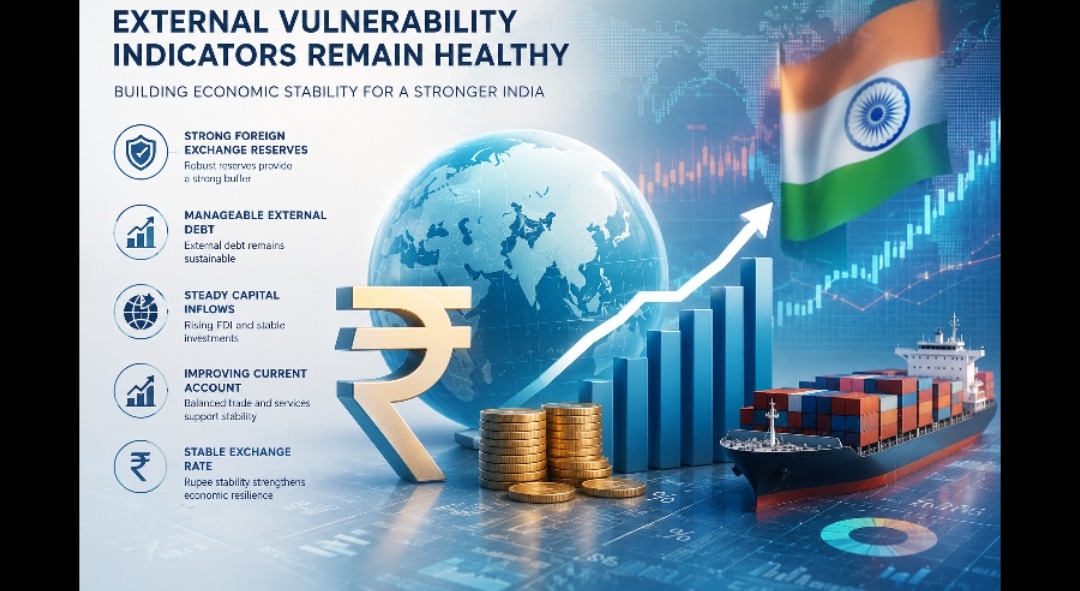
- External Vulnerability Indicators remain healthy, reflecting India's strong macroeconomic stability.
- Adequate foreign exchange reserves provide a buffer against external economic shocks.
- A stable current account position supports long-term economic resilience.
- Prudent external debt management reduces financial risks.
- Strong capital inflows enhance investor confidence and economic growth.
- Healthy external indicators strengthen the country's creditworthiness.
- Diversified export markets help minimize dependence on a single economy.
- Sound monetary and fiscal policies support external sector stability.
- Continuous monitoring of global economic conditions enables timely policy responses.
- Maintaining healthy external vulnerability indicators promotes sustainable economic development.
Introduction
In the modern interconnected world, no economy is completely isolated, meaning that increases or decreases in commodity prices, financial crises, or changes in international trade can cause changes in many countries at once. For some countries, the negative consequences of these large-scale factors will be temporary; for others, their economies will be more vulnerable to external interference, making them more challenging to govern. These traits are crucial to assess when examining the external vulnerability of the economy.
Specifically, India is a developing country that is greatly influenced by external economic forces. The country imports most of its crude oil, conducts a significant amount of trade with other countries, and attracts foreign investments. However, the same factors that integrate India into the global economy are also potential sources of vulnerability. Fortunately for the Indian economy, external vulnerability indicators suggest that the country is resilient to external shocks. Although the economy still has some weaknesses, the overall tendency indicates that India is becoming more stable.
What Is External Vulnerability?
External vulnerability is a relative measure that determines the sensitivity of a country’s economy to the inflows and outflows of external forces such as rising inflation, geopolitical tensions, exchange rates, surging oil prices, or decreased international trade.
A country with a high external vulnerability indicator is not capable of countering the identified risks adequately. In contrast, Nations with low external vulnerability levels have sufficient reserves, appropriate management strategies, and policies that allow them to withstand the hostile environment.
There are several indicators that can be used to assess the level of external vulnerability of a country, namely foreign exchange reserves, the current account balance, external debt, exchange rates, and foreign investment. Considering the combination of indicators is more informative than analyzing each element in isolation.
Why Are India’s External Vulnerability Indicators Considered Healthy?
In recent years, India has demonstrated positive trends in a number of key areas.
1. India’s foreign exchange reserves are a sign of the country’s financial security. They allow the country to pay off external debts, import goods, and prevent depreciation of the national currency in case of capital flight from the country.
2. India’s external debt is decreasing, although the country still has borrowings in foreign markets. However, this debt is relatively small for the economy of India, which allows the country to withstand financial market fluctuations in the global economy.
3. India has been able to attract foreign investment into the country, including investment in the industrial, IT, and renewable energy sectors, as well as in the development of infrastructure. Such investments are usually more reliable and consistent than short-term investments.
Thus, these three components reduce the volatility of the Indian economy and allow it to better withstand financial crises.
How Healthy Indicators Support Economic Stability
Healthy external vulnerability indicators play a significant role in improving the economic situation during periods of political or social instability in the world.
The ability of the national economy to withstand various challenges and not fail in bad times is critical. In other words, the more stable the foreign exchange reserves, the more promising the investment environment in the region seems to foreign investors.
In addition, a stable economy makes it easier for companies to make strategic decisions to develop their business and plan new projects. It also helps to inspire consumer confidence, as well as the trust of financial institutions and business partners in general.
It should be recognized that the negative consequences of systemic political or economic risks for the national economy are very difficult to predict. However, the presence of healthy external vulnerability indicators significantly reduces the likelihood of panic and minimizes negative surprises.
Challenges That Still Need Attention
Healthy indicators do not mean that all risks are mitigated. India’s heavy reliance on imported crude oil makes it vulnerable to a sudden price increase.
A rise in the price of oil may lead to an adverse impact on the economy caused by a change in international interest rates.
This factor, along with geopolitical tensions, supply chains, and the slowdown of global economic growth, may lead to a decrease in exports and affect the national economy. Therefore, it is necessary to focus on economic fundamentals and take measures to consolidate the economy instead of being comfortable with the current situation.
The external vulnerability is something that policymakers must watch over carefully and consistently instead of being overtly relaxed about the situation, assuming that this will not change.
Looking Ahead
As India’s economy grows, it is essential to continue focusing on external indicators for the country to maintain its current status. Increasing exports, promoting domestic production, attracting long-term investments, and building up reserves of foreign currency can help achieve this goal.
Moreover, developing technologies and digital payment systems, expanding infrastructure projects, and engaging in international trade relations can contribute to the growth of the nation’s external sector. However, proper fiscal policies and economic management will remain at the center of the government’s attention.
After all, a healthy economy is not something that grows solely during good times. It requires preparation for bad times so that the country can withstand crises and emerge stronger. And India’s external vulnerability indicators are a promising sign of such resilience.
Conclusion
A country’s economic development is not measured solely by a rise in growth. In fact, the health of the external vulnerability indicators suggests that India is indeed in a better position to withstand global economic surprises than it was a few years ago. Huge forex reserves, low external debt, and a continuous influx of investment into the country are all positive signs of the Indian economy being strong and steady.
That being said, the same indicators should not distract people from the potential challenges and pitfalls ahead. As mentioned earlier, the global economic environment is extremely dynamic and unpredictable; therefore, continuing to implement economic reforms and ensuring fiscal discipline in the country will be critical in the years to come. This will allow India to be stronger and more stable in the face of global economic challenges while also promoting sustainable economic growth.
References
[1] Intereconomics, G. William, “External Vulnerability Index: A Tool to Assess Trade Weaknesses”
https://www.intereconomics.eu/contents/year/2025/number/1/article/external-vulnerability-index-a-tool-to-assess-trade-weaknesses.html
[2] The Economic Times, “India’s external vulnerability indicators remain stretched: UBS”, March 20, 2018.
ttps://economictimes.indiatimes.com/news/economy/indicators/indias-external-vulnerability-indicators-remain-stretched-ubs/articleshow/63378884.cms
[3] RBI, “Resilient industrial and services sectors helped Indian economy to sustain despite global pressures: RBI”, July 22, 2026.
https://newsonair.gov.in/resilient-industrial-and-services-sectors-helped-indian-economy-to-sustain-despite-global-pressures-rbi/
[4] Financial Express, “Financial conditions, oil prices remain key concerns for economy: RBI Bulletin”, May 22, 2026.
https://www.financialexpress.com/business/news-financial-conditions-oil-prices-remain-key-concerns-for-economy-rbi-bulletin-4248437/
External Vulnerability is becoming an important concern for businesses and economies facing global uncertainty. Rising External Vulnerability can increase exposure to trade disruptions, currency movements, supply-chain challenges, and geopolitical risks. Managing External Vulnerability requires strong financial planning, diversified suppliers, and flexible business strategies. By reducing External Vulnerability, organizations can improve resilience, protect operations, and respond more effectively to sudden changes in the global economic environment.
Managing External Vulnerability is essential for maintaining stable business performance in a changing global environment. High External Vulnerability can expose companies to international trade disruptions, rising input costs, currency volatility, and unexpected geopolitical developments. To address External Vulnerability, businesses can diversify markets, strengthen domestic supply networks, and adopt effective risk-management practices. A proactive approach to External Vulnerability can support long-term growth, financial stability, and greater confidence among investors and stakeholders.
Reserve Bank of India (RBI) — Useful for information on exchange rates, external sector developments, and financial stability. Ministry of Commerce & Industry — Relevant for trade policy, imports, exports, and global trade developments. International Monetary Fund (IMF) — Provides research on global economic risks, external shocks, and financial stability. World Trade Organization (WTO) — Useful for international trade trends, tariffs, and trade-related risks. World Bank — Helpful for information on global economic conditions and external economic risks.
Frequently Asked Questions
What are external vulnerability indicators?
External vulnerability indicators measure a country’s ability to withstand external economic and financial shocks.
Why are external vulnerability indicators important?
They help assess economic stability and investor confidence.
What does “external vulnerability indicators remain healthy” mean?
It means the country’s external financial position is stable and resilient.
What role do foreign exchange reserves play?
They provide a financial cushion against currency and trade-related shocks.
How does a healthy current account benefit the economy?
It supports sustainable trade and reduces dependence on external borrowing.
Why is external debt management important?
Effective debt management lowers financial risks and improves economic stability.
How do healthy external indicators affect investors?
They increase investor confidence and attract foreign investment.
Can global events impact external vulnerability indicators?
Yes, factors such as oil prices, geopolitical tensions, and global interest rates can influence them.
How can a country maintain healthy external vulnerability indicators?
By managing debt prudently, maintaining adequate reserves, and promoting exports.
What is the overall benefit of healthy external vulnerability indicators?
They strengthen economic resilience and support long-term growth.
Citations & References
References
[1] Intereconomics, G. William, “External Vulnerability Index: A Tool to Assess Trade Weaknesses”
https://www.intereconomics.eu/contents/year/2025/number/1/article/external-vulnerability-index-a-tool-to-assess-trade-weaknesses.html
[2] The Economic Times, “India’s external vulnerability indicators remain stretched: UBS”, March 20, 2018.
ttps://economictimes.indiatimes.com/news/economy/indicators/indias-external-vulnerability-indicators-remain-stretched-ubs/articleshow/63378884.cms
[3] RBI, “Resilient industrial and services sectors helped Indian economy to sustain despite global pressures: RBI”, July 22, 2026.
https://newsonair.gov.in/resilient-industrial-and-services-sectors-helped-indian-economy-to-sustain-despite-global-pressures-rbi/
[4] Financial Express, “Financial conditions, oil prices remain key concerns for economy: RBI Bulletin”, May 22, 2026.
https://www.financialexpress.com/business/news-financial-conditions-oil-prices-remain-key-concerns-for-economy-rbi-bulletin-4248437/
Drive massive brand engagement with 10 million+ college students across 3,000+ premier institutions, both online and offline. EvePaper is India’s leading youth marketing consultancy, connecting brands with the next generation of consumers through innovative, engagement-driven campaigns. Know More.
Mail us at [email protected]
Connect Your Brand with Gen-Z
Unlock high-impact youth marketing strategies with EvePaper.
Book Strategy Call