
Federated Learning for Privacy-Preserving Data Collaboration
Published: July 6, 2026
Key Strategy Takeaways
- Prioritize user privacy by training AI models without transferring raw personal data.
- Build trust through privacy-first AI architecture using federated learning.
- Reduce regulatory compliance risks by keeping sensitive data on user devices.
- Improve AI performance while minimizing centralized data collection.
- Enable secure collaboration across organizations without sharing confidential datasets.
- Adopt privacy-by-design principles to align with evolving AI and data protection regulations.
- Strengthen customer confidence by demonstrating responsible AI development practices.
- Leverage on-device machine learning to deliver personalized experiences without compromising privacy.
- Combine federated learning with differential privacy and secure aggregation for stronger security.
- Address communication and bandwidth challenges through efficient model update optimization.
- Mitigate model poisoning attacks with robust anomaly detection and validation techniques.
- Support scalable AI innovation across industries such as healthcare, finance, and mobile applications.
- Balance AI accuracy with ethical data governance to create sustainable machine learning systems.
- Position federated learning as a competitive advantage for organizations focused on trustworthy AI.
- Future-proof AI strategies by adopting decentralized learning frameworks that respect user data ownership.
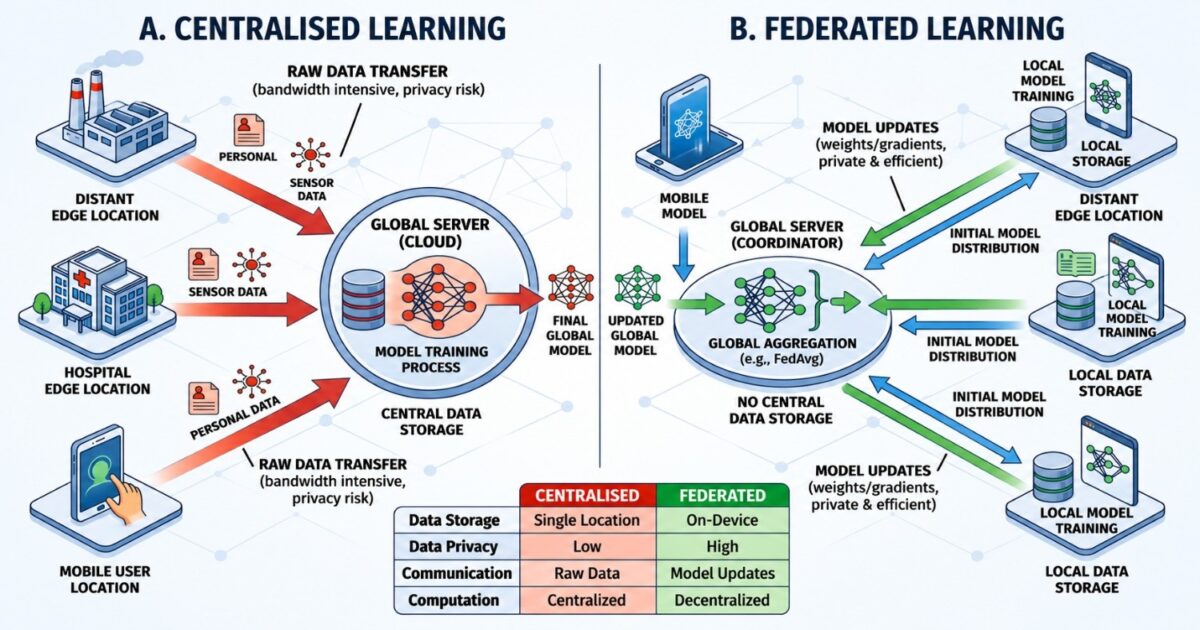
What if your phone could help train an artificial intelligence model without ever sending your personal data to anyone? That idea, which sounds like science fiction, is actually the premise behind one of the most quietly significant developments in modern computing. Federated learning is not a buzzword that only researchers in Silicon Valley care about — it is a shift in how machines learn, and it matters to every person who has ever wondered what happens to their data when they use an app.
The way machine learning has traditionally worked is fairly straightforward. Organisations collect massive amounts of user data, send it to centralised servers, and use that pooled data to train their models. It is efficient. It is effective. And for years, nobody asked too many questions about it. But as awareness around data privacy AI has grown — especially after events like the Cambridge Analytica scandal and the introduction of GDPR in Europe — the model started to feel uncomfortable. People began asking: does the AI need to see my data directly, or can it just learn from it?
The Core Idea, Without the Jargon
Federated learning, first introduced by Google researchers in 2016, flips the traditional model on its head. Instead of bringing data to the algorithm, you bring the algorithm to the data. In practical terms: a global model is pushed out to thousands or millions of devices. Each device trains a local version of the model using its own data. Only the model updates — not the raw data — are sent back to a central server. The server then aggregates these updates to improve the global model, and the cycle repeats.
This architecture means the actual data never leaves the device. Your messages, your medical records, your browsing behaviour — they stay with you. The model learns patterns without ever accessing the specifics. It is, in a very real sense, a privacy-first approach to machine intelligence, and it is one reason why so many in the field of data privacy AI are paying attention to it.
Where It Is Actually Being Used
It would be easy to keep this theoretical, but federated learning is already running on devices that billions of people use every day. Google’s Gboard keyboard is perhaps the most well-known example. When you type on an Android phone, the keyboard uses federated learning to improve its next-word prediction and autocorrect features. The model gets smarter based on how you type — your slang, your shortcuts, your patterns — and yet none of that text is ever uploaded to Google’s servers.
The improvement is real; the exposure is minimal. Apple has quietly done something similar with features like Face ID improvement and voice recognition in Siri. On-device learning allows Apple to refine these systems across its user base without centralising sensitive biometric information. The company has made privacy a marketing pillar for years, and federated learning is one of the technical mechanisms that makes that claim more than just branding.
Perhaps the most compelling real-world application is in healthcare. Hospitals and medical institutions hold vast quantities of patient data — imaging scans, lab results, treatment records. Under traditional machine learning, building a powerful diagnostic model would require aggregating data from multiple hospitals, which raises enormous legal and ethical concerns. Federated learning allows institutions like Massachusetts General Hospital and partners in academic medicine to collaboratively train models for detecting diseases like cancer or COVID-19 from chest X-rays, without any patient records crossing institutional boundaries. Each hospital contributes learning without surrendering data. The resulting model is stronger than any single institution could produce alone.
It Is Not Perfect — And That Honesty Matters
Any fair treatment of federated learning has to acknowledge its limitations, because the field is still evolving and there is a tendency in popular coverage to oversell the idea. One genuine challenge is communication overhead. When millions of devices are sending model updates to a central server, the bandwidth demands can be significant. Researchers are working on techniques like model compression and update sparsification to reduce this, but it remains a practical constraint — especially in low-connectivity environments.
There is also the problem of statistical heterogeneity. In the real world, the data on different devices is rarely uniform. A language model trained mostly on updates from English-speaking users in urban areas will perform poorly for rural users typing in regional languages. This is not unique to federated learning — it is a problem in AI generally — but the distributed nature of the approach makes it harder to detect and correct.
And then there are adversarial attacks. Research has shown that a sufficiently motivated attacker who controls a subset of devices can attempt model poisoning — feeding manipulated updates designed to corrupt the global model’s behaviour. Defending against this requires additional techniques like differential privacy, secure aggregation, and anomaly detection in updates. These add complexity, and complexity introduces its own tradeoffs. The point is not that federated learning fails — it is that it solves some problems while opening up others, which is honest and true of almost every technology.
The Bigger Conversation It Is Starting
What makes federated learning interesting beyond its technical specifications is what it represents philosophically. For most of the history of the internet, the dominant model has been: give us your data, and we will give you a better product. It has been a largely invisible transaction, and most people accepted it without much thought. Federated learning suggests an alternative: the product can still improve, and the data can stay yours.
This matters increasingly as we enter a period where AI systems are becoming embedded in healthcare, education, financial services, and criminal justice. The stakes of poorly handled data privacy AI are not abstract. They are real people having real outcomes shaped by systems that were trained on data they never consented to share in the way it was used. Federated learning is not a complete solution to that problem, but it is a meaningful step toward building AI systems that do not require mass surveillance as a precondition.
Regulators are beginning to take notice. The European Union’s AI Act and ongoing updates to GDPR are pushing companies toward privacy-by-design principles — an approach that federated learning naturally aligns with. For organisations navigating compliance in data-heavy industries, this may soon shift from a technical curiosity to a regulatory necessity.
Conclusion
Federated learning is one of those ideas that is genuinely hard to dismiss once you understand what it is actually doing. It is technically clever, but more than that, it reflects a particular set of values about who data belongs to and how much access an AI system actually needs to be useful. The question of whether artificial intelligence has to be built on a foundation of centralised data collection is not settled — and federated learning is one of the most serious arguments that it does not. As the technology matures and the tooling around it improves, it could quietly become one of the defining architectural choices in how AI gets built responsibly going forward.
Frequently Asked Questions
What is federated learning?
Federated learning is a machine learning approach that trains AI models directly on users’ devices instead of sending personal data to a central server. Only model updates are shared, allowing AI systems to improve while keeping sensitive information private.
How does federated learning protect user privacy?
Federated learning protects user privacy by ensuring that raw data never leaves a device. Instead of uploading personal information, devices send encrypted model updates to a central server, significantly reducing the risk of data exposure.
Why is federated learning important for AI?
Federated learning allows organizations to build accurate AI models without collecting large amounts of personal data. This makes AI development more privacy-focused, secure, and aligned with modern data protection regulations.
Where is federated learning used in real life?
Federated learning is used in smartphone keyboards, voice assistants, facial recognition systems, healthcare research, financial services, and IoT devices. It helps improve AI models while protecting users’ sensitive information.
What are the main benefits of federated learning?
The main benefits of federated learning include enhanced data privacy, reduced regulatory risks, improved security, decentralized AI training, and the ability to create smarter machine learning models without storing user data in one central location.
Can federated learning improve AI accuracy?
Yes. Federated learning allows AI models to learn from data generated across millions of devices while keeping that data private. This often results in more personalized and continuously improving AI systems.
Is federated learning completely secure?
Federated learning significantly improves privacy, but it is not completely immune to security threats. Organizations often combine it with techniques such as secure aggregation, differential privacy, and anomaly detection to strengthen protection against attacks.
What challenges does federated learning face?
Federated learning faces challenges such as communication overhead, varying data quality across devices, limited computing resources, and potential model poisoning attacks. Researchers continue to develop solutions to address these issues.
How is federated learning different from traditional machine learning?
Traditional machine learning requires collecting data on centralized servers before training AI models. Federated learning reverses this process by sending the model to users’ devices, allowing training to occur locally while keeping personal data private.
Which industries benefit the most from federated learning?
Healthcare, finance, mobile technology, automotive, education, cybersecurity, and smart devices all benefit from federated learning because these industries handle sensitive data that must remain secure and private.
Does federated learning help organizations comply with privacy regulations?
Yes. Federated learning supports privacy-by-design principles by minimizing the movement of personal data. This helps organizations align with regulations such as GDPR and other emerging data protection laws.
Can federated learning reduce the need for centralized data storage?
Yes. Since federated learning trains AI models directly on local devices, organizations can reduce their reliance on centralized databases containing sensitive user information, lowering privacy and security risks.
Citations & References
1. McMahan, B., Moore, E., Ramage, D., Hampson, S., & Arcas, B. A. (2017). Communication-Efficient Learning of Deep Networks from Decentralized Data. Proceedings of the 20th International Conference on Artificial Intelligence and Statistics (AISTATS).
2. Rieke, N., et al. (2020). The Future of Digital Health with Federated Learning. npj Digital Medicine, 3(1), 119.
3. Yang, Q., Liu, Y., Chen, T., & Tong, Y. (2019). Federated Machine Learning: Concept and Applications. ACM Transactions on Intelligent Systems and Technology (TIST), 10(2), 1-19. Available at: https://dl.acm.org/doi/10.1145/3298981
4. European Commission. (2021). Proposal for a Regulation on Artificial Intelligence (AI Act). European Parliament and Council. Available at: https://eur-lex.europa.eu/legal-content/EN/TXT/?uri=CELEX52021PC0206
5. Google AI Blog. (2017). Federated Learning: Collaborative Machine Learning without Centralized Training Data. Available at: https://ai.googleblog.com/2017/04/federated-learning-collaborative.html
6. Information Commissioner’s Office (ICO). (2023). Guidance on AI and Data Protection. Available at: https://ico.org.uk/for-organisations/guide-to-data-protection/key-dp-themes/guidance-on-ai-and-data-protection/
Transform Your Brand’s Engagement with India’s Youth
Drive massive brand engagement with 10 million+ college students across 3,000+ premier institutions, both online and offline. EvePaper is India’s leading youth marketing consultancy, connecting brands with the next generation of consumers through innovative, engagement-driven campaigns. Know More.
Mail us at collaborate@evepape
Connect Your Brand with Gen-Z
Unlock high-impact youth marketing strategies with EvePaper.
Book Strategy Call