
Four-slab GST structure at 0/5/18/40%
Published: August 31, 2026
Key Strategy Takeaways
- Highlight products moving to lower GST slabs to attract price-conscious consumers.
- Communicate any price reductions transparently to build customer trust and encourage purchases.
- Adjust pricing strategies quickly to remain competitive as GST rates change.
- Focus promotional campaigns on categories benefiting from lower tax rates to drive higher sales.
- Prepare premium brands for the 40% GST slab by emphasizing quality, exclusivity, and value.
- Educate customers about GST changes through blogs, FAQs, social media, and email campaigns.
- Monitor consumer demand and purchasing behavior after the revised GST structure is implemented.
- Leverage festive seasons and limited-time offers to maximize the impact of GST-driven price changes.
- Coordinate marketing, finance, and sales teams to ensure consistent pricing and messaging across channels.
- Use customer feedback and sales data to refine marketing strategies as the new GST structure takes effect.
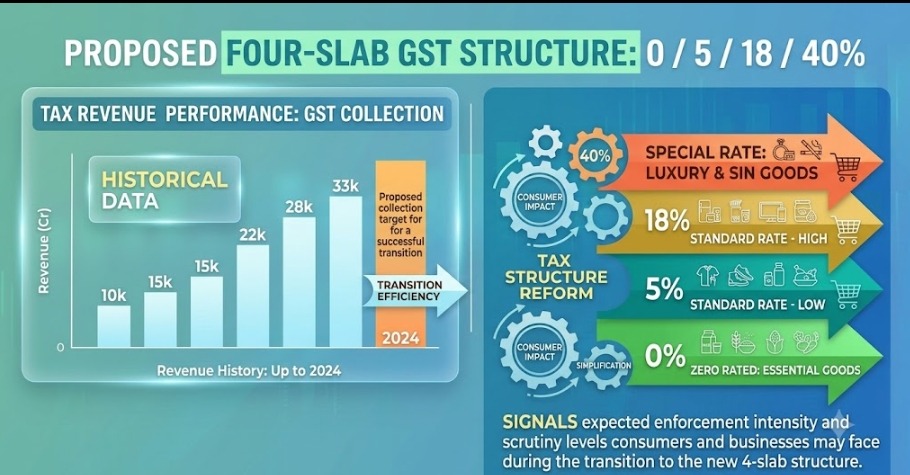
The New Four-Slab GST Structure: What 0/5/18/40% Actually Means for You
GST slabs are a key part of India’s indirect tax system, determining how much tax consumers and businesses pay on different goods and services. The proposed four-slab GST structure of 0%, 5%, 18%, and 40% aims to create a more streamlined taxation framework while influencing product prices, consumer spending, and business strategies. Understanding the changes in GST slabs is important for businesses, marketers, and consumers as they assess their potential impact on pricing, demand, and market competitiveness.The revised GST slabs could significantly influence pricing and consumer demand across different sectors. Under the proposed structure, GST slabs of 0%, 5%, 18%, and 40% would classify products and services based on their nature and consumption patterns. Lower GST slabs could make essential and commonly used products more affordable, potentially encouraging higher consumer spending. At the same time, businesses may need to revise pricing strategies, update billing systems, and reassess profit margins based on the applicable GST slabs. Understanding these changes will help companies plan effectively and communicate price adjustments clearly to customers.
Check your last grocery bill or the price tag on a new appliance and you may notice something has shifted. Since September 22, 2025, India’s Goods and Services Tax system runs on a simpler four-slab structure: 0%, 5%, 18%, and 40%. Gone are the old 12% and 28% brackets that made tax classification a genuine headache for businesses and a source of confusion for ordinary consumers trying to understand why two similar products were taxed so differently.
A Quick Look at How We Got Here
GST replaced seventeen different central and state taxes when it was introduced in July 2017, and the promise back then was simplicity. In practice, the system settled into five slabs: 0%, 5%, 12%, 18%, and 28%. Over time, businesses and tax professionals kept running into the same problem. Two products that seemed nearly identical to a shopper often sat in different slabs because of some technical classification detail, which led to endless disputes, court cases, and confusion at the billing counter.
The revised GST slabs could significantly influence pricing and consumer demand across different sectors. Under the proposed structure, GST slabs of 0%, 5%, 18%, and 40% would classify products and services based on their nature and consumption patterns. Lower GST slabs could make essential and commonly used products more affordable, potentially encouraging higher consumer spending. At the same time, businesses may need to revise pricing strategies, update billing systems, and reassess profit margins based on the applicable GST slabs. Understanding these changes will help companies plan effectively and communicate price adjustments clearly to customers.
The GST Council took up rate rationalisation as a serious agenda item through 2025, and the proposal that eventually got approved in the 56th Council meeting was more radical than most analysts expected. Instead of tweaking a few rates, the Council collapsed the middle of the structure entirely, folding the 12% slab almost completely into 5%, and moving most of the 28% slab down to 18%. Finance Minister Nirmala Sitharaman described it as the biggest reform to GST since its 2017 launch, and the changes took effect on September 22, 2025, timed to coincide with the start of Navratri.
The new GST slabs may also influence purchasing decisions and competitive positioning across industries. Businesses can use lower GST slabs as an opportunity to offer attractive prices, launch targeted promotions, and expand their customer base. For products facing higher GST slabs, brands may need to strengthen their value proposition and focus on product differentiation. By closely tracking how consumers respond to the revised GST slabs, companies can adjust their pricing and marketing strategies while maintaining profitability and customer trust.
The new GST slabs may also influence purchasing decisions and competitive positioning across industries. Businesses can use lower GST slabs as an opportunity to offer attractive prices, launch targeted promotions, and expand their customer base. For products facing higher GST slabs, brands may need to strengthen their value proposition and focus on product differentiation. By closely tracking how consumers respond to the revised GST slabs, companies can adjust their pricing and marketing strategies while maintaining profitability and customer trust.
Where Everything Actually Landed
The 12% slab is effectively gone. Roughly ninety nine percent of the goods that used to sit there moved down to 5%, which covers a lot of everyday items: dairy products, personal care goods like soaps and shampoos, packaged snacks, and medical devices. The small remainder shifted up to 18%, mostly higher-value textiles and select services.
The new GST slabs may also influence purchasing decisions and competitive positioning across industries. Businesses can use lower GST slabs as an opportunity to offer attractive prices, launch targeted promotions, and expand their customer base. For products facing higher GST slabs, brands may need to strengthen their value proposition and focus on product differentiation. By closely tracking how consumers respond to the revised GST slabs, companies can adjust their pricing and marketing strategies while maintaining profitability and customer trust.
The old 28% slab saw a similar split, though skewed differently. Around ninety percent of what used to sit at 28% dropped to 18%, which is why air conditioners, televisions, and small cars have gotten noticeably cheaper for a lot of households. The remaining ten percent, mostly luxury and sin goods, jumped up into the brand new 40% bracket instead.
The 0% category also expanded in a way that directly affects household budgets. Individual health and life insurance premiums, which used to carry an 18% tax, are now nil-rated entirely. So are thirty three lifesaving medicines that previously sat at 12%, along with educational stationery. For families paying for insurance or managing a chronic illness, this alone represents real, tangible savings every month.
Then there is the new 40% slab, reserved specifically for goods the government classifies as luxury or demerit items. This includes tobacco products, pan masala, cigars, aerated and sugary beverages, luxury cars, motorcycles above 350cc, yachts, private aircraft, and casino or online gambling admissions. This special rate, layered with an additional cess in some cases, is expected to remain in place until the compensation cess loans tied to the earlier GST structure are fully repaid.
Why the Government Chose This Particular Split
Revenue Secretary Arvind Shrivastava described the restructuring as fiscally sustainable, and the underlying logic makes sense once you look at the numbers. Lowering rates on essentials and mass-market goods reduces revenue in the short term, but the government is betting that lower prices will boost consumption enough to offset that gap over time. Meanwhile, pushing luxury and sin goods up to 40% recovers some of that lost revenue from a smaller group of buyers who are less price-sensitive to begin with.
There is also a simplicity argument that matters more than it might seem at first glance. Every extra slab in a tax system creates another point of classification, another opportunity for disputes about which rate a specific product should fall under, and another compliance burden for small businesses trying to file returns correctly. Cutting the slab count down to four, with only one genuinely unusual outlier at 40%, makes the whole system easier to administer and easier to explain to the average taxpayer.
What This Means at the Checkout Counter
For most households, the everyday impact has been positive. Soaps, toothpaste, packaged food, and a wide range of consumer electronics have gotten cheaper, since items that used to sit at 12% or 28% mostly landed at 5% or 18% respectively. Insurance premiums no longer carry an extra tax layer, which matters a lot for families who were already stretching their budgets to stay covered.
On the other end, if your spending includes items in the sin or luxury bucket, whether that’s cigarettes, a premium SUV, or a night at a casino, expect the tax bite to be noticeably sharper than before. What used to be a 28% hit is now effectively 40%, a jump that is meant to be felt rather than absorbed quietly.
Businesses have had to adjust too, and not entirely without friction. Invoicing systems, accounting software, and HSN code mappings all needed updates to reflect the new rates, and companies with existing e-way bills for goods already in transit did not need to cancel or reissue them, since those bills remain valid under their original terms. This transition period is especially tough for small businesses who don’t have large operations or enough people for the job.
A Few Things that changed.
Not every product fits neatly into this simplified picture, and a few grey areas remain, particularly around certain textile categories and specific services. But these are relatively small grey areas. As with any major tax restructuring, expect some fine-tuning over the coming months as the Council responds to classification disputes and industry feedback.
It is also worth keeping an eye on how the 40% slab evolves. Since it is tied partly to repaying compensation cess loans from the earlier GST era, there is a real possibility that once those loans are cleared, the structure or rate could be revisited again. For now, though, the four-slab system looks like it is here to stay for the foreseeable future.
GST Council – official information, recommendations, and GST updates: GST CouncilGST Rate Notifications – official notifications on changes to GST rates: GST Rate NotificationsGST Rates for Services – official GST rate information for services: GST Rates of ServicesGST FAQs – official answers and guidance on GST-related topics: GST FAQsCentral GST – official information on the CGST Act, rules, notifications, and circulars: Central GST
Conclusion
This is not just a technical tax adjustment buried in a finance ministry press release. It changes what you actually pay at the checkout counter every single day, whether you notice it consciously or not. Fewer slabs mean less guesswork for businesses filing returns, fewer disputes over classification, and a clearer, more predictable picture for consumers trying to understand why their bill looks different than it did a year ago.
Whether this reform ends up being remembered as a genuine simplification or just another iteration in GST’s ongoing evolution will depend on how consistently the government sticks with these four slabs over the next few years. For now, the math is simple enough to explain in one sentence: essentials got cheaper, luxury and sin goods got more expensive, and everything in between mostly settled at 18%.
Frequently Asked Questions
What is the four-slab GST structure?
The proposed four-slab GST structure consists of 0%, 5%, 18%, and 40% tax rates, with different goods and services placed into different slabs.
What is the purpose of the four-slab GST structure?
The structure aims to simplify GST rates, reduce tax complexity, and create a clearer framework for businesses and consumers.
How could the 0% GST slab benefit consumers?
Essential goods placed under the 0% slab would become more affordable because no GST would be charged on those products.
How could the 5% GST slab affect businesses?
A lower tax rate could support competitive pricing, potentially increase consumer demand, and improve sales volumes in eligible product categories.
What does the 18% GST slab represent?
The 18% slab would continue to cover standard-rated goods and services that are neither essential enough for lower rates nor subject to the highest rate.
What is the 40% GST slab?
The 40% slab is intended as a higher tax rate for selected goods and services considered premium or otherwise appropriate for higher taxation.
How can businesses prepare for the new GST structure?
Businesses should review pricing, update billing and accounting systems, assess supply-chain costs, and communicate any price changes clearly to customers.
Citations & References
References
1. Fincart, New GST rate slabs of 5% and 18% explained. https://www.fincart.com/blog/new-gst-rate-slabs/
2. BUSY, GST slabs 0%, 5%, 18%, 40% and the September 2025 reform. https://busy.in/gst/gst-slabs-5-percent-18-percent/
3. Outlook Money, GST Council clears 40% slab for sin and luxury goods. https://www.outlookmoney.com/tax/new-gst-rates-2025-council-clears-40-per-cent-tax-slab-for-sin-and-luxury-goods-in-gst-20-overhaul
4. Tally Solutions, New GST rate structure 2025 explained. https://tallysolutions.com/gst/new-gst-rate-structure/
5. Kotak Mutual Fund, GST 2.0 new 5% and 18% slabs effective September 22, 2025. https://www.kotakmf.com/Information/blogs/gst-2-point-0
Drive massive brand engagement with 10 million+ college students across 3,000+ premier institutions, both online and offline. EvePaper is India’s leading youth marketing consultancy, connecting brands with the next generation of consumers through innovative, engagement-driven campaigns. Know More.
Mail us at [email protected]
Connect Your Brand with Gen-Z
Unlock high-impact youth marketing strategies with EvePaper.
Book Strategy Call