
Hostel Hacks for dealing with difficult roommates: A guide for peaceful hostel life
Published: October 18, 2026
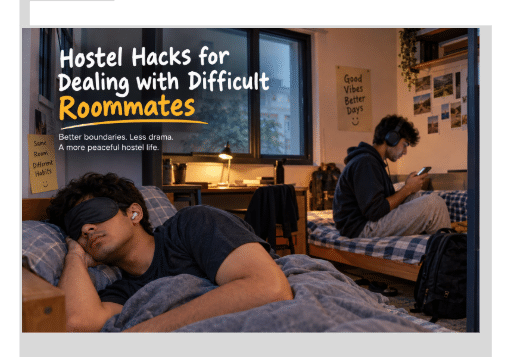
hostel roommate hacks
Abstract: Living in a hostel can be exciting; however, sharing a room with someone who has contrasting expectations, mannerisms and preferences can be a test. From unnecessary disturbances to sudden arguments over guests and shared expenses, roommates can cause a number of headaches. This article aims to discuss why roommate conflicts occur, how to handle the most common types of difficult roommates and what practical strategies can be used to make co-habiting easier. It can be concluded that although a harmonious relationship with the roommate may not be possible, a living arrangement that accommodates the needs and preferences of both is attainable.
Introduction
College hostel life can teach a student a number of valuable life lessons. Apart from learning how to budget money, manage personal duties and adapt to new social environments, one also learns to wake up to the morning class when the roommate set the alarm off at the tenth hour. Unfortunately, none of these life lessons are particularly enjoyable.
The most challenging aspect of residing in a hostel is undoubtedly the roommate issue. Some of the typical problems include waking up to the videos watched at full volume by the roommate who likes to sleep at odd hours, discovering one’s personal belongings misplaced or stolen, and having to deal with the roommate’s visitors who like to stay longer than they are allowed. It is normal for the first two problems to be ignored as not to cause serious disputes on the first day. Nevertheless, they will accumulate as an inevitable burden.
Moreover, one should understand that not all roommate-related issues can be solved with time.
Nevertheless, some of the problems require a calm and friendly approach whereas certain situations may demand more attention and resources to be handled properly.
Why roommate issues actually occur?
Prior to discussing the possible solutions it is essential to highlight the most common reasons why they appear. Not all roommate conflicts are deliberately created, and some issues are beyond human power.
Different sleep and lifestyle schedules
Students have different preferences as far as sleeping hours are concerned. Some people are night owls while others have to wake up at ungodly hours to catch the first bus.
In itself, this is not a problem. It becomes a problem when each roommate uses their roommate’s sleeping patterns as a justification for disturbing their roommate’s peace at inconvenient hours.
This is especially true for examination times. A student may need extra sleep hours for studying, while their roommate sees no problem with talking on the phone at midnight. This leads to tension between roommates, which can often be avoided by establishing certain ground rules.
Discrepancy of cleanliness
Ask ten different students what they consider to be an acceptable standard of cleanliness and you will get ten different answers.
Some people can throw their clothes on the floor and put their empty packets of chips on the dining table and call it a day. Others will be offended at the sight of this and will accuse you of being a pig.
The root of the problem lies in their use of the same space.
It becomes an issue when you must always wait for your roommate to move their clothes off the table so that you can get your own items.
Instead of trying to adopt a similar standard of living (or convincing yourself that their standard is fine), it is important to set certain rules. For example, if you both have items on the dining table, make sure you can place no more than a certain number of items there for a given period of time.
Respecting personal space
Although some people are quite open, most people do not like it when someone casually goes through their personal belongings. This applies to both physical and digital belongings.
Reading a person’s text messages out loud, talking about their love life with their classmates and walking into a person’s room without asking are all unacceptable.
Although these issues may start as a nuisance, they can quickly become irritating. A number of roommates find it difficult to set healthy boundaries, which can place their roommate’s comfort in jeopardy.
Stress, finances and misunderstandings
Student life can sometimes be extremely stressful. The increased pressure can lead to snapping at someone for something that may not be worth arguing about. People tend to behave differently when they are under pressure.
The stress can also influence the way you approach financial issues. One roommate may always buy snacks for both of you, while the other roommate never contributes. The same problems can occur in relation to personal hygiene products.
It is always important to clearly agree on who is responsible for what.
How to handle the five most common types of roommate problems
Each problem should be handled differently, depending on the context.
- Noisy roommate who wastes other’s time
This kind of roommate is always talking on his/her phone at unsuitable hours or watching videos without using headphones.
It is essential to address a particular issue to a roommate instead of criticizing in general. For instance, you could say “I have to get up early for class and I can’t stand your phone calls at night”. A statement like this will not offend or stimulate roommate’s defending his/her actions.
Asking for specific changes allows a roommate to understand what exactly he/she did wrong and try to improve. Besides, it is vital to agree on quiet hours and ways to minimize disturbances (using headphones, speaking loudly and so on).
- Messy roommate
The majority of messy people are generally sloppy and see no problem in it.
In order to avoid being irritated every time you spot something that bothers you, it is important to sit down and set some standards concerning what you allow and what you forbid on your common areas (dining table, etc), and set rules for an inappropriate amount of disorganization. It is also a good idea to set who will be responsible for things like taking out the garbage and so on.
- Roommate who borrows everything
Some people do not see the difference between borrowing and stealing. They are very free with your belongings and only stop when there is an explicit agreement.
While many are quite relaxed about this, others might be under the impression that their things are always at risk of being stolen. In such cases it is important to be polite, but firm. You might want to add a polite message to your belonging saying that items should not be taken without asking or make it clear that you are happy to lend certain items but not the entirety of you things.
- Roommate who always invites too many friends over
Having friends in the hostel is part and parcel of college life. However, it becomes a problem, when your roommate never asks your permission, to bring his friends to his hostel room. They may also arrive in groups, and spend the night, when the hostel rules prohibit having guests in the room.
You should set clear ground rules about how many friends your roommate can bring, if they can stay overnight etc. Say, you have an exam the next day, it would be unfair to expect your roommate to host his friends, when you need a quiet place to study. On the other hand, it would be unreasonable, to ask your roommate to always accommodate his friends, if you need regular sleep hours. As, with most issues, compromise is the best solution.
- Roommate who takes everything you say the wrong way
Some roommates can turn every discussion into an argument. They immediately react negatively to any criticism and blame their roommate for everything that goes wrong.
This can be extremely frustrating. Do not get frustrated and start giving your roommate a personal evaluation (saying something like “I do not like how you are behaving”). Stick to the issue at hand. For example, instead of saying “you are such a mean roommate” you can say “I need to sleep before my morning classes, so will you please stop talking?”. Always make sure you state the issue clearly and concisely.
However, if the roommate resorts to name-calling, threatening you in any way and refusing to accept responsibility for their actions, it is important to stop considering the problem as a petty roommate issue. In cases of constant harassment, it is best to contact the hostel warden directly and ask for intervention.
Practical strategies that make roommate problems easier to deal with
Understanding the problem is only half the battle. The other half is actually dealing with it. Here are some practical strategies that will help you navigate roommate issues:
- Talk to your roommate before resentment grows
Never Wait Too Long To Talk About The Issue. If you already have been frustrated for three weeks, then talking about it sooner rather than later is a better idea. It may also help to pick the right time to have this conversation. Try not to confront your roommate (as well as yourself) when one of you is tired or upset.
Make sure you clearly state your problem and what you would like to change. For example, if you have been bothered by the constant noise after midnight, you could say “when the lights are on after midnight it is difficult for me to sleep”. By clearly stating the issue you allow the roommate to clearly know what you would like to change. Your roommate may not agree with your proposed solution but at least they will know what is bothering you.
- Reach an agreement on basic standards
You do not need to sign any complex legal documents, however, it is always a good idea to have an informal talk to set a few ground rules. You can decide to agree upon sleeping hours, cleaning, having visitors and borrowing things. If you can manage it more easily, you can always write your rules and regulations down for easy reference.
- Make use of simple solutions such as headphones
Sometimes the issue can be easily solved without discussing it. Putting earplugs or headphones can help to solve most of the conflicts about sounds. It might also be helpful to use an eye mask and a little lamp instead of the lights. You can also reach an agreement about a specific level of mess instead of arguing over every single thing. Using earphones or separate boxes for storing things may seem like a cheap way to solve the problems, but it can really help in some cases if both sides are open to a conversation.
- Keep track of shared expenses
Though it may be difficult to discuss, it is essential to clearly identify who owes money to whom. If you and your friends frequently share grocery expenses, it is important to make sure who will be responsible for which kind of grocery. Likewise, you should keep a record of expenses for those items that are to be shared between you all (e.g., cleaning products) and note clearly how much each member should contribute to it.
Say, for instance, you decide to buy cleaning products for your hostel room for Rs. 200. If you and your roommate decide to share this expense, you will get back Rs. 100 from him/her. Thus, it becomes clear who has to bear which expense, avoiding unnecessary disputes over money. However, keep in mind that not all personal expenses have to be shared, unless you have decided to do so beforehand.
- Pick your battles wisely
Not all complaints can be considered a battle of sorts. It is essential to distinguish between annoying habits and unacceptable behaviour. If your roommate occasionally leaves their books scattered on the table it is probably not worth an argument. However, if your roommate frequently goes through your things, takes your belongings without asking, and does not give you space to study in peace, this can be considered a serious violation. Ask yourself whether a habit is affecting my health or safety/study patterns/wallet/privacy. If it is affecting any of these, it definitely deserves attention.
- Know when to involve the hostel warden
Sometimes it is best to cut all ties. If your roommate is not respecting your boundaries and shows no sign of improvement it would be best to involve the hostel warden.
Always explain the situation thoroughly so that the warden can fully understand the conflict. It is also vital that you specify what you want the warden to do. Instead of saying “my roommate is being annoying” it would be better to say “my roommate is bringing visitors even though we agreed on only allowing visitors on specific times”. In addition if you are feeling harassed, threatened, touched without permission or just generally unsafe in your hostel room you should not have to suffer in silence. Always make sure you follow hostel protocol when you are filing a complaint and do not hesitate to involve the authorities.
Common pitfalls
Even the most reasonable people can make mistakes when dealing with a difficult roommate. Here are some common pitfalls to avoid:
The silent treatment
Suppose Rahul is annoyed with Aman for leaving dirty dishes on their shared dining table every day. Instead of confronting Aman, Rahul decides to withhold his anger and silently resent Aman for ruining his day. In doing so, Rahul makes things far worse. The silent treatment can be very effective in cases of harassment or when you do not know how to respond to an accusation. However, it should not be used as a permanent solution.
It is always best to clearly state the issue and your expectations. It may help to take some time to cool off before addressing the issue in order to avoid unnecessary arguments.
Complaining to everyone except the roommate
It is always important to talk to a trusted friend about your hostel problems. It may feel good to vent your frustration, but complaining to your entire class about your roommate is not only unproductive; it can also cause the conflict to escalate. Classmates will start taking sides, and what was meant to be a petty argument can easily turn into a hostel-wide feud. Do not involve everyone in your personal drama. Talk to a trustworthy friend about it, and avoid humiliating your roommate publicly.
Making rules you will not follow
If you set rules for your roommate, make sure you are willing to accept the same consequences. Making rules that apply to your roommate only can result in a number of issues.
Do not expect special treatment if you have agreed to a punishment. Likewise, do not ask for special considerations unless you are willing to accept consequences for your actions.
Expecting your roommate to become your best friend
It is important to remember that your roommate is not your best friend and will not always share your interests and preferences. You may find yourself enjoying your roommate’s company and hanging out with them every weekend. You may also find that you rarely talk to your roommate aside from asking for permission to use something. Either scenario is completely fine.
The only expectation that should be set is mutual respect. It is completely normal for roommates to become more comfortable with each other over time. Try not to force your roommate to meet all your expectations.
Avoiding problems due to potential drama
There is a big difference between annoying habits and unacceptable behaviours. Do not ignore unacceptable actions in the hopes of avoiding drama. Do not involve yourself in a potentially dangerous situation just for the sake of being polite. There are different procedures for handling serious violations. Always follow hostel guidelines when filing a complaint against your roommate for harassment, threats to your safety and so on.
How to deal with the next roommate problem (in seven easy steps)
When confronted with a problem it is natural to act immediately. However, it is always best to bide your time and carefully consider how to respond. Here is a simple guideline on how to respond to the next roommate problem:
- Pinpoint the problem
Try to clearly define the issue. Instead of saying “I do not like my roommate” clearly state what you dislike about your roommate’s behaviour. “My roommate watches videos at full volume at inconvenient hours” is a much clearer definition of the problem.
- Determine whether the problem is worth your time and effort
Ask yourself whether the problem is affecting your studies, health, safety, wallet, space or dignity. The minor issues should not be given much attention. Remember that not all roommates are expected to meet the same standards of living.
- Choose the right time to confront your roommate
Unless it is an emergency do not confront your roommate when either one of you is upset, tired or has a group of friends with them.
- Clearly state the problem
Always describe the unacceptable behaviour without labelling your roommate. Instead of saying “you are such an annoying roommate” it is always best to say “I do not like your behaviour”.
- Make a specific request
Ask your roommate to address a specific issue: “I will appreciate it if you stop talking when my lights are off”.
- Give the agreement time to work
Give your agreement a reasonable amount of time to work before holding another discussion. If the same problem occurs again it can be addressed more formally.
- Involve hostel wardens or college authorities if necessary
If all else fails you can always contact a superior authority. Always clearly describe the situation to give them all the necessary details. You can also include a personal note stating what you would like them to do. If you are in immediate danger it may help to send a copy of this email to a trusted adult. Do not involve anyone in a personal conflict unless it is a legal matter or you feel physically threatened.
Keeping a diary of repeated problems
You may also want to keep a diary of repeated problems for future reference. It is always important to clearly document any repeated problems, particularly if you need to involve hostel wardens and college authorities.
Keeping a diary can also help you keep track of agreements and follow through. It is always a good idea to note the dates and details of any agreement. This way everyone involved will know the exact time when the agreement expires and needs to be re-discussed. Never unlawfully record or distribute any personal conversations. Never record any conversation without the consent of the person who is recording it.
Conclusion
Difficult roommate problems are part and parcel of hostel living. Most common roommate problems can easily be solved if both sides make an effort to find a middle ground. You may not always get the answer you want. Some people are simply unreasonable and will not bend their rules for you. However, you should always strive to improve your living standards within reasonable limits. Start with one problem and one conversation and agree on one solution. You do not need to turn your roommate into your best friend, but you can at least improve your overall co-habiting experience.
Hostel Roommate Hacks: 20 FAQs, 20 Key Takeaways, and One Core Marketing Question
Primary SEO keyword: hostel roommate hacks
These FAQs and key takeaways are based on your article, Hostel Hacks for Dealing with Difficult Roommates: A Guide for Peaceful Hostel Life. The keyword “hostel roommate hacks” is integrated naturally to support SEO while addressing common student concerns about noise, cleanliness, privacy, shared expenses, boundaries, and conflict resolution.
1. Frequently Asked Questions (20 FAQs)
Writing
FAQs About Hostel Roommate Hacks
1. What are hostel roommate hacks?
Hostel roommate hacks are practical tips that help students manage shared living spaces, prevent misunderstandings, establish boundaries, and resolve conflicts with roommates. They include setting quiet hours, dividing cleaning duties, tracking shared expenses, and respecting personal belongings.
2. How can I deal with a difficult roommate in a hostel?
Identify the specific behaviour that is causing a problem, choose a suitable time to talk, and explain how it affects you. Make a clear and reasonable request, agree on a solution, and approach the hostel warden if the problem continues or involves harassment or safety concerns.
3. What are the best hostel roommate hacks for peaceful living?
Establish basic ground rules for sleeping hours, cleanliness, guests, borrowing belongings, and shared expenses. Communicate respectfully, maintain personal boundaries, and address small issues before they turn into major disagreements.
4. How do I deal with a noisy roommate?
Explain how the noise affects your sleep or studies and suggest specific quiet hours. You can also agree on using headphones, lowering phone volumes, and taking calls outside the room when appropriate.
5. How can I manage a messy roommate?
Discuss shared cleaning standards and agree on responsibilities for common areas, rubbish disposal, and cleaning schedules. Focus on keeping shared spaces usable rather than forcing your roommate to adopt your personal standards of cleanliness.
6. What should I do if my roommate borrows my things without permission?
Politely but firmly explain that your belongings should not be used without asking. Clarify which items, if any, you are comfortable lending, and keep valuable or private belongings secure.
7. How do I handle a roommate who frequently invites friends over?
Discuss visitor limits, suitable visiting hours, overnight guests, and quiet periods. Make sure any agreement follows hostel rules and considers both roommates’ needs for privacy, rest, and social interaction.
8. How can I stop arguments with my hostel roommate?
Avoid personal attacks and focus on the specific issue. Listen to your roommate’s perspective, use calm language, and propose a practical compromise. If either person becomes too upset, pause the discussion and return to it later.
9. How can roommates establish clear boundaries?
Discuss expectations around personal belongings, privacy, visitors, noise, study time, and shared facilities. State your boundaries clearly and respect the same boundaries when your roommate expresses them.
10. How should roommates divide shared expenses?
Agree in advance on which expenses will be shared and how much each person will contribute. Keep a simple written record of purchases, payments, and outstanding amounts to prevent misunderstandings.
11. What should I do if my roommate never contributes to shared expenses?
Review your original agreement and explain the outstanding amount calmly. Avoid paying for additional shared purchases until responsibilities are clarified, and involve hostel management or a trusted mediator if the dispute continues.
12. How can I maintain cleanliness when sharing a hostel room?
Create a simple cleaning schedule, assign specific responsibilities, and agree on standards for shared surfaces and rubbish disposal. Keeping personal belongings organized can also reduce friction over limited space.
13. Is it okay if I am not friends with my hostel roommate?
Yes. Roommates do not have to become close friends to live together peacefully. Mutual respect, communication, privacy, and cooperation are more important than sharing the same interests or social circle.
14. When should I complain to the hostel warden about my roommate?
Contact the hostel warden when repeated conflicts remain unresolved, agreed rules are consistently ignored, or your roommate violates your privacy or property rights. Threats, harassment, unwanted physical contact, or immediate safety concerns warrant prompt help rather than waiting for informal discussions to work.
15. How can I handle a roommate who takes every comment personally?
Use neutral language and describe the behaviour rather than judging the person’s character. For example, explain that late-night phone calls disturb your sleep instead of calling your roommate inconsiderate. Keep the discussion focused on a specific solution.
16. What are some affordable hostel roommate hacks?
Use storage boxes you already own, keep separate spaces for personal belongings, use headphones to manage ordinary noise, create a shared expense tracker, and agree on a cleaning schedule. Most effective roommate solutions require communication rather than spending money.
17. Should I ignore small problems with my roommate?
Minor annoyances may not require confrontation every time. However, problems affecting your sleep, studies, finances, privacy, health, or safety deserve attention. Consider the impact of the behaviour before deciding how to respond.
18. How can I avoid misunderstandings with my roommate?
Discuss expectations early, communicate changes clearly, confirm shared agreements, and avoid making assumptions about what the other person considers acceptable. Written notes can help everyone remember agreed responsibilities.
19. Should I keep a record of recurring roommate problems?
Yes, if the issues are persistent or may require formal intervention. Record dates, specific incidents, relevant agreements, and steps taken to resolve the problem. Keep the information private, factual, and limited to what is necessary.
20. What should I do if my roommate makes me feel unsafe?
Prioritize your safety. Move to a safer place if necessary, contact the hostel warden or appropriate college authorities, and seek help from a trusted person. If there is immediate danger, contact local emergency services. You do not have to resolve threats or harassment through a private conversation.
2. Key Takeaways (20 Points)
Writing
20 Key Takeaways: Hostel Roommate Hacks for Peaceful Living
- Communicate early: Address recurring problems before frustration turns into resentment.
- Focus on specific behaviour: Explain what is happening rather than criticizing your roommate’s personality.
- Agree on quiet hours: Set reasonable expectations for sleeping, studying, phone calls, and entertainment.
- Establish cleaning responsibilities: Divide household tasks and agree on acceptable standards for shared spaces.
- Respect personal belongings: Never borrow or use another person’s possessions without permission.
- Set visitor rules: Discuss guest numbers, visiting hours, overnight stays, and hostel regulations in advance.
- Protect personal privacy: Respect physical boundaries, private conversations, personal devices, and belongings.
- Keep shared expenses transparent: Record purchases, agreed contributions, and outstanding payments.
- Choose the right time to talk: Avoid unnecessary confrontations when either roommate is tired, upset, or surrounded by friends.
- Make specific requests: Ask for practical changes, such as reducing late-night noise or keeping the study table clear.
- Listen to the other person: Understand your roommate’s needs while communicating your own expectations.
- Use affordable solutions: Headphones, eye masks, separate storage areas, and simple schedules can help address everyday disagreements.
- Pick your battles wisely: Distinguish between minor irritations and problems that affect your well-being, finances, privacy, or studies.
- Avoid the silent treatment: Take time to cool down when needed, but communicate recurring concerns constructively when it is safe to do so.
- Do not escalate conflicts unnecessarily: Avoid public humiliation, gossip, and involving unrelated people in personal disagreements.
- Follow rules you agree to: Shared arrangements work best when expectations apply fairly to everyone.
- Accept different personalities: You do not need identical routines, interests, or standards to coexist respectfully.
- Document recurring problems: Keep factual notes of incidents and agreements when formal intervention may be necessary.
- Know when to seek help: Involve the hostel warden or appropriate authorities when repeated violations, harassment, or safety concerns arise.
- Prioritize mutual respect over friendship: A peaceful hostel experience depends on cooperation, reasonable boundaries, and accountability rather than becoming best friends.
3. One Core Marketing Question
Writing
How can hostel roommate hacks help college students resolve everyday conflicts, protect their personal space, and create a peaceful shared living environment without unnecessary stress or extra expenses?
This marketing question positions hostel roommate hacks as a practical solution to a common student problem. It highlights the key benefits of the article: fewer conflicts, better communication, improved privacy, more manageable shared expenses, and a more comfortable hostel experience.
For your next step, I can help you create SEO title and meta description or 10 additional SEO keywords
Connect Your Brand with Gen-Z
Unlock high-impact youth marketing strategies with EvePaper.
Book Strategy Call