
How Sustainability Is Becoming a Marketing Advantage for New-Age Brands
Published: October 8, 2026
community marketing
Sustainability used to be a line in the footer. Now a lot of newer brands build their whole pitch on it, and that’s caused a problem, because shoppers and regulators both quit trusting vague green claims. This piece covers how we got here, what the good versions look like, where brands mess up, and a simple way to build a claim people will actually believe. Short version: it only pays off if you can prove it.
Introduction
Scroll through any shopping app and try counting the “recycled,” “refillable,” and “plastic free” tags. You’ll lose count fast. Ten years ago that language belonged to a few niche labels, and now it’s on toothpaste tablets, sneakers, tea pouches, even toilet paper. Enough buyers, younger ones mostly, use it to break ties between two similar products, and brands noticed.
Problem is, when every brand uses the same words, none of them land. People got suspicious, and then regulators stepped in. So saying you’re sustainable isn’t the edge anymore. Being believed is.
We’ll go through why the shift happened, the different ways brands turn it into an advantage, what’s working, what keeps going wrong, and a rough framework if you’re starting from zero.
Why This Stopped Being Optional
Buyers changed
People who grew up with climate news as background noise tend to research a brand before they trust it. They read the about page, check the ingredients, maybe dig up the founder’s last interview. Sustainability became one more thing on the checklist, right next to price and reviews.
Here’s the thing though. People buy green products and then purchase the cheaper alternative anyway. Researchers call it an attitude-behavior gap which survey results repeatedly show. The behavior can be influenced when the green alternative is roughly the same price and just as effective, which is where new-age companies have targeted their efforts from the beginning.
No retailer to hide behind
Sell through a big supermarket and nobody asks about your supply chain. Sell directly through your own site and Instagram and you’re talking to customers every single day. Your story is your shelf space. “Here’s where this comes from and what happens after you use it” is a much easier story to tell than “we’re 5% cheaper.”
The rules caught up
Founders tend to skip this part. October 2024, India’s Central Consumer Protection Authority (CCPA) issued guidelines on greenwashing, requiring proof of any environmental claims and mandating disclosure. In parallel, the EU adopted a directive promoting consumers’ empowerment in the context of the green transition.It bans generic claims like “eco-friendly” when there’s no proof, and it blocks “carbon neutral” claims that rest only on offsets. Member states have to start applying it from late September 2026, so that’s this month.
Either way, vague green language is turning from a habit into a legal risk.
What the Advantage Looks Like in Practice
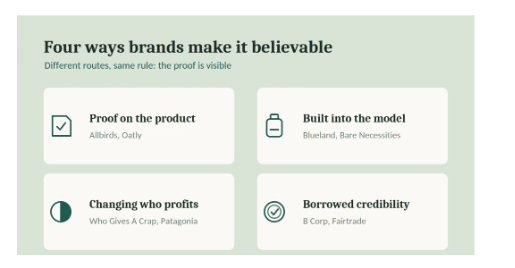
Green marketing doesn’t look one way. A few patterns keep showing up, so see which one you’re closest to.
Proof built into the product
Allbirds puts a carbon footprint number on every product page, and it open-sourced its life cycle assessment tool so anyone can check how it got there. Oatly printed climate figures right on the carton. Argue with the numbers if you want. The point is they’re inviting you to.
Sustainability as the business model
Some brands build it into the format, so there’s nothing to “claim.” Blueland produces cleaning tablets, which are dissolved in a bottle specially designed for them; thus, the company does not produce any plastic waste. The company Lush is known for its shampoo bars, which are free from any packaging. In India, there is a zero-waste personal care brand called Bare Necessities. Ecoware creates compostable tableware from agricultural waste.
A refill pouch is hard to fake. That’s the whole appeal.
Changing who profits
Then you get the far end. Who Gives A Crap sends half its profits to sanitation projects. Patagonia ran “Don’t Buy This Jacket” on Black Friday 2011, later started Worn Wear for repairs, and in 2022 moved ownership into a trust and a nonprofit so the profits go to climate work. Nobody’s copying that at a startup, but it shows how far “credible” can go.
Borrowed credibility
Various certification schemes such as B Corp, Fairtrade and Rainforest Alliance exist so that another party can testify on your behalf. These are neither cheap nor quick, and for B Corp you even have to renew the certificate every three years. But if nobody’s heard of you yet, it’s often the fastest way to get believed.
What Works
Some of this is obvious. Some of it took a lot of brands a few painful launches to learn.
Pick one claim and make it airtight. “100% recycled cotton, GRS certified” sticks in people’s heads, and a list of six soft virtues doesn’t.
Say the awkward number too. If your packaging is 80% recycled, print 80%. Shoppers have been burned enough that a brand admitting a gap looks more honest, and you’ve got something to announce next year.
Put the proof where the decision happens. A short line near the buy button does more than a gorgeous sustainability report that nobody opens.
The after-sale stuff matters more than people think. Repair guides, refill reminders, take-back schemes. They turn a claim into a habit, and habits bring people back.
Price is where a lot of green brands quietly lose. Charge 40% more for the same performance and most people walk. Keep the gap small, or say exactly where the extra money goes, whether that’s fair wages or certified farms.
Teach your sales team the sourcing story in two sentences. In B2B this is huge, since the buyer at a hotel or a corporate gifting company often has to justify the purchase to their boss, and you’re handing them the answer.
And the least exciting one: get supplier data from day one. It’s way easier to write tracking into your first contracts than to chase vendors for paperwork after the claim is already printed on the label.
Common Pitfalls
Words with nothing behind them
“Eco-friendly.” “Green.” “Natural.” “Planet-positive.” None of these tell a customer anything, and under the newer rules they’re the phrases most likely to get you in trouble. If you can’t finish the sentence “eco-friendly because…” with a number or a certificate, cut the word.
Leaning on offsets
Buy some carbon credits, stamp “carbon neutral” on the box. This is one of the most criticized moves in marketing right now. Credit quality is all over the place, and regulators are going after the claim itself. So cut emissions first, offset what’s left, and don’t blur the two.
Shouting about the small thing
A “recyclable” tag on the bottle while most of the footprint sits in manufacturing and shipping. People notice. H&M got called out in 2022, including by Norway’s consumer authority, for sustainability claims that didn’t explain how they were calculated or what they covered.
Promising what operations can’t deliver
You announce “zero plastic by next year,” a supplier falls through, and now you’re either quietly killing the goal or shipping something that contradicts your own launch. It usually happens right when nobody has time to deal with it calmly.
Running it as a campaign
A green month, a tree-planting promo, a limited edition line, then silence. People can smell a campaign from a distance, and it makes a brand look opportunistic instead of committed.
Getting defensive
Oatly got hit in 2020 over one of its investors, and the way they responded mattered almost as much as the deal. Just explain yourself plainly and fix what’s fair to fix. A polished PR statement makes it worse.
A Simple Framework
Here’s a rough order that works for a small team without much budget.
- Audit what’s real. Write down everything environmental or social you actually do, with proof. Materials, packaging, sourcing, energy, wages. You’ll find things you forgot to mention, and maybe one or two you’d rather not.
- Pick one or two claims. Go for the truest ones, the ones your customer cares about. Park everything else.
- Get it verified. A certification, a lab test, a life cycle assessment, depending on your category. Even a basic footprint calculation gives you a real number to talk about.
- Rewrite the copy. “Packed in 100% recycled cardboard” beats “sustainably packaged.” Every time.
- Put it where people look. Product page, label, checkout, sales deck. Not buried in a PDF.
- Set a public target with a date. Small enough to hit, like cutting virgin plastic in packaging by a set amount within twelve months.
- Report back once a year, wins and misses both. That’s what turns a claim into a reputation.
- Check the rules first. In India that’s the CCPA, plus ASCI for ads. Ten minutes now beats a takedown later.
Conclusion
Sustainability became a real marketing edge because buyers got pickier and the internet made every claim easy to check. It only stays an edge if it’s part of how the business actually runs, and not a coat of paint. The brands that are truly doing well, boast less and show more. In an era of increasing standards, the distance between brands that have actually achieved something and those that have merely adopted the accompanying vocabulary will grow. Start with one assertion that you would be willing to defend in front of a skeptical inquisitor.
20 Key Takeaways About Community Marketing
- Community marketing can help new-age brands build trust by creating stronger relationships with customers around shared values and interests.
- Sustainability can become a powerful foundation for community marketing when brands provide genuine evidence rather than vague environmental claims.
- Modern consumers increasingly research brands before purchasing, making trust and transparency important parts of community marketing.
- Brands can use sustainability initiatives to give customers a reason to identify with and participate in a brand community.
- Community marketing works best when sustainability is built into the product, business model, or customer experience rather than treated as a temporary campaign.
- Clear environmental claims can give community members something specific to understand, discuss, and share.
- Third-party certifications can provide additional credibility for brands using sustainability as part of their community marketing strategy.
- Community marketing becomes stronger when brands openly communicate both their achievements and their limitations.
- Specific claims such as the percentage of recycled material can be more credible than broad terms such as “green” or “eco-friendly.”
- Brands can strengthen communities by placing sustainability information where customers actually make purchasing decisions.
- Repair programmes, refill systems, take-back schemes, and other post-purchase initiatives can turn sustainability into an ongoing customer relationship.
- Community marketing should provide value beyond simply asking customers to buy sustainable products.
- Price and product performance remain important because customers may support sustainability in principle but still choose cheaper or more effective alternatives.
- Transparent sourcing information can help customers understand the real impact behind a brand’s sustainability claims.
- Supplier data is important because credible community marketing depends on brands being able to support the claims they communicate.
- Vague sustainability language can weaken trust and make community members more sceptical.
- Overemphasising a minor environmental improvement while ignoring larger impacts can damage a brand’s credibility.
- Treating sustainability as a one-time marketing campaign can make community members question the brand’s long-term commitment.
- Public goals and regular progress reports can encourage accountability and strengthen relationships between brands and their communities.
- The most effective community marketing strategies make sustainability something customers can believe in, participate in, and verify, rather than simply something a brand claims.
30 FAQs About Community Marketing
1. What is community marketing?
Community marketing is a strategy in which brands build ongoing relationships with groups of customers who share common interests, values, goals, or experiences.
2. How can community marketing support sustainable brands?
It can help sustainable brands create deeper relationships with customers by giving them opportunities to learn about, discuss, support, and participate in sustainability initiatives.
3. Why is trust important in community marketing?
Community marketing depends on relationships. If customers do not trust a brand’s claims or actions, they are less likely to participate, recommend the brand, or remain loyal.
4. How does sustainability influence community marketing?
Sustainability can give customers a shared value around which a community can form, particularly when the brand can demonstrate measurable environmental or social impact.
5. Can sustainability claims attract a brand community?
Yes, but claims need to be credible. Specific evidence, certifications, measurable goals, and transparent reporting can make sustainability more meaningful to potential community members.
6. Why are vague sustainability claims harmful to community marketing?
Terms such as “green” or “eco-friendly” without supporting evidence can create scepticism and make customers question the authenticity of the brand.
7. What makes a sustainability claim credible?
A credible claim should be specific, measurable, relevant, and supported by appropriate evidence such as certification, testing, supplier information, or environmental assessments.
8. How can brands communicate sustainability to their communities?
Brands can share sourcing information, product materials, environmental data, certifications, progress reports, targets, and explanations of how products are made.
9. Should brands disclose their sustainability limitations?
Yes. Acknowledging gaps can make communication more credible because it demonstrates that the brand is not presenting itself as perfect.
10. How can community marketing help sustainable brands build loyalty?
Shared values, transparency, participation, and ongoing communication can create stronger emotional relationships than short-term promotional campaigns.
11. Can certifications support community marketing?
Yes. Independent certifications can provide additional credibility by allowing a third party to verify certain environmental or social claims.
12. Why is third-party verification useful?
Customers may have difficulty evaluating sustainability claims themselves. Independent verification can provide additional evidence that supports the brand’s communication.
13. How can brands avoid greenwashing in community marketing?
They should avoid unsupported environmental claims, provide evidence, communicate the scope of their claims clearly, and ensure that marketing statements accurately reflect business practices.
14. What is greenwashing?
Greenwashing occurs when a brand creates an exaggerated, misleading, or unsupported impression about its environmental performance or sustainability.
15. How does greenwashing affect brand communities?
It can damage trust and cause community members to question other claims made by the brand.
16. Can community members help hold sustainable brands accountable?
Yes. An engaged community can ask questions, provide feedback, identify inconsistencies, and encourage brands to make progress on their sustainability commitments.
17. Why should brands publish sustainability targets?
Public targets give customers and community members something measurable against which they can evaluate future progress.
18. How can brands make sustainability part of the customer experience?
They can introduce refill programmes, repair services, take-back schemes, reusable packaging, transparent sourcing, and educational resources.
19. Is community marketing only about social media?
No. Community marketing can take place through social media, email, events, online groups, product experiences, workshops, customer programmes, and offline communities.
20. How can sustainable brands build communities offline?
Brands can organise workshops, sustainability events, product demonstrations, repair sessions, refill events, educational programmes, and local community activities.
21. Does sustainable community marketing require a large budget?
No. Small brands can begin with direct conversations, educational content, small events, customer feedback, and transparent communication rather than expensive campaigns.
22. Why is transparency important for sustainable community marketing?
Transparency allows customers to understand what a brand is actually doing and gives them the information needed to make informed decisions.
23. How can brands use customer feedback in sustainability initiatives?
Brands can use community feedback to identify concerns, improve products, understand customer expectations, and prioritise future sustainability initiatives.
24. Why is price important in sustainable community marketing?
Consumers may support sustainability but still consider price and product performance when making purchases. Sustainable products therefore need to provide compelling overall value.
25. Can sustainable products create stronger communities?
They can when customers feel connected to the values behind the product and have opportunities to participate in those values beyond the purchase itself.
26. How can brands turn sustainability into an ongoing community activity?
They can create recurring initiatives such as repair events, refill programmes, recycling drives, educational sessions, progress updates, and community challenges.
27. What is the role of storytelling in community marketing?
Storytelling can help customers understand the people, materials, processes, and decisions behind a product, making sustainability easier to understand and connect with emotionally.
28. How can brands prove sustainability claims to their communities?
They can use measurable data, certifications, testing, environmental assessments, supplier documentation, public targets, and regular progress reports.
29. What is the biggest mistake brands make in sustainability community marketing?
One major mistake is treating sustainability as a promotional campaign rather than integrating it into the company’s products, operations, and long-term strategy.
30. What is the future of community marketing for sustainable brands?
Community marketing is likely to become more focused on transparency, participation, accountability, shared values, and measurable impact as consumers become more sceptical of unsupported sustainability claims.
One Marketing Question
How can brands use community marketing to build trust, demonstrate genuine sustainability, and turn environmentally conscious customers into long-term brand advocates?
Frequently Asked Questions
Connect Your Brand with Gen-Z
Unlock high-impact youth marketing strategies with EvePaper.
Book Strategy Call