
How the New Income-Tax Framework Handles Belated and Revised Returns
Published: September 14, 2026
Key Strategy Takeaways
- The revised return deadline has been extended to March 31 of the assessment year (e.g., March 31, 2027, for AY 2026-27) [cite: 1.2.3].
- Filing a revised return after December 31 now incurs a new Section 234I fee of up to ₹5,000 [cite: 1.2.1].
- The Updated Return (ITR-U) window is now available for up to 48 months from the end of the assessment year [cite: 1.2.2].
- ITR-U features a four-slab additional tax structure of 25%, 50%, 60%, and 70%, depending on how late the return is filed [cite: 1.2.2].
- Taxpayers can now utilize ITR-U to revise loss returns if the update converts the loss into positive income or reduces the previously claimed loss [cite: 1.2.2].
- Receiving a refund does not bar a taxpayer from filing a revised return to claim omitted deductions, provided it is filed within the statutory window [cite: 1.1.5].
Key Strategy Takeaways
- The revised return deadline has been extended to March 31 of the assessment year (e.g., March 31, 2027, for AY 2026-27) [cite: 1.2.3].
- Filing a revised return after December 31 now incurs a new Section 234I fee of up to ₹5,000 [cite: 1.2.1].
- The Updated Return (ITR-U) window is now available for up to 48 months from the end of the assessment year [cite: 1.2.2].
- ITR-U features a four-slab additional tax structure of 25%, 50%, 60%, and 70%, depending on how late the return is filed [cite: 1.2.2].
- Taxpayers can now utilize ITR-U to revise loss returns if the update converts the loss into positive income or reduces the previously claimed loss [cite: 1.2.2].
- Receiving a refund does not bar a taxpayer from filing a revised return to claim omitted deductions, provided it is filed within the statutory window [cite: 1.1.5].
Table of Contents
How the New Income-Tax Framework Handles Belated and Revised Returns
Missing your original tax return deadline used to feel like a bit of a scramble — figure out what section applies, remember which cut-off date you’re now racing against, and hope you don’t run into a fresh penalty along the way. That confusion hasn’t fully gone away, but the Income Tax Department has laid out clear statutory time limits under the new Income-tax Act, 2025, and honestly, once you see the dates side by side, it’s not as messy as it sounds.
Here’s a straightforward walk-through of how belated and revised returns actually work now, and what’s changed compared to the older rules.
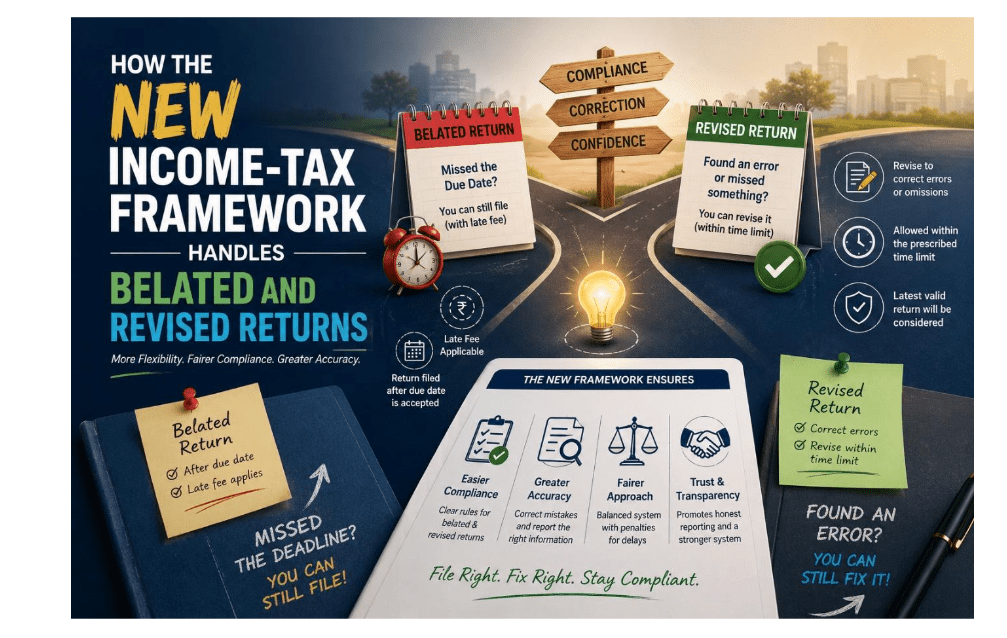
What A Belated Return Actually Is
Think of a belated return as your backup option when you’ve missed the original due date. Nothing dramatic about it — it’s the return the law allows once that first deadline has come and gone. It still needs to be filed by a fixed cut-off, though. For most individual taxpayers, that cut-off is December 31 of the assessment year, or before the assessment gets completed, whichever happens first. For businesses that go through a tax audit, that window ends earlier, around September 30.
It’s worth remembering that a belated return isn’t a free pass, either. Depending on your income level, a late fee usually applies, along with interest on any tax that’s still due. And if you’ve got business or capital losses to carry forward, filing late can cost you that ability, so it’s genuinely better to file on time whenever you can manage it.
Where Revised Returns Come In
Revised returns work differently. Say you already filed your return — on time or as a belated one, doesn’t matter — and a few weeks later you spot something wrong. Maybe you forgot to add bank interest, or a capital gain slipped through the cracks. That’s when you’d revise. Once you do, your new filing takes over completely and the old one no longer counts. There isn’t a hard limit written into the law on how many times you can go back and revise, but sending in revision after revision does tend to draw the assessing officer’s attention, so it’s not something to treat casually.
This is actually where one of the bigger changes shows up. The revised return window used to run for nine months from the end of the tax year. Under the new framework, that’s been stretched to a full twelve months. For income earned in FY 2025-26, for example, the revised return deadline moves from December 31, 2026 out to March 31, 2027. That extra three months exists for a pretty practical reason — a lot of taxpayers were finding that their nine-month window kept closing before their full Annual Information Statement data had even come through, which made correcting a return properly a lot harder than it needed to be.
One small catch to know about — if you file your revised return during that extended three-month window, a fee now applies. So the window is genuinely longer, but there’s a cost attached to using the extra time, which is worth factoring in if you’re deciding when to file.
And What Happens If You Miss Both Deadlines
If both the belated and revised return windows close and you still discover an error, you’re not completely out of options. That’s what an Updated Return, or ITR-U, is for. It’s meant for situations where a taxpayer wants to voluntarily fix an omission after the earlier deadlines have already passed, and it comes with additional tax owed on top of whatever you originally underpaid.
This window has also been extended quite a bit — it used to run for 24 months, and it’s now been pushed out to 48 months from the end of the relevant tax year. That’s a much longer runway to fix a genuine mistake. The trade-off is the additional tax, which scales up the longer you wait, running across four slabs from 25% up to 70% of the extra tax and interest owed. So it’s there as a safety net, but it’s clearly designed to reward filing sooner rather than later. It’s also worth knowing that an Updated Return generally can’t be used to claim a bigger refund or reduce your tax liability — it’s meant for disclosing more income, not less.
A Transition Point Worth Knowing
Since the Income-tax Act, 2025 only came into force on April 1, 2026, there’s a bit of a split depending on which year you’re dealing with. Anything relating to tax years before that date still runs under the old Act’s rules and section numbers. Returns for AY 2025-26 or earlier, for instance, needed their belated or revised filing window closed out before April 1, 2026 — that window doesn’t carry over into the new Act at all. From Tax Year 2026-27 onward, though, it’s the new Act’s provisions that apply, and the section numbers have shifted along with it, so it’s worth double-checking which set of rules actually governs the year you’re filing for before you file anything.
Bottom Line
The core idea behind belated, revised, and updated returns hasn’t changed — they’re still there to give taxpayers a way to file late, fix a mistake, or correct an omission after the fact. What has changed is the timing. Revised returns now get three extra months, and Updated Returns get a much longer four-year window instead of two. Both changes are aimed at giving taxpayers more breathing room to get things right, even if it does mean an extra fee or a bit more tax the longer you wait to fix things.
References
[1] Income Tax Department, Government of India. (2026). Income Tax Returns — Help Centre.
https://www.incometax.gov.in/iec/foportal/help/all-topics/e-filing-services/income-tax-returns
[2] IncorpX. (2026, April 1). Revised Return Extended to 12 Months: IT Act 2025.
https://www.incorpx.io/blog/revised-return-12-months-new-income-tax-act
[3] ClearTax. (2026, May 28). Belated Return: Section 139(4), Penalty, How to File Belated Income Tax Return After Due Date.
https://cleartax.in/s/how-to-file-income-tax-return-for-last-years
- Proofreading Report
- Plagiarism Report
- AI Detection Report
*
Frequently Asked Questions
What is the new deadline for filing a revised return for AY 2026-27?
The revised return window has been extended up to March 31, 2027, or before the completion of the assessment, whichever is earlier [cite: 1.2.1].
Is there a penalty for filing a revised return late?
There is no extra fee if filed by December 31, 2026, but filing between January 1 and March 31, 2027, attracts a new fee under Section 234I of up to ₹5,000 [cite: 1.2.1].
Can I file a revised return if my original return was processed and I received a refund?
Yes, receiving a refund does not prevent you from filing a revised return to report an omission or claim a missed deduction within the prescribed time limit [cite: 1.1.5].
What is the time limit for filing an Updated Return (ITR-U)?
The window for filing an ITR-U has been extended to a maximum of 48 months from the end of the relevant assessment year [cite: 1.2.2].
Can an Updated Return (ITR-U) be used to claim a missed refund?
No, an Updated Return cannot be used to claim a new refund or increase an existing refund [cite: 1.2.2]. It is primarily for declaring additional taxable income [cite: 1.2.2].
Can I carry forward my business or capital losses if I file a belated return?
No, if you file a belated return after the original due date, you generally lose the ability to carry forward business or capital losses to future years.
How many times am I allowed to file a revised return?
There is no hard statutory limit on the number of times you can file a revised return within the open window, but submitting multiple revisions may draw unwanted scrutiny from the assessing officer.
What is the strict deadline for filing a belated return for individual taxpayers?
For most individuals, the cut-off for a belated return is December 31 of the assessment year, or before the assessment is completed by the tax department—whichever happens first.
Can I use an Updated Return (ITR-U) to correct an error that would reduce my overall tax liability?
No, the Updated Return (ITR-U) is strictly for disclosing additional income; it cannot be used to claim a larger refund or reduce your overall tax liability.
Do these new deadlines apply if I am fixing an error for Assessment Year 2025-26?
No, the new framework under the Income-tax Act, 2025 only applies from Tax Year 2026-27 onward. Returns for AY 2025-26 and earlier are governed by the older rules and deadlines.
Citations & References
[1] Income Tax Department, Government of India. (2026). Income Tax Returns — Help Centre.
https://www.incometax.gov.in/iec/foportal/help/all-topics/e-filing-services/income-tax-returns
[2] IncorpX. (2026, April 1). Revised Return Extended to 12 Months: IT Act 2025.
https://www.incorpx.io/blog/revised-return-12-months-new-income-tax-act
[3] ClearTax. (2026, May 28). Belated Return: Section 139(4), Penalty, How to File Belated Income Tax Return After Due Date.
https://cleartax.in/s/how-to-file-income-tax-return-for-last-years
Connect Your Brand with Gen-Z
Unlock high-impact youth marketing strategies with EvePaper.
Book Strategy Call