
Why Inter-College Events Are Becoming More Attractive to Student Communities
Published: September 13, 2026
Key Strategy Takeaways
- Use inter-college events to break the regular college routine and give students new experiences and challenges.
- Create opportunities for students to build connections with people from different colleges, courses, and backgrounds.
- Give students platforms to showcase their talents through cultural events, hackathons, debates, sports, and competitions.
- Focus on practical skill development such as teamwork, communication, leadership, coordination, time management, and problem-solving.
- Use healthy competition to encourage improvement by exposing students to different strategies, skill levels, and approaches.
- Make events accessible and offer different ways to participate through competitions, workshops, volunteering, networking, performing, and organizing roles.
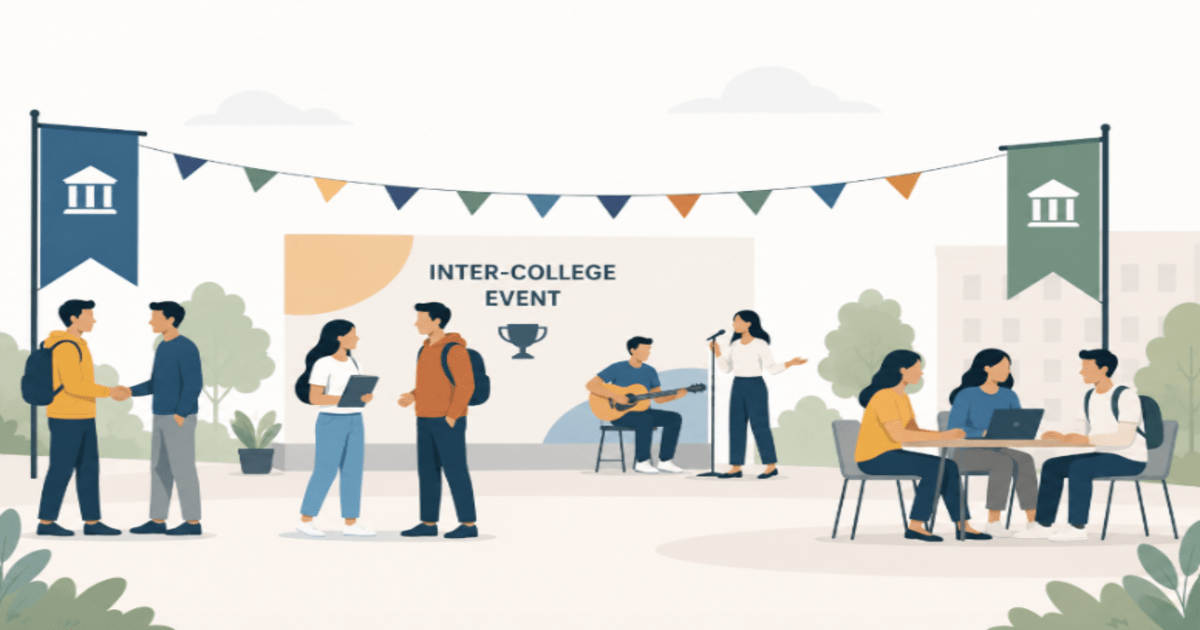
Key Strategy Takeaways
- Use inter-college events to break the regular college routine and give students new experiences and challenges.
- Create opportunities for students to build connections with people from different colleges, courses, and backgrounds.
- Give students platforms to showcase their talents through cultural events, hackathons, debates, sports, and competitions.
- Focus on practical skill development such as teamwork, communication, leadership, coordination, time management, and problem-solving.
- Use healthy competition to encourage improvement by exposing students to different strategies, skill levels, and approaches.
- Make events accessible and offer different ways to participate through competitions, workshops, volunteering, networking, performing, and organizing roles.
Why Inter-College Events Are Becoming More Attractive to Student Communities
College life gets imagined as this routine loop — lectures, assignments, exams, repeat. But honestly, the stuff students remember years later usually happens outside that loop entirely.
An inter-college event throws students from completely different institutions into the same auditorium, sports ground, or competition hall. They show up as competitors, performers, or volunteers, and they leave having met people they’d genuinely never have crossed paths with otherwise. That’s basically the whole appeal in a nutshell.
Whether it’s cultural fests, debate competitions, hackathons, sports tournaments, or business case competitions — these events create a much wider social world than anything happening on a single campus. Research backs this up too — a 2025 study covering nearly 28,000 students across 148 U.S. institutions found that students who participated in activities had noticeably higher belonging scores than those who didn’t, across pretty much every category of activity. For inter-college events specifically, that opens up something interesting — students end up building connections not just within their own campus, but across campuses entirely.
It’s a Genuine Break From the Routine
One of the simplest reasons these events pull students in is just… they break the pattern. Same classrooms, same faces, same predictable timetable — college can start feeling repetitive fast. An event at another campus throws in new faces, unfamiliar environments, different challenges. A student who spends most days sitting through lectures might suddenly find themselves prepping for a debate or performing on someone else’s stage — and that shift alone makes the whole thing feel exciting. It also gives students a shot at using skills that regular coursework never really touches.
You Meet People You’d Never Otherwise Cross Paths With
An inter-college event naturally widens your social circle in a way your own campus can’t. Instead of just classmates and society members, you’re suddenly meeting an engineering student at a business competition, or a design student during a cultural event. People swap thoughts on courses, career plans, competitions, internships, whatever comes up. Not every conversation turns into a lasting friendship, sure — but the sheer opportunity for it matters. A 2026 scoping review on student belonging describes it as being built from exactly this — social connections, participation, and a genuine sense of membership — and inter-college events stretch that experience beyond just one institution’s walls.
You’re Exposed to Completely Different Ways of Thinking
Every college has its own unspoken culture — how it runs events, how it approaches competition. Meet students from other colleges, and suddenly you’re seeing different approaches everywhere — a team solving the same problem completely differently, a theatre group with a totally different style, a business team pitching an idea in a way you’d never have considered. This is especially valuable when events lean toward collaboration instead of pure competition — instead of just asking “how do we win,” students start asking “what can we actually learn from how that other team approached this?” That shift alone turns a competition into a genuine learning experience.
A Stage for Talents That Never Show Up in Class
Not every student gets to show their real strengths through exams. Someone might be a phenomenal singer, coder, designer, or speaker without any of that ever surfacing in a lecture hall. Inter-college events hand these students an actual platform — a cultural fest gives performers an audience, a coding contest gives programmers something real to solve, a debate gives sharp speakers a stage. And even without winning, just going through the experience builds something valuable — proof to yourself that you can perform in a completely unfamiliar setting.
The Learning Happens Behind the Scenes Too
There’s usually way more going on than what happens on stage. Someone’s preparing, dividing responsibilities, managing deadlines, coordinating with organizers, solving last-minute chaos. It’s basically real-world project work in miniature — plan, communicate, coordinate, solve problems, deliver. Research on extracurricular involvement keeps linking this kind of participation to stronger belonging and genuine skill development, so the learning here doesn’t really stop when the event ends.
Healthy Competition Pushes You to Actually Get Better
Competing against the same classmates every time gets predictable fast. Competing against a completely different institution changes the game — suddenly you’re up against a team with a different level of prep, a different strategy, maybe a strength you hadn’t even considered. Done right, this pushes better preparation, more discipline, sharper creativity, and real resilience. Losing one round doesn’t mean you lack ability — it usually just shows you where more practice is needed.
Representing Your College Builds Real Pride
There’s something genuinely different about wearing your college’s identity at someone else’s event. You’re not just competing as yourself anymore — you’re representing your whole campus in a small way, and that creates real pride. Students cheer for their team, support performers, pitch in with prep — and these shared moments end up strengthening bonds within your own college just as much as they build connections outside it. It’s community-building on two fronts at once.
Competition Often Hides Real Collaboration
The word “competition” can be misleading — a lot of these events involve real collaboration too. Colleges might team up for a workshop, a cultural exchange, or a joint project. Bigger events often need student organizers from multiple institutions working together, which forces people with completely different working styles to actually communicate and divide things up — a skill that matters way beyond college.
It Builds Real Confidence Over Time
Walking into an unfamiliar college and introducing yourself to strangers can genuinely feel intimidating. But doing it repeatedly makes it easier — first you volunteer for a small role, then you compete, eventually maybe you’re organizing the whole thing yourself. Each round adds a layer of comfort with the unfamiliar, and research on belonging consistently links this kind of active participation with students feeling more genuinely connected to their environment.
The Connections Often Outlast the Event Itself
The event lasts a day. The relationships don’t have to. Students who meet at a competition sometimes end up collaborating on a project later, or discover a shared creative interest, or stay in touch through future competitions entirely. Because student communities aren’t static — people graduate, switch courses, move on — these cross-campus connections give students a genuinely broader network to lean on long after the event’s over.
What Colleges Can Actually Do to Make This Work Better
Just running more events isn’t enough — the quality of participation is what actually matters. Colleges do this well when they offer a real range of ways to get involved: competitions across different skill levels, cultural events, academic challenges, sports, workshops, volunteering, and organizing roles — plus making sure it’s affordable and accessible. Some students want to perform, others want to organize, some love competing, others just want to network. A broader range of roles means more students actually find a way in that fits them.
The Bigger Picture
Inter-college events end up being more than a shot at winning a trophy — they become temporary meeting points where entirely different student worlds overlap. A commerce student bumps into a designer. A computer science student meets an entrepreneur. A first-year meets a senior from a completely different university. Some of these encounters fade. Some turn into friendships, collaborations, or just a shifted perspective that sticks around long after graduation.
The Bottom Line
Inter-college events have become such an attractive part of student life because they offer something the regular classroom routine simply can’t — new people, new ideas, new challenges, and real opportunities to represent your college and build practical skills alongside people you’d never otherwise meet. Most importantly, they teach students something simple but important — that community doesn’t have to end at your own campus’s gate.
Honestly, the real win here probably isn’t even the trophy sitting on someone’s shelf. It’s more likely the random person you got talking to in the queue, the skill you didn’t know you had until you were forced to use it, the confidence that quietly showed up somewhere between all the nervousness, or the collaboration that only happened because two colleges decided, for one day, to just show up in the same room. At the end of it all, these events were never really just about competing across campuses — they were always about connecting them.
References:
[1] Journal of American College Health — Activity Participation & Belonging
[2] Taylor & Francis — Extracurricular Activities & Belonging
[3] Taylor & Francis — Student Participation & Belonging
[4] Taylor & Francis — 2026 Higher-Education Belonging Review
Frequently Asked Questions
Why are inter-college events becoming popular among students?
Inter-college events offer students new people, new ideas, different challenges, and opportunities to participate outside their regular college routine.
What are some examples of inter-college events?
Examples include cultural fests, debate competitions, hackathons, sports tournaments, and business case competitions.
How do inter-college events help students meet new people?
Students from different colleges participate in the same event, giving them opportunities to make friends, share ideas, and build connections.
How do inter-college events provide a break from college routine?
They take students away from their usual classrooms and schedules and introduce them to new campuses, people, environments, and challenges.
Can inter-college events help students discover their talents?
Yes. Students can showcase talents such as singing, coding, designing, speaking, performing, and problem-solving that may not appear through regular coursework.
What skills can students develop through inter-college events?
Students can develop teamwork, communication, leadership, time management, coordination, problem-solving, and organizational skills.
How does healthy competition benefit students?
Competing against students from different colleges can encourage better preparation, creativity, discipline, and resilience.
How do inter-college events build college pride?
Students represent their college while competing or performing, which can create a sense of pride and strengthen bonds within their own college community.
Can inter-college events lead to long-term connections?
Yes. Students may continue friendships, collaborations, creative projects, or professional connections after the event ends.
What can colleges do to make inter-college events more successful?
Colleges can provide different types of competitions, cultural events, workshops, sports, volunteering, and organizing roles while keeping participation affordable and accessible.
Transform Your Brand’s Engagement with India’s Youth
Drive massive brand engagement with 10 million+ college students across 3,000+ premier institutions, both online and offline. EvePaper is India’s leading youth marketing consultancy, connecting brands with the next generation of consumers through innovative, engagement-driven campaigns. Know More.
Mail us at [email protected]
Connect Your Brand with Gen-Z
Unlock high-impact youth marketing strategies with EvePaper.
Book Strategy Call