
International Scholarships for Indian Students: 5 Key Funding Options
Published: October 11, 2026
Key Strategy Takeaways
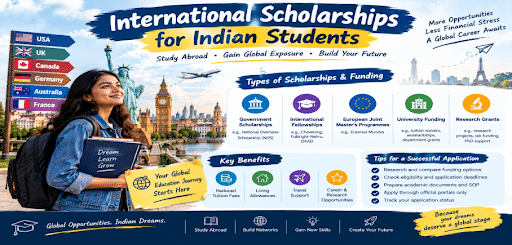
- - Explore government scholarships, international fellowships, and university awards.
- - Compare tuition coverage, living allowances, travel support, and eligibility.
- - Use official portals to identify genuine opportunities and deadlines.
- - Prepare strong academic documents and a clear statement of purpose.
- - Check whether research assistantships and departmental grants are available.
- - Verify all funding conditions before accepting an admission offer.
Key Strategy Takeaways
- – Explore government scholarships, international fellowships, and university awards.
- – Compare tuition coverage, living allowances, travel support, and eligibility.
- – Use official portals to identify genuine opportunities and deadlines.
- – Prepare strong academic documents and a clear statement of purpose.
- – Check whether research assistantships and departmental grants are available.
- – Verify all funding conditions before accepting an admission offer.
International Scholarships for Indian Students
International scholarships for Indian students can help reduce the financial burden of studying abroad by covering tuition fees, living expenses, travel, and other eligible educational costs. Government-sponsored schemes, international fellowships, European joint master’s programmes, and university funding offer different opportunities for eligible applicants. Students should compare scholarship coverage, eligibility criteria, and application deadlines before choosing suitable programmes.Image Source ChatGpt
Abstract— studying abroad offers Indian students opportunities to gain international exposure, specialised knowledge, and access to global research networks. However, tuition fees, living expenses, travel, and insurance can make overseas education financially challenging. International scholarships, study-abroad grants, and university-funded awards can reduce these barriers. This article examines five important funding pathways for Indian students, including government scholarships, international fellowships, European joint master’s programmes, university funding, and research grants. It also outlines practical steps for identifying suitable opportunities and preparing competitive applications.
Keywords— International Scholarships Indian Students, Study Abroad Grants, Foreign University Funding, Higher Education, Global Education, Research Fellowships.
I. INTRODUCTION
Studying abroad is a significant investment in a student’s academic and professional future. Countries such as the United States, United Kingdom, Germany, France, and Japan attract Indian students through specialised programmes, research facilities, and international learning environments.
However, admission to a foreign university does not automatically guarantee financial assistance. Students must research funding options alongside university applications.
The Indian government’s National Overseas Scholarship and international programmes such as Chevening and Erasmus Mundus provide different pathways for eligible students to pursue higher education abroad. Understanding their coverage and eligibility can help students plan realistically.
II. RESEARCH ANALYSIS
A. Explore Government-Sponsored Scholarships
Government scholarships can cover substantial educational expenses, depending on the programme.
The National Overseas Scholarship (NOS), administered by India’s Ministry of Social Justice and Empowerment, supports eligible low-income students from specified marginalised communities pursuing master’s or Ph.D. degrees abroad. The scheme allocates 125 scholarships annually, including 115 for Scheduled Caste candidates and designated slots for other eligible groups.
Students should review the official eligibility conditions, income limits, approved courses, and selection requirements before applying.
B. Consider International Fellowships
Several foreign governments offer scholarships to students from India.
Chevening Scholarships (UK): Support eligible students pursuing one-year master’s degrees, with funding that includes tuition, living expenses, and other eligible costs. The 2027–28 application cycle is open until October 6, 2026.
Fulbright-Nehru Fellowships (USA): Support eligible Indian students and professionals pursuing selected master’s programmes, research, and academic exchange opportunities. Applicants should consult USIEF for India-specific eligibility and application requirements.
DAAD Scholarships (Germany): Provide funding opportunities for graduates, doctoral candidates, and researchers across selected disciplines. The DAAD scholarship database allows applicants to search by destination, subject, and academic status.
These programmes may consider academic performance, professional experience, leadership, research interests, and future goals, depending on the award.
C. Look at European Joint Master’s Programmes
Erasmus Mundus Joint Master’s programmes offer students an opportunity to study at multiple participating universities in different countries.
Scholarships are available for selected programmes and can contribute towards participation costs and living expenses. Students should identify eligible courses through the official European Commission catalogue and review each programme’s admission and scholarship deadlines.
For students interested in international exposure and interdisciplinary learning, these programmes combine academic study with experience across different education systems.
D. Check University Funding and Research Grants
Foreign universities may offer merit-based scholarships, tuition waivers, graduate assistantships, teaching assistantships, and research funding.
For research-focused master’s or doctoral programmes, departments may provide funding through grants, laboratories, or funded research projects. Availability depends on the university, subject, supervisor, and admission offer.
Students should examine the funding section of each university’s official website and ask whether awards cover tuition only or also include accommodation, insurance, travel, and living expenses.
A scholarship described as fully funded should still be checked against its actual award conditions and the cost of living in the destination.
E. Prepare a Competitive Application
A successful application begins with careful planning. Students should prepare academic transcripts, recommendation letters, a statement of purpose, language-test results where required, and a research proposal for relevant programmes.
The statement of purpose should explain why the course is suitable, how the student’s experience connects with the programme, and what they intend to contribute after graduation.
Applicants should maintain a deadline calendar and apply only through verified scholarship or university portals. They should also check whether the award permits simultaneous funding from other sources.
III. CONCLUSION
International scholarships can make overseas education more accessible to Indian students by reducing tuition and living costs and supporting academic development.
The most practical approach is to research opportunities early, compare funding coverage, understand eligibility, and prepare a focused application. Students should treat scholarship research as an essential part of study-abroad planning rather than a last-minute activity.
IV. KEY TAKEAWAYS
Explore government scholarships, international fellowships, and university awards.
Compare tuition coverage, living allowances, travel support, and eligibility.
Use official portals to identify genuine opportunities and deadlines.
Prepare strong academic documents and a clear statement of purpose.
Check whether research assistantships and departmental grants are available.
Verify all funding conditions before accepting an admission offer.
Frequently Asked Questions
Citations & References
[1] Ministry of Social Justice and Empowerment, Government of India, “National Overseas Scholarship for SC etc. Candidates,” 2026. [Online]. Available: https://socialjustice.gov.in/schemes/28
[2] Chevening, “Chevening Scholarships: India,” 2026. [Online]. Available: https://www.chevening.org/scholarship/india/
[3] United States-India Educational Foundation, “Fulbright-Nehru Fellowships.” [Online]. Available: https://www.usief.org.in/
[4] German Academic Exchange Service (DAAD), “Scholarship Database—DAAD India.” [Online]. Available: https://www.daad.in/en/find-funding/scholarship-database/
[5] European Commission, “Erasmus Mundus Joint Masters.” [Online]. Available: https://erasmus-plus.ec.europa.eu/opportunities/opportunities-for-individuals/students/erasmus-mundus-joint-masters
[6] Campus France India, “Scholarships for Indian Students.” [Online]. Available: https://www.inde.campusfrance.org/scholarships-for-indian-students
Connect Your Brand with Gen-Z
Unlock high-impact youth marketing strategies with EvePaper.
Book Strategy Call