
7 Powerful Ways Data Analytics Is Helping Brands Understand Student Buying Behaviour
Published: October 7, 2026
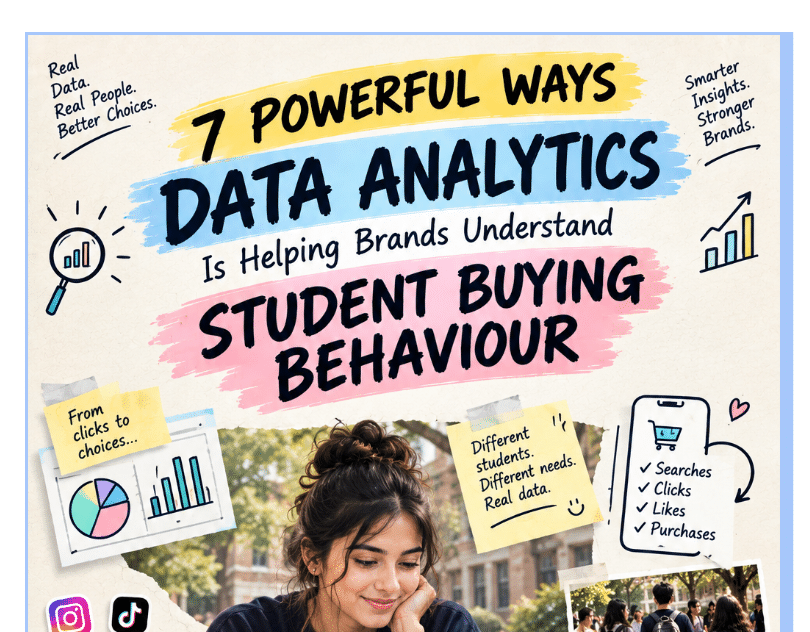
marketing analytics
Although students may appear to be a single large consumer group to an outside observer, brands are finding that they are by no means uniform. For example, a college student who is buying skincare, another who is looking for cheap food and a third one who is spending money on sneakers may all have entirely different reasons for making their purchases.
That’s where data analytics comes in.
Rather than depending solely on assumptions regarding young consumers, companies can now examine search patterns, purchase histories, their behaviour on websites, interactions on social media, reviews and all other customer signals in order to find out what students really want. This change is especially beneficial for brands that are aiming at younger consumers since Gen Z finds it easy to move between online discovery, social media, physical stores and digital payments.
A study carried out by Google in 2025 into Gen Z in India revealed that 79% of Indian Gen Z consumers use Google and/or YouTube every day, demonstrating the growing importance of digital discovery in the consumer journey.
- The data reveals what students really buy.
A simple application of data analytics is to examine purchasing patterns.
A brand that is aiming to sell products to college students might think that price is the main consideration. However, sales data could show a different situation: it’s possible that students are willing to pay more for better quality in some areas, while still being very sensitive to price in others.
This distinction matters.
A study carried out in 2026 among Indian Gen Z consumers discovered that product quality was the main factor influencing purchases for 43 per cent of the respondents, compared with price which accounted for 20 per cent.
For brands, information of this kind can have an effect on all aspects such as product development, pricing, and advertising.
- Brands can find different student groups
The group consisting of college students is not in fact a single customer segment.
A first-year student who lives in a hostel could have quite different spending habits to a final-year student who earns money by working part-time. Students in Delhi might also act differently from students in smaller cities.
Data analytics enables brands to identify these differences.
By taking into account how often customers make purchases, the amount they spend on average, the product categories they buy, their location and their online behaviour, companies are able to form smaller groups of customers. Rather than sending the same offer to all customers, a brand could adapt its communications to different segments.
It allows marketing to become more relevant without assuming that all young consumers want the same things.
- Data obtained through search activities can show what students want.
There are instances when consumers tell brands what they would like without speaking directly to them.
They carry out these actions by means of their searches.
Students could look for things such as “the best budget laptop for college”, “affordable skincare for students”, “the best cafés near campus” or “formal clothes for internship”. If there are thousands of similar searches, these can show what patterns exist in consumer interest.
According to Google’s research, members of India’s Gen Z group are very active when using search engines and employ the service to find out information and look at different options rather than just taking in what is displayed before them.
Using this information, brands will be able to gain an understanding of emerging demand and then develop products, content or campaigns in response to real questions.
- Social Media Data Is Useful For Monitoring Changing Trends
For students, trends can change very rapidly.
A product which goes completely unnoticed one month can suddenly be all over the place a few months later thanks to some popular videos. Brands can use data analytics to keep an eye on such changes by looking at engagement, searches, mentions, comments and other signals.
It doesn’t follow that every viral trend will result in sales.
In fact, recent research indicates that members of Gen Z might make heavy use of social media when discovering products while still depending on other sources to check whether or not a product is worth buying. A consumer study carried out by McKinsey in 2026 showed that social media was an important source throughout Gen Z’s process of discovering and purchasing products, but trust in both social media and AI remained fairly low when compared to a number of offline sources.
What this implies for brands is that attention and purchase intent must not be regarded as identical.
- Buying Data Can Improve Personalisation
Picture two students going to the same online store.
One often buys sportswear while the other continually looks at skincare products.
It would be rather pointless to show both customers the same recommendations.
Data analytics enables brands to gain an understanding of their past interactions and then use that understanding to make their recommendations, offers, and communications more relevant.
Personalisation must be dealt with carefully since research involving Gen Z has uncovered a “personalisation paradox” – that is, young consumers can appreciate relevant personalised content even as they feel uncomfortable about excessive data collection and tracking.
The objective is not to make use of all the data that is available, but to use relevant information responsibly.
- Analytics Can Show Where Students Drop Off
A student can go to a website, have a look at a product, put it in their cart and then without buying it leave.
For a brand the journey has useful information.
Analytics can indicate the points at which potential customers cease to engage. For example, if thousands of students abandon their carts after viewing the delivery charges, the problem might not lie with the product itself. Likewise, if users leave right after opening a certain page, the issue could be unclear information or bad design.
Because of these insights brands are able to test changes instead of just guessing.
The actual behaviour of customers can then be used to evaluate small changes made to the pricing, the website design, the payment options or the communication.
- Data Enables Brands to Progress From Trends to Better Decisions
One of the main benefits of data analytics is that it is able to turn dispersed customer actions into a more clear image.
A company might observe that students are searching more often for a product, talking about it on social media and keeping on visiting its website. If all of these signs are present, then the company has stronger evidence that interest is increasing.
This is especially valuable in a market where Gen Z’s preferences can change quickly.
Research into Indian Gen Z consistently shows that this group of consumers places importance on authenticity, personal relevance and value rather than merely adhering to traditional notions of brand prestige. As the 2025 ET-Snapchat Gen Z Index demonstrated, the purchasing decisions of Indian Gen Z are influenced by authenticity, value and personal meaning.
What Data Analytics Cannot Tell Brands
Data can tell us what students are doing, but it doesn’t always explain why.
A drop in sales might be due to price, competition, changes in preferences, bad reviews or something entirely unrelated. While the figures can show what the pattern is, surveys, interviews, reviews and direct conversations can be used to understand it.
That is the reason why the best method is not to rely on data against human research.
It is data plus human understanding.
The Future of Understanding Student Buying Behaviour
Because more and more students are moving from search engines to social platforms, e-commerce websites, physical stores and digital payment systems, the signals generated as part of their buying journey have never been greater.
The problem facing brands is that it has moved beyond merely gathering information to involving knowing which of that information is actually important.
Data analytics can be used to identify patterns, segment customers, monitor changing interests and enhance marketing decisions. However, the final aim is not to convert students into figures on a dashboard; rather, it is to use those figures to gain a better understanding of real people.
Since each click, search, and purchase is made by a student who is acting on the basis of a reason, those brands which understand that reason are far more likely to produce products and experiences that students really want.
References
- Google, “Gen Z trends & search behaviour in India,” Think with Google APAC, 2025. Think with Google – Gen Z trends & search behaviour in India
- Business Today, “The Gen Z Consumer: Beyond Cliches,” 2026. Business Today – The Gen Z Consumer
- McKinsey & Company, “From likes to buys,” 2026. McKinsey – From likes to buys
- McKee et al., “Gen Z’s personalization paradoxes: A privacy calculus examination of digital personalization and brand behaviors,” Journal of Consumer Behaviour, 2024. Wiley – Gen Z’s personalization paradoxes
- The Economic Times, “ET Snapchat Gen Z Index: How Gen Z is changing shopping, careers and brand loyalty in India,” 2026. Economic Times – ET Snapchat Gen Z Index
20 Key Takeaways on Marketing Analytics and Student Buying Behaviour
- Marketing analytics helps brands understand what students actually buy instead of relying on assumptions about young consumers.
- Brands can use marketing analytics to identify whether students prioritise price, product quality, convenience, or brand value.
- Student consumers are not a single homogeneous group, making customer segmentation an important part of marketing analytics.
- Marketing analytics can identify differences in buying behaviour based on age, location, spending patterns, interests, and product preferences.
- Search data provides valuable insights into what students are actively looking for before making a purchase.
- Brands can use marketing analytics to identify emerging student trends from search behaviour and online activity.
- Social media analytics helps companies monitor mentions, engagement, comments, searches, and changing consumer interests.
- High social media engagement does not necessarily mean that a student is ready to purchase a product.
- Marketing analytics can help brands connect product discovery with purchase behaviour across multiple channels.
- Purchase-history data enables brands to provide more relevant product recommendations and offers.
- Effective personalisation requires brands to balance relevance with consumer privacy and responsible data use.
- Marketing analytics can reveal where students abandon their shopping journeys.
- Cart abandonment data can help brands identify problems with pricing, delivery charges, website design, or payment options.
- Analytics allows brands to test changes to their websites and marketing campaigns rather than making decisions based only on assumptions.
- Combining search, social media, website, and purchase data can give brands a more complete picture of student demand.
- Marketing analytics can help companies distinguish between a temporary trend and sustained consumer interest.
- Data can reveal what students do, but it cannot always explain why they do it.
- Surveys, interviews, reviews, and direct customer feedback should complement marketing analytics.
- The most effective approach is to combine data-driven insights with human understanding.
- The future of student marketing will increasingly depend on using marketing analytics to create relevant, valuable, and authentic customer experiences.
30 FAQs About Marketing Analytics and Student Buying Behaviour
1. What is marketing analytics?
Marketing analytics is the process of collecting and analysing marketing and customer data to understand consumer behaviour and improve marketing decisions.
2. How does marketing analytics help brands understand students?
Marketing analytics allows brands to study students’ searches, purchases, website activity, social media interactions, and other customer signals to identify preferences and buying patterns.
3. Why is marketing analytics important for student marketing?
Students have diverse needs and purchasing motivations. Marketing analytics helps brands understand these differences instead of treating all students as one customer group.
4. What data can brands use for marketing analytics?
Brands can analyse purchase histories, search behaviour, website interactions, social media engagement, customer reviews, location data, and other relevant customer signals.
5. How does marketing analytics identify student buying behaviour?
It identifies recurring patterns in what students search for, view, purchase, abandon, review, and engage with across different channels.
6. Can marketing analytics show what students value when buying products?
Yes. Purchase and customer data can help brands identify whether different student groups place greater importance on factors such as quality, price, convenience, or relevance.
7. How does marketing analytics help with customer segmentation?
It allows brands to group students according to characteristics such as purchasing frequency, spending levels, product interests, location, and online behaviour.
8. Why should brands segment student consumers?
Students have different lifestyles, budgets, interests, and purchasing needs. Segmentation enables brands to create more relevant marketing messages and offers.
9. How can search data support marketing analytics?
Search behaviour can reveal the products, services, questions, and problems that students are actively interested in solving.
10. What can student search behaviour tell marketers?
It can indicate emerging demand, popular product categories, purchase considerations, and questions students have before making buying decisions.
11. How does social media contribute to marketing analytics?
Social media provides signals such as engagement, comments, mentions, searches, and content interactions that can help brands monitor changing interests and trends.
12. Does social media engagement always indicate purchase intent?
No. A student may engage with or discover a product on social media without necessarily intending to purchase it.
13. How can marketing analytics help identify trends?
Brands can compare changes in searches, purchases, website visits, social engagement, and other signals to determine whether interest in a product or category is increasing.
14. What is personalisation in marketing analytics?
Personalisation involves using relevant customer information to provide more appropriate recommendations, offers, content, or communications to individual customers or segments.
15. How does purchase data improve personalisation?
Past purchases and interactions can indicate a customer’s interests, allowing brands to recommend products and offers that are more relevant to their previous behaviour.
16. What is the personalisation paradox?
The personalisation paradox refers to the situation in which consumers appreciate relevant personalised experiences while also becoming concerned about excessive data collection and tracking.
17. How can brands use marketing analytics responsibly?
Brands should collect and use relevant data transparently, respect privacy, avoid unnecessary tracking, and focus on information that genuinely improves the customer experience.
18. How does marketing analytics help reduce cart abandonment?
It can identify where customers leave the buying journey, helping brands investigate issues such as delivery costs, payment options, pricing, website design, or unclear information.
19. What is customer journey analytics?
Customer journey analytics examines how consumers interact with a brand across different stages, from discovery and research to purchase and post-purchase engagement.
20. Can marketing analytics improve website performance?
Yes. Brands can analyse user behaviour to identify pages or stages where visitors encounter problems and then test improvements to the website experience.
21. Can marketing analytics predict student purchasing behaviour?
It can identify patterns and help estimate likely behaviour, but predictions are not guaranteed because consumer preferences can change quickly.
22. What are the limitations of marketing analytics?
Data can show patterns but may not explain the underlying reasons. External factors, changing preferences, competition, reviews, and other influences can affect consumer behaviour.
23. Why should brands combine analytics with customer research?
Surveys, interviews, reviews, and conversations can provide context that behavioural data alone may not reveal.
24. How can marketing analytics support product development?
Brands can use customer searches, purchases, reviews, and behavioural patterns to identify unmet needs and opportunities for new or improved products.
25. How does marketing analytics improve marketing campaigns?
It helps brands understand which audiences, messages, channels, and offers generate stronger engagement and conversions.
26. Can marketing analytics help brands understand Gen Z?
Yes. By analysing digital behaviour, purchasing patterns, searches, social interactions, and customer feedback, brands can develop a more evidence-based understanding of Gen Z consumers.
27. Why is authenticity important when marketing to students?
Students may respond more positively to brands that provide genuine value and relevance rather than relying only on traditional ideas of brand prestige.
28. What is the difference between marketing analytics and customer research?
Marketing analytics primarily uses data and behavioural signals to identify patterns, while customer research often directly investigates consumer opinions, motivations, and experiences.
29. What is the best approach to understanding student buying behaviour?
The strongest approach combines marketing analytics with qualitative research, customer feedback, surveys, reviews, and direct conversations.
30. What is the future of marketing analytics in student marketing?
Marketing analytics is likely to become increasingly important as students move between search engines, social platforms, e-commerce sites, physical stores, and digital payment systems during their buying journeys.
One Marketing Question
How can marketing analytics help brands understand and respond to changing student buying behaviour?
Connect Your Brand with Gen-Z
Unlock high-impact youth marketing strategies with EvePaper.
Book Strategy Call