
How Colleges Are Using Marketing Automation to Manage the Admission Season
Published: October 6, 2026
Key Strategy Takeaways
- 1.Send an automated welcome email the moment a student submits an inquiry form, registers for an event or clicks an ad
- 2.Build a 3-week nurture sequence covering program info, campus life and financial aid, matched to each student's interests
- 3.Segment prospects by program interest and location so every message feels personal, not generic
- 4.Set automatic reminders for missing documents and application deadlines to reduce incomplete applications
- 5.Use chatbots to answer common questions about deadlines and financial aid at any hour
- 6.Connect your CRM with email, web analytics, event tools and the application portal so all student data lives in one place
- 7.Track source enrollment and engagement rates to see which channels bring in real applicants, then move budget to them
- 8.Automate admission and enrollment steps, including congratulations emails, financial aid offers and enrollment checklists
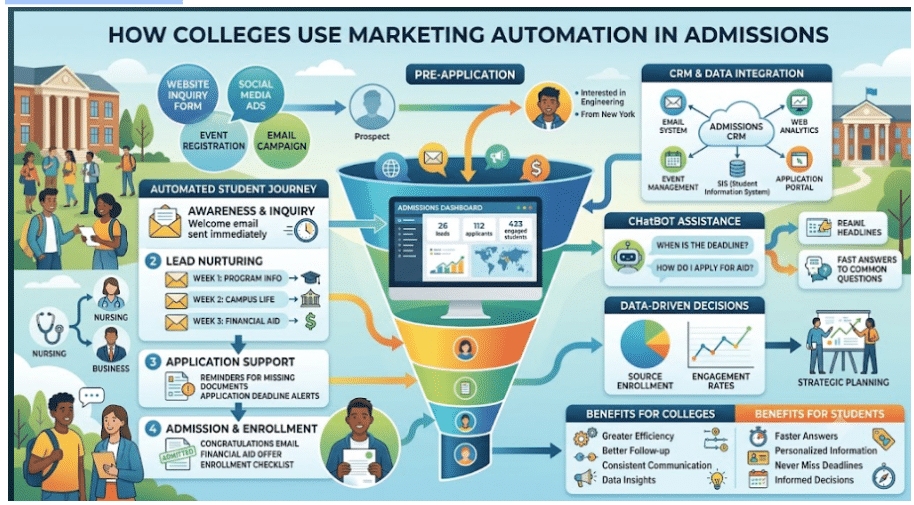
Key Strategy Takeaways
- 1.Send an automated welcome email the moment a student submits an inquiry form, registers for an event or clicks an ad
- 2.Build a 3-week nurture sequence covering program info, campus life and financial aid, matched to each student’s interests
- 3.Segment prospects by program interest and location so every message feels personal, not generic
- 4.Set automatic reminders for missing documents and application deadlines to reduce incomplete applications
- 5.Use chatbots to answer common questions about deadlines and financial aid at any hour
- 6.Connect your CRM with email, web analytics, event tools and the application portal so all student data lives in one place
- 7.Track source enrollment and engagement rates to see which channels bring in real applicants, then move budget to them
- 8.Automate admission and enrollment steps, including congratulations emails, financial aid offers and enrollment checklists
Introduction
For colleges and universities, admission season can be one of the busiest times of the year. Admission teams must handle thousands of prospective students, answer questions, promote programs, organize events, follow up on applications, and encourage enrolled students to complete enrollment. Furthermore, students now expect relevant, fast, and personalized communication.
Handling everything manually can get complicated. A prospective student who fills out an inquiry form today still needs to be contacted for a reply, provided with information about their program of choice, invited to an open house, reminded to apply, and given information on financial aid and enrollment. When hundreds or thousands of students are interacting with an institution, it can be challenging to keep track of everything.
This is where marketing automation has come to the rescue of higher education. By allowing colleges and universities to use technology to automate repetitive communication and marketing activities while using student data to make those interactions more personalized, marketing automation tools have been incredibly helpful. Instead of a uniform approach to communication, institutions can use software to target students based on things like academic interests, location, application status, interaction with the institution, and more.
Modern higher-education marketing technology can link marketing automation with CRM systems, admissions databases, websites, email, event systems, and analytics. It has led to an improved recruitment process, helping institutions guide students from their first inquiry through application and enrollment.
What Is Marketing Automation in Higher Education?
Marketing automation is the use of technology to automate, personalize, schedule, and measure marketing activities.
In the context of college admissions, it could mean that when a prospective student fills out a form requesting information about a business program, the following actions could be automatically triggered or assisted:
- Create a prospect record in the CRM.
- Send a confirmation email.
- Identify the program of interest.
- Add the student to an email list.
- Send information about the business program.
- Invite the student to a webinar or open house.
- Track if the student views the email or any other information.
- Remind an admissions counselor if the student engages strongly.
- Modify future communication based on student behavior.
Marketing automation, therefore, goes beyond just scheduling emails. It is a combination of data, communication, workflow, targeting, personalization, and measurement that together forms a connected recruitment process. The kinds of platforms used in higher education can include tools like Slate, Salesforce Education Cloud, Ellucian CRM Recruit, HubSpot, Element451, and others, with the particular recruitment technology varying from institution to institution. Some colleges might use more specific email platforms, or have to connect a variety of software together at different recruitment stages.
Why Marketing Automation Matters During Admission Season
- Admissions Teams Deal With Large Volumes of Prospects
Admissions season often means a spike in inquiries. Students can reach out to an institution through their website, social media, forms, ads, events, emails, and more. There is a lot of ground to cover in a short amount of time, and it can be overwhelming to keep up with.
One real-world example of this occurred at the University of San Diego, whose Knauss School of Business had days with hundreds of leads at a time who were interested in the business programs. This was overwhelming to the admissions team, who had to spend significant amounts of time manually following up with everyone. The university reported that they were able to scale up their outbound and email marketing efforts by using the CRM and email automation features of HubSpot.
Automation can solve this issue by automating repetitive first-level communication and allowing admissions counselors to spend their time on more meaningful one-on-one conversations. In addition, automation can help with keeping track of these conversations to avoid having the information become siloed somewhere.
- Students Expect Relevant Communication
If a student is interested in an engineering program, they may not be as interested in the same information as a student who has expressed interest in psychology or business.
Marketing automation allows institutions to segment prospects.
Some examples of this could be:
- Prospective students interested in a specific program or area of study.
- Undergraduate or postgraduate applicants.
- Domestic or international students.
- Students in a particular geographic region.
- Prospects at different stages of the recruitment funnel.
- Students who have attended particular events or engaged with the institution in specific ways.
- Students who have applied but have not yet enrolled.
Salesforce’s higher-education guidance recommends utilizing CRM data to segment prospects based on academic interests, demographics, location, extracurricular activities, and enrollment status. By dividing prospects into categories that have something in common, colleges can send more targeted and relevant communication that resonates better with students.
How Marketing Automation Supports the Recruitment Funnel
Marketing automation can be applied at almost every stage of the recruitment funnel.
Stage 1: Creating Awareness
The first stage of recruitment is to raise awareness of the institution and its offerings. Colleges and universities can do this through:
- Social media marketing
- Search engine marketing
- Content creation
- Program-specific landing pages and webinars
- Virtual campus tours
- Guides and downloadable materials
- Financial aid and scholarship information
- Student testimonials
Marketing automation can help by capturing information when a prospective student takes an action, like downloading a guide or filling out an inquiry form. Instead of being left in a spreadsheet, that student can be put into a recruitment pathway, using automation to trigger an appropriate email or next step.
Stage 2: Responding to Inquiries
Speed is of the essence when a prospective student gets in touch. With marketing automation, a welcome email or message can be sent out immediately to acknowledge the request and provide general information, like an overview of the programs, application guidelines, or information about events. The student is far more likely to remain interested if they do not have to wait for a human representative to reply. However, this does not eliminate the need for counselors; it just automates repetitive first-level communication, letting counselors spend their time on more complex requests.
Stage 3: Nurture Leads
Not every student who enquires is immediately ready to apply. Many may be considering different options or need more time to research their choices, discuss things with their families or financial advisors, and so on.
At this point, automated communication can help keep prospects engaged with the institution without putting undue pressure on them. For instance, colleges can design a series of automated, targeted, and timed communications with a prospect. A four-week pathway could look like this:
Week 1
Program and student experience overview.
Week 2
Careers and internship information.
Week 3
Financial aid and scholarships.
Week 4
Application guidelines and deadline reminder.
The communication can change depending on what the student does or does not engage with, meaning prospects continue to feel connected even if they can’t make an application decision right away.
For instance, if a student repeatedly engages with information about engineering programs, the marketing automation can be used to continue providing them with engineering-specific content. This kind of targeting can be useful at all stages in the recruitment funnel and is often powered by engagement tracking, like how a student interacts with an email or website.
Email Campaigns and Automated Communication
Email campaigns continue to be one of the most-used recruitment tools in higher education. But effective automated email marketing goes beyond just sending lots of messages to students; it utilizes targeting, personalization, segmentation, and scheduling.
For instance, marketing automation can be used to create different pathways for students depending on their recruitment stage or behavior, like:
Prospective student pathway
Program information → Faculty information → Student experience → Application information
Student who has begun their application pathway
Application reminder emails → Missing document reminder emails → Application deadline reminder emails.
Admitted student pathway
Congratulations message → Financial information → Orientation information → Enrollment checklist
Students who have attended an event pathway
Thank you email → Event recording or replay → Program and application information → Counselor follow-up
Automated email marketing makes it much simpler to keep track of these kinds of communication sequences, as they can be initiated automatically based on a date or action taken by the student. For instance, when a student applies to the University of San Diego, the HubSpot automated emails let the admissions team know what the next appropriate step should be. According to the university, this helped their graduate schools stay efficient and organized while still managing their events and recruitment efforts well.
Personalized Communication at Scale
One of the most valuable uses of automation is to combine personalization at scale: making sure students feel that communication is relevant to them while not devoting too much time or resources to the task. Without automation, personalization can be prohibitively time-consuming. With it, a college can develop general rules for communication that make sense for different categories of students.
For instance, a prospective student interested in nursing may need very different information than a student interested in business administration. Marketing automation can be used to send the nursing student information about nursing facilities, opportunities, faculty, and requirements, while the business student receives information about specializations, internships, and so on.
Personalization can go beyond program areas of study. Other factors that institutions can utilize for personalization could include:
- Location
- Admission status
- Attendance at an event
- Engagement with the institution
Automation helps colleges ensure students receive relevant, timely information without requiring counselors to spend excessive time on email and marketing management.
CRM Integration: Connecting Marketing and Admissions
Another major aspect of admissions automation is CRM (Customer Relationship Management) software. CRM tools allow institutions to track information about prospects and students throughout their interactions with the institution. Instead of having prospect information scattered across different mediums, a connected CRM can allow counselors to keep track of everything in one place.
For instance, a counselor may be able to see that a prospect:
- Downloaded a course catalog
- Attended an online seminar
- Opened several emails
- Visited the tuition page
- Submitted an application
- But has not yet provided required documents.
That information may help the counselor determine what conversation they should have with the prospect or student.
CRM software can be utilized in the opposite direction as well. If a student applies to an institution, the marketing automation can be used to stop sending general recruitment emails and instead send them information relevant to their application.
This is one way in which disconnected systems and communication can cause issues for students, who may get emails or messages that no longer apply to their situation.
Data Analytics and Smarter Admission Decisions
Marketing automation generates a wealth of valuable data about prospects and students. Colleges and universities can utilize this data to measure the performance of their campaigns and make smarter decisions in the future. Some of the metrics that can be tracked and analyzed include:
- Email open rates
- Click-through rates
- Website visits
- Form submissions
- Event attendance
- Application starts and completions.
- Student engagement
- Conversion rates
- Enrollment by source
With this information, institutions can determine what recruitment activities were most fruitful in garnering applications and enrolled students. For instance, a college may have run three different recruitment campaigns: two using social media advertising and one using email marketing. By analyzing the data, the institution can see which channels drove the most inquiries or applications.
Similarly, an institution can analyze what programs are generating the most interest or inquiries. It can identify where in the recruitment funnel students are dropping off, what messages get students to engage, and which channels contribute most to applications and enrollment. By connecting CRM and marketing analytics, colleges and universities can get a more comprehensive view of their recruitment efforts.
Chatbots and Automated Student Support
One of the most promising developments in marketing technology is the use of chatbots. These are computer programs that can answer simple questions or help with tasks, while more complex issues can be escalated to humans.
During the busy admission season, students may find themselves asking the same basic questions:
- When is the application deadline?
- What documents are needed?
- What are the tuition fees?
- Is there financial aid available?
- When does the semester start?
- How can I schedule a campus visit?
Marketing automation can utilize chatbots to answer these questions immediately, without the prospect having to wait for a counselor to become available. In addition, chatbots can help with more complex issues if they are programmed to know when to escalate a query to a human. Some systems can even record conversations in the CRM, allowing institutions to determine what kind of information the prospect is looking for and what journey they should take.
Benefits for Colleges and Universities
Greater Efficiency
Automation reduces time spent on repetitive administrative tasks.
Rather than having to manually send out hundreds or thousands of reminder emails, for instance, an admissions counselor can create a workflow that will send the reminders on their behalf. It saves the counselor’s time and energy for more meaningful and human-centric activities. The University of San Diego reported that they were able to save staff time by relying on automated email sequences, campaign management, reporting, and event processes.
Better Follow-Up
One of the biggest challenges in recruitment is making sure that prospects are followed up with promptly.
Automation can help send regular follow-up reminders to prospects based on their engagement with the institution.
Better Use of Data
Automation can collate information from multiple sources and make it more accessible, rather than having it in different silos.
Admissions counselors can use the information to make better judgments and connections with prospects rather than relying solely on their own memory.
More Consistent Communication
Automation can help ensure that students are reminded of important dates and that they receive relevant information at the right time.
Application, event, and deadline dates can all be scheduled in advance and sent to students automatically.
Better Measurement
Marketing automation can help colleges tie marketing efforts to recruitment outcomes. Colleges can utilize these insights to improve their recruitment strategies.
Benefits for Prospective Students
Marketing automation is not solely about benefits for colleges and universities; if done well, it can also benefit students.
Faster Answers
By providing automated replies and basic information, students do not have to wait for a counselor to reply to their inquiry.
More Relevant Information
Students can receive information that is relevant to their academic interests and recruitment stage, increasing the chance that they will see something that sparks their interest.
Fewer Missed Deadlines
Automation can help remind students about application, document, event, and enrollment deadlines.
Easier Decision-Making
Information about the college, its programs, costs, and financial aid can be timely and relevant to the prospect’s needs, helping them make a more informed decision about where to apply or enroll.
A More Connected Experience
By connecting CRM, email, events, websites, and admissions systems together where possible, students can have a more integrated experience rather than feeling like they are dealing with different unconnected systems.
Challenges of Marketing Automation in Higher Education
Marketing automation is not a magic tool that can solve all of an institution’s recruitment needs. Some of the most common pitfalls of marketing automation include:
Poor Data Quality
Automation is only as good as the data that feeds into it. If the data is poor, the automation will be poor.
Over-Automation
Students should not be overwhelmed by too many automated messages.
A student should not receive multiple automated messages about the same topic if several automation tools are in play at once.
Lack of Personal Human Contact
Admissions is ultimately about building relationships. Automation should enhance human interactions, rather than replacing them entirely. Students with complex or personalized questions about the institution may need to speak to a real person.
System Integration Problems
Colleges and universities often have a variety of different systems for their CRM, student information system, website, email, events, and more. If these systems are not designed to work together, it can cause problems.
In their guidance, researchers and analysts consistently warn about the importance of CRM and marketing-system integration in driving connected recruitment technology.
Privacy and Data Governance
Colleges and universities hold sensitive data about their students. As such, institutions need to ensure that they have proper governance, consent, and communication around data privacy and its use.
Best Practices for Implementing Marketing Automation
Start With the Student Journey
Colleges and universities should start by charting the student journey and recruitment funnel before deciding on the best tools and technologies to implement.
Determine what the main stages in the recruitment funnel are:
- Awareness
- Inquiry
- Engagement
- Application
- Admission
- Enrollment
Then, determine what the students need at each stage.
Segment the Audience
Avoid sending the same message to everyone. Instead, divide students into meaningful groups or segments based on characteristics that make sense to you.
Use Automation for Repetitive Tasks
Automate repetitive and generic communication, while retaining personal touches for counselors to deliver.
Integrate the CRM
Whenever possible, utilize CRM integration to make sure that recruitment and student information are flowing smoothly between systems.
Monitor Performance
Keep an eye on the performance of your marketing automation and make adjustments as needed.
Test Before Scaling
Before launching any large-scale marketing automation, run a few tests to make sure that things are working as intended.
Check:
- Are the right students receiving the right information?
- Are there any errors in dates or links?
- Is the student being prompted to take the right action?
- Only after testing should you scale up your marketing automation.
The Future of Marketing Automation in College Admissions
Marketing automation is continuing to evolve, and the future will likely see increased use of artificial intelligence, analytics, chatbots, behavioral targeting, and content personalization in higher education recruitment and admissions. However, the more important focus should be on how technology can be utilized to enhance human interactions, rather than replace them entirely.
An automated system recognizes that a student has viewed several pages about financial aid. A counselor can use that information to begin a conversation with the student about their needs and concerns.
Conclusion
Marketing automation is changing the way that colleges and universities are managing their increasingly complex admission seasons. By utilizing email automation, lead nurturing, personalization, CRM, chatbots, and analytics, institutions are able to manage a large volume of prospects while delivering relevant information. For colleges, the benefits of implementing marketing automation include increased efficiency, better follow-up, improved use of data, and better measurement of recruitment activities. For students, marketing automation can provide faster answers and a more personalized experience while guiding them through the steps of the application and enrollment process. The most important consideration for institutions should be a balanced approach to marketing automation, which should prioritize meaningful human connections with students while utilizing automation to reduce repetitive administrative tasks.
Frequently Asked Questions
1. What is marketing automation in college admissions?
It is software that sends emails, reminders and messages to prospective students automatically, based on their actions and interests.
2. Why are colleges using marketing automation during admission season?
Admission season brings thousands of inquiries in a short time. Automation lets small teams respond fast and follow up with every student.
3. How does a college welcome email work?
It is sent immediately after a student fills in an inquiry form, registers for an event or clicks an ad, so the student gets a reply within minutes.
4. What is a lead nurturing sequence?
It is a series of scheduled emails, such as program info in week 1, campus life in week 2 and financial aid in week 3, that guide a student toward applying.
5. How do colleges personalize messages for prospective students?
They segment students by program interest, location and behavior, so a nursing applicant gets different content than a business applicant.
6. What is an admissions CRM?
It is a central system that connects the email platform, web analytics, event management and application portal, so all student data sits in one place.
7. How do chatbots help in admissions?
They answer common questions like “When is the deadline?” or “How do I apply for aid?” at any hour, without waiting for staff.
8. Can automation reduce incomplete applications?
Yes. Automatic reminders for missing documents and deadline alerts help students finish what they started.
9. What data do colleges track with marketing automation?
Yes. Automatic reminders for missing documents and deadline alerts help students finish what they started.
10. How does automation help with strategic planning?
Source enrollment and engagement data show which channels bring real applicants, so colleges can move budget to the best ones.
11. What are the benefits of marketing automation for colleges?
Greater efficiency, better follow-up, consistent communication and useful data insights.
12. What are the benefits for students?
Faster answers, personalized information, no missed deadlines and the details they need to make informed decisions.
13. Does automation replace admissions counselors?
No. It handles repetitive tasks, so counselors can spend more time on personal conversations and complex questions.
14. Which tools do colleges use for admissions automation?
Common options include Slate, Salesforce Education Cloud, HubSpot and Mailchimp, along with chatbot tools.
15. How can a small college start with marketing automation?
Start with one welcome email and one 3-week nurture sequence, connect them to a simple CRM, then add reminders and chatbots as you grow.
Connect Your Brand with Gen-Z
Unlock high-impact youth marketing strategies with EvePaper.
Book Strategy Call