
Post-Diwali Retention: Turning One-Time Festive Buyers Into Loyal Customers
Published: November 12, 2026
customer retention
Diwali, a time of the year, is some of the busiest of the year for many brands. Purchasing gifts, clothes, electronics, beauty items, along with special offers are all items that customers are actively seeking out. When consumers are flocking to certain retailers during the holidays it’s likely that stores are receiving all kinds of marketing efforts from businesses to lure people to their web and brick-and-mortar locations: festive campaigns, influencer promotions, discounts, and more marketing.
However, what goes on when the festivities are over?
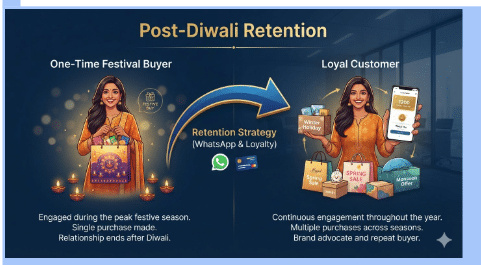
One customer who buys something one day during a holiday sale, does not necessarily mean each and every customer who purchases will turn into a loyal customer. They could have purchased as a discounted special or because they had been given as a condition or they may be purchasing because it is necessary for a certain season or time of year. After the advertisements for the holiday season end, you can’t guarantee that they will be back.
That’s where customers’ retention comes in to be valuable to the business. It’s time brands think beyond the less than 21st day of Diwali and start thinking long-term about what it heralds more: the start of building with the customer. The time following 8th November is a golden opportunity to gain insight into your customer’s shopping habits, enhancing their customer experience, and making it more likely that they will return.
The end of Diwali is a special day.It’s a special day at the end of Diwali.
While some campaigns can get a good volume of first-time customers to a business’ doors, it is not acquiring them that’s the key to growing a business, it is retaining them. Now the key will be if they come back without having to be sold again at a significant loss.
Arguably, post festive retention is the next battleground in the attention of the Indian D2C brands as revealed in a report “The 90-Day Festive Season Marketing Test” by Inc42 in September 2026. In the report, the concept of personalised communications is discussed, as well as recommendations for products, remarketing and tracking repeat purchases over a more extended period. It also suggests there is a need for the brands to know what their consumers have purchased before making their proposal.
An assessment of the Diwali peak is given the thumbs down by AppsFlyer’s 2025 India Festive Report as well. It discovered that there was an opportunity for increased engagement after the basic festive period, given over 20.5 million installs and over $576 million spent on user acquisition and remarketing. For instance, in the same period of time after Diwali, IOS shopping app sessions rose by 20%, and so did web visits.For instance, after Diwali, the number of IOS shopping app sessions grew by 20%, similar to web visits.
The results indicate that activities don’t just cease when the festival ends! Brands which invest wisely in the minds of their customers and in acquisition throughout the holidays will be more likely to reap the rewards.
- Plan for the first purchase of the customer.
Before you can retain, you need to comprehend why folks become buyers in the first place.
If they made a purchase of some skin care product, it might be worth sending an email reminder to them that they need to buy one of the complementary products. Someone that purchased a festive outfit might be more receptive to suggestions for every day wear or accessories. Someone who bought a smartphone may want to buy a case, screen protector or some other helpful extras that they will need.
Do not send out the same promotional message to all of these customers as it is better to break them into meaningful groupings on the basis of their purchasing habits and their interests and engagement in these products.
This is the point where personalisation will come in handy. If a recommendation happens to be related to someone’s past purchase, then it’s much more relevant than a typical message that makes a general announcement about a sale.
- Make Great after-Guarantee Experience.
Marketing shouldn’t stop after the transaction is a done deal. Sharing delivery updates, providing product instructions, offering a hassle-free return policy and offering prompt and responsive customer support can all impact first impressions.
An immediate “Thanks for your order” after ordering can make it seem like it goes into greater detail when it comes to personal interaction. After delivery, a mention of useful information, instructions for care for the product, or the opportunity for honest feedback, is an appropriate way to follow up to convey a brand.
In January 2025, researchers published an article in the Journal of Retailing and Consumer Services that sheds light on the effects of post-purchase communication on consumer engagement, satisfaction, and repurchase follow-through when the communication is congruent with the customer’s sense of self. Thus the lesson to marketers is that the communication should resonate with the customer, rather than being a further pushy sales message.
Companies that care for their customers once they have paid have a good chance of gaining customers’ trust.
- Offer incentives for buying products – it can be a reason to come back to the customer.
Competition is intensified at this time of year with lots of tempting deals being pitched by a number of brands. However, if a business is dependent on discounts to attract them, visitors might choose to move to a different business if they can find a cheaper option from one of the businesses that they’ve previously been visiting.
Rather, brands should develop reasons for return, that are associated to the product and the client’s experience.
Representatives suggest the following as some possible solutions:
Inform employees that employees that purchase multiple times or that make referrals will receive points or benefits for their actions.
– Product suggestions: Make appropriate suggestions about other products that will enhance the initial product.
Important – Early access: Customers who already buy your product first to have access to new collections, launches or limited-edition products.
Include useful content: include styling advice, product how to’s, maintenance, or useful, relevant information.
Customers use certain products on a regular basis, sending reminders based on realistic usage cycles: replenishment reminders.
The goal is to get customers to feel recognised, not pressured at all.
- Handle all communication using WhatsApp, email and social media in a responsible manner
The weeks following Diwali are a perfect opportunity to continue discussions via existing channels – the easiest ones are the ones that customers are already communicating on. After all, too much promotion and it’s sure to get obnoxious.
WhatsApp can work well for communicating with customers, providing updates on orders and providing information on product/purchase accordingly. More detailed information, like ‘new arrivals’ or ‘personalised collections’ or ‘updates about loyalty programmes’ can be included in an email. Product demonstrations, customer stories and helpful content can be utilized to highlight the presence of the brand on social media.
Timing and relevance are important. Customers don’t have to get another discount even after buying a product on the same day. It might be better to find out if the order was received or not, offer support and proffer further recommendations that qualify later.
Brands can also honor the preferences of communication, seek consent and allow consumers to easily withdraw from promotional offers.
- Capture when items are ordered more than once, but not when they’re sold on a holiday.
Efforts made during Diwali should not be evaluated solely based on the revenue generated during this period. Importantly, businesses should know what is going on with – or what they’re missing out on – by those customers who were purchased in that window.
The following are a few useful metrics:
Repeat purchase rate: This is the rate ofCustomers’ re-purchasing the product within a stated time frame.
Customer Lifetime Value – The value a Customer adds over the course of his or her business experience.
Time to second purchase: Customer delay time between first and second purchases.
Customer retention rate is the proportion of customers that a company keeps over a given time.
Customer acquisition cost (CAC): Measures the cost of acquiring a customer while taking into account the revenue and value that the customer provides.
Brands will be able to contrast one-time holiday buyers with repeat buyers, and study re-purchases after 30, 60 and 90 days. The timeframes indicated must be read based on the type of products. You might get yours sooner than someone who buys a TV or an elaborate Christmas garment.
They can then monitor such figures to gauge if their festive acquisition costing is adding value in the long term or just making short-term sales.
- Develop a realistic retention program 30-90 days into the future
Post festive marketing is successful if it is done in a sequential order instead of random promotions.
First 7 days: Experience.
Confirm order and make sure they have all necessary product information, offer support and resolve any order issues. What is key is making an initial purchase a positive one.
Days 8–30: Build engagement
Seek feedback as the right time, offer loyalty incentives and the content related to a customer’s purchase. Only use product recommendations when they really are relevant.
Day 31–60 Start the next buy;
Serve complementary items, suggestions for reordering or new collections following customer preferences. Try out various messages and offers, not assuming that all customers will react the same when weeding those responses out.
Their attention should be directed to Days 61-90, where they look for ways to re-engage customers who might not be paying attention.
Check customer activity and/or return history. If a few customers are not fully interested in the brand, they can be re-engaged through a targeted reminder, helpful information or a well-chosen incentive.
This will be a schedule, not a framework. The timing should be change as per to delivery dates, customer’s consent and based on the product usage and normal purchasing cycles.
Conclusion
Diwali can be an introduction to customers, but the delivery thereafter can make the difference in prompting customers to return. Whilst for those in marketing the weeks following 8 November would be regarded as a chance to convert festive interest into lasting relationships.
An increase in advertising costs or larger discounts are not necessarily the answer to keeping customers coming back. Occasionally begins with a straightforward delivery, a brief and appropriate recommendation, a good message or a true loyalty benefit.
Brands who see this beyond a monthly “Shopping for New Year Sales” and make sure to invest in the entire customer journey are in a much better position to get customers to buy again the following year. The point is not the number of customers a company gets during Diwali, it’s the number of customers that wish to return to them after!
References
- Reflections on Indian D2C Brands’ journey with post-festive retention, personalisation and repeat-purchase quantification.
- Data around festive activity, post-Diwali engagement, remarketing activity.
- The Journal of Retailing and Consumer Services is Volume 82.
- On the migration from spurts in festive shopping to regular and habit-driven eCommerce.
- Digital festive shopping behaviour, category trends & convenience and product value.
.
15 Key Takeaways
1. Customer retention is essential for converting one-time Diwali shoppers into repeat buyers and building long-term relationships with a brand.
2. Festive sales and customer acquisition may generate immediate revenue, but sustainable business growth depends on encouraging customers to purchase again.
3. Brands should analyse customers’ first purchases to understand their shopping habits, preferences and interests before developing retention strategies.
4. Personalised product recommendations based on previous purchases can improve customer engagement and increase the likelihood of repeat purchases.
5. A positive post-purchase experience, including timely delivery updates, product instructions and responsive customer support, plays an important role in customer retention.
6. Brands should maintain communication with customers even after festive campaigns and promotional activities have ended.
7. Loyalty programmes, referral rewards and exclusive benefits can encourage customers to return without depending entirely on discounts.
8. Early access to new collections, limited-edition products and product launches can make existing customers feel valued and appreciated.
9. WhatsApp, email and social media can support customer retention when used for relevant, personalised and consent-based communication.
10. Brands should avoid excessive promotional messages and focus on providing useful information, product recommendations and after-sales assistance.
11. Tracking repeat purchase rates, Customer Lifetime Value (CLV) and time to second purchase helps businesses evaluate their customer retention performance.
12. Comparing customer behaviour over 30, 60 and 90 days allows brands to understand whether festive shoppers are becoming regular customers.
13. A structured 30–90-day retention strategy can help businesses maintain customer engagement through experience-building, personalised recommendations and targeted re-engagement.
14. Brands should adapt retention campaigns according to product categories, customer preferences, delivery timelines and regular purchasing cycles.
15. Successful customer retention depends on building trust, delivering consistent customer experiences and giving buyers meaningful reasons to return after the festive season.
10 Frequently Asked Questions (FAQs)
1. What is customer retention, and why is it important for businesses after Diwali?
2. How can brands convert one-time festive buyers into repeat customers?
3. What are the most effective customer retention strategies for Indian D2C brands?
4. How does personalised marketing improve customer retention after festive sales?
5. Why is the post-purchase experience important for building long-term customer relationships?
6. How can loyalty programmes and referral rewards encourage repeat purchases?
7. How can businesses use WhatsApp, email and social media to improve customer retention?
8. Which metrics should brands track to measure customer retention after Diwali?
9. What is a 30–90-day customer retention strategy, and how can businesses implement it?
10. How can brands reduce their dependence on festive discounts while improving customer retention?
Core Marketing Question
How can Indian D2C brands turn one-time Diwali shoppers into loyal, repeat customers through personalised marketing, effective post-purchase experiences and strategic customer retention initiatives?
Connect Your Brand with Gen-Z
Unlock high-impact youth marketing strategies with EvePaper.
Book Strategy Call