
Quantum Computing: From Theory to Practical Applications
Published: July 1, 2026
Key Strategy Takeaways
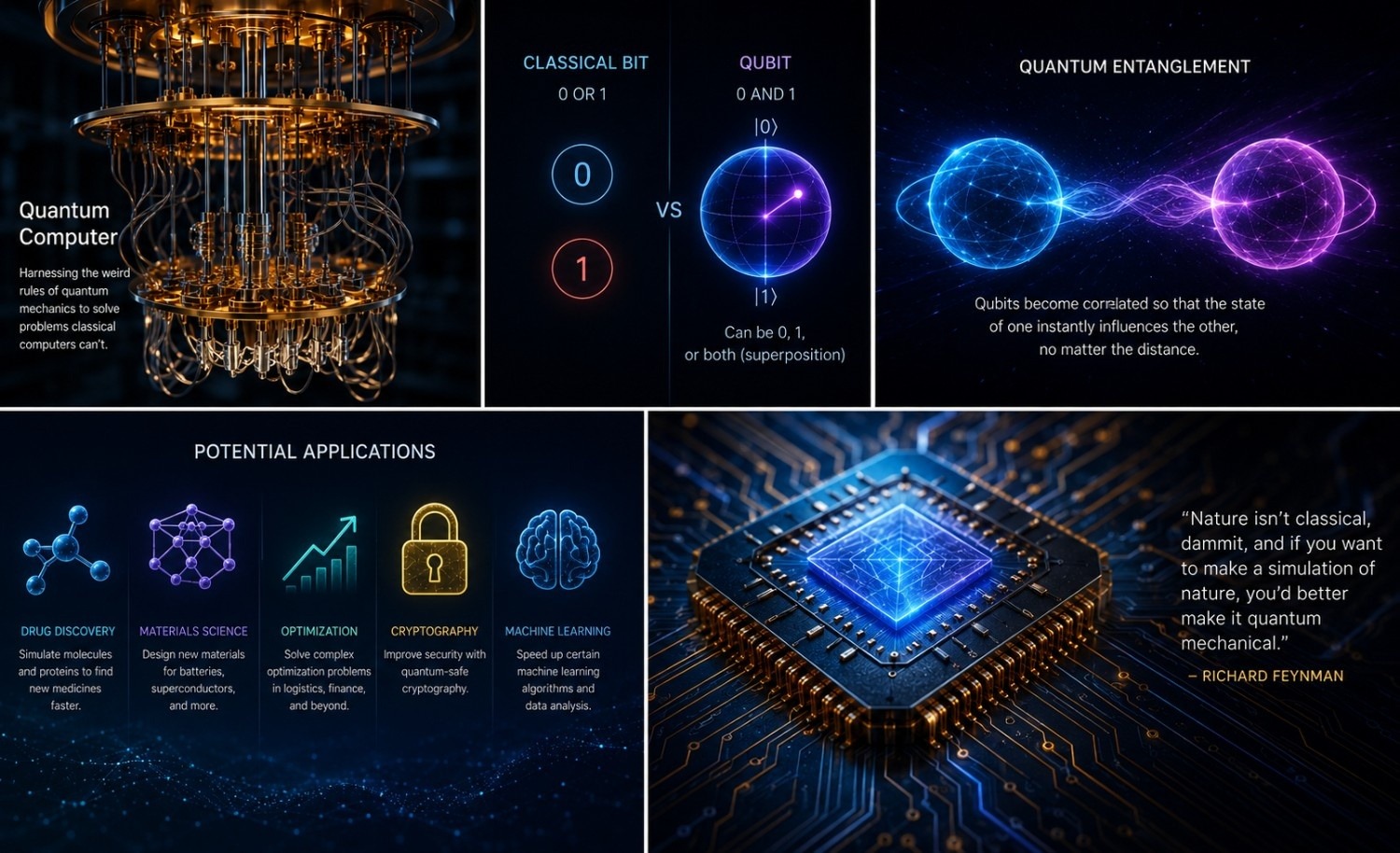
- Quantum computing is considered the next revolution in computing because it uses qubits to process multiple possibilities simultaneously, enabling faster solutions to complex problems than classical computers. Its potential to transform healthcare, cybersecurity, artificial intelligence, finance, and scientific research makes it a groundbreaking technology with the power to reshape numerous industries.
Key Strategy Takeaways
- Quantum computing is considered the next revolution in computing because it uses qubits to process multiple possibilities simultaneously, enabling faster solutions to complex problems than classical computers. Its potential to transform healthcare, cybersecurity, artificial intelligence, finance, and scientific research makes it a groundbreaking technology with the power to reshape numerous industries.
Introduction
One moment it’s just theory, next thing you know, machines are solving problems once thought impossible. Bits in regular computers stick to either zero or one, never both at once. Qubits break that rule completely – existing here, there, and everywhere in between until measured. Because of this strange behavior, certain computations collapse into answers almost instantly. Speed like that changes what we expect from problem-solving across many areas. Medicine needs precision, security demands unbreakable codes, and money moves fast – all places where these machines start making sense. Intelligence beyond current limits might not stay fiction for long.
At the heart of quantum computing lies quantum mechanics – this part of physics looks at how tiny particles act when they’re smaller than atoms. Once seen as just an idea on paper, progress now shows it might actually work in real life. Big organizations and labs are spending serious money here, drawn by what could happen down the road. Its power to change things later keeps interest high. This growing field is now seen as a major part of advanced technology.
Understanding Quantum Computing
Superposition, along with entanglement, forms the base of quantum computing. What makes it work? These two ideas together hold everything up.
Superposition
A single bit inside traditional machines takes just one form – zero or one. But here’s where it shifts: the qubit lives in two states at once, thanks to something known as superposition. Because of that overlap, quantum systems handle heaps of information together, which cranks up how fast they compute without burning extra steps.
Entanglement
Out here, qubits link up in a strange way – called entanglement. When that happens, whatever one does affects the other instantly, no matter the distance between them. Because of this odd connection, quantum machines handle complex math more smoothly and quickly.
What sets quantum computing apart is its potential in tackling tasks too complex for regular machines. Though still emerging, it stands out where older systems struggle. Experts believe this form of advanced technology could transform multiple industries.
Evolution from Theory to Practice
Back then, a physicist named Richard Feynman started talking about quantum computing during the 1980s. Because he saw limitations in regular computers when handling quantum physics, his thoughts took shape slowly. Years passed while researchers worked quietly, building on early insights without rushing ahead. One breakthrough came through Shor’s method, followed later by another called Grover’s – each showing what these strange new machines might do instead of just theory. Though progress crept forward, it carried weight.
Now comes a shift – firms such as IBM, Google Quantum AI, and Microsoft Quantum craft quantum chips alongside online access points for them. From theory to real tasks, progress slips quietly forward through these tools.
Quantum Computing Uses in Real Situations
Healthcare and Drug Discovery
Computing at the quantum level opens doors in medicine. Through it, molecules and their reactions are examined more quickly compared to standard machines. Speedier analysis means scientists might craft treatments sooner, spotting illnesses earlier along the way.
Cybersecurity
One moment, these machines tackle tough math puzzles fast – posing a challenge to today’s codes. Later on, new kinds of protection emerge, built to resist quantum power, keeping data safer through smarter design.
Artificial Intelligence
Out front, artificial intelligence paired with quantum machines might speed up how computers learn. Not far behind, recognizing patterns could become way more precise through this mix. Suddenly, digging into big piles of data feels less slow, thanks to their joint power. Behind the scenes, automated tasks start acting sharper and adapting quicker than before. Down the line, decisions happen at a pace that once seemed out of reach.
Financial Services
Now here’s a twist – banks tap into quantum computing, not just for speed but for sharper fraud spotting. Instead of old-school methods, these systems chew through massive piles of financial data like nothing before. Risk checks get smarter because the math behind them shifts entirely. Portfolios? They’re tuned using patterns most computers cannot even see. Efficiency jumps – not by inches, but leaps – all thanks to how information gets handled at the core level.
Problems With Quantum Computers
Even though it shows promise, quantum computing runs into multiple hurdles. Not just noise but temperature shifts mess up operations fast. Keeping qubits steady? That part rarely works well yet. Cost adds pressure – machines demand rare materials plus custom cooling. Few labs have space or funds to try.
Day by day, scientists tweak the nuts and bolts of quantum machines, nudging them closer to stability. Through these small steps, better ways to catch mistakes in calculations begin to take shape. With each fix, the tech feels less like a lab oddity and more like something real people might one day use.
Conclusion
Now picture this: quantum computing isn’t just math on paper anymore – it’s becoming real, fast, useful. It may soon become one of the most important examples of advanced technology in the modern era. Speed like that doesn’t come along every decade, yet here it is, tackling puzzles too tough for regular machines. True, there are snags – hardware hiccups, stability issues – but labs keep pushing anyway. Step by step, trial after trial, progress piles up quietly behind closed doors. One day soon, hospitals might diagnose better, banks could secure money differently, spies and coders may rethink everything, while robots learn in ways once thought impossible. Science never promised smooth roads, only change – and this shift feels less like a leap, more like quiet tectonic grind.
Frequently Asked Questions
What is quantum computing?
Quantum computing is an advanced computing technology that uses qubits instead of classical bits to perform complex calculations much faster than traditional computers.
How does a quantum computer works?
A quantum computer works using quantum mechanical principles such as superposition, entanglement, and interference to process multiple possibilities simultaneously.
what is qubit?
A qubit is the basic unit of quantum information. Unlike a classical bit, it can exist in both 0 and 1 states at the same time.
Is quantum computing is better than classical computing?
Quantum computers are not replacements for classical computers. They excel at solving specific complex problems much faster, while classical computers remain better for everyday computing tasks.
Which industry will benifit the most from quantum computing?
Healthcare, pharmaceuticals, finance, cybersecurity, manufacturing, logistics, aerospace, telecommunications, and artificial intelligence are expected to benefit significantly.
what is the future of quantum computing?
Experts believe quantum computing will become increasingly practical over the next decade, enabling breakthroughs in science, medicine, optimization, and secure communications.
How is quantum computing different from classical computing?
Classical computers use bits that are either 0 or 1, while quantum computers use qubits that can exist in multiple states simultaneously. This allows quantum computers to solve certain complex problems more efficiently.
What are the biggest challenges facing quantum computing?
The major challenges include maintaining qubit stability, reducing computational errors, developing scalable hardware, and operating quantum computers at extremely low temperatures.
What are the practical applications of quantum computing?
Quantum computing is used in drug discovery, artificial intelligence, cybersecurity, financial modeling, logistics optimization, climate research, and material science.
Is quantum computing better than classical computing?
Quantum computers are not replacements for classical computers. They excel at solving specific complex problems much faster, while classical computers remain better for everyday computing tasks.
Citations & References
IBM – What is Quantum Computing?
https://www.ibm.com/think/topics/quantum-computing
Google Quantum AI
https://quantumai.google/
Microsoft Quantum Computing
https://azure.microsoft.com/en-us/solutions/quantum-computing/
TechTarget – What is Quantum Computing?
https://www.techtarget.com/whatis/definition/quantum-computing
Council on Foreign Relations – What Is Quantum Computing?
https://www.cfr.org/backgrounder/what-quantum-computing
Connect Your Brand with Gen-Z
Unlock high-impact youth marketing strategies with EvePaper.
Book Strategy Call