Youth Trends
👁 5 READS
How Remote and Hybrid Jobs Are Changing the Search for Entry-Level Work
Published: September 22, 2026
Key Strategy Takeaways
- Target relevant remote jobs: Focus on remote jobs that match your skills, education, and career goals instead of applying randomly.
- Build a strong portfolio: Use projects, case studies, certifications, and practical work to demonstrate your ability to succeed in remote jobs.
- Develop in-demand skills: Strengthen skills in areas such as data analysis, software development, SEO, digital marketing, and CRM to become more competitive for remote jobs.
- Optimize your resume: Tailor your resume to each remote job description and highlight relevant skills and measurable achievements.
- Consider hybrid opportunities: Hybrid positions can provide experience that may help you qualify for future remote jobs.
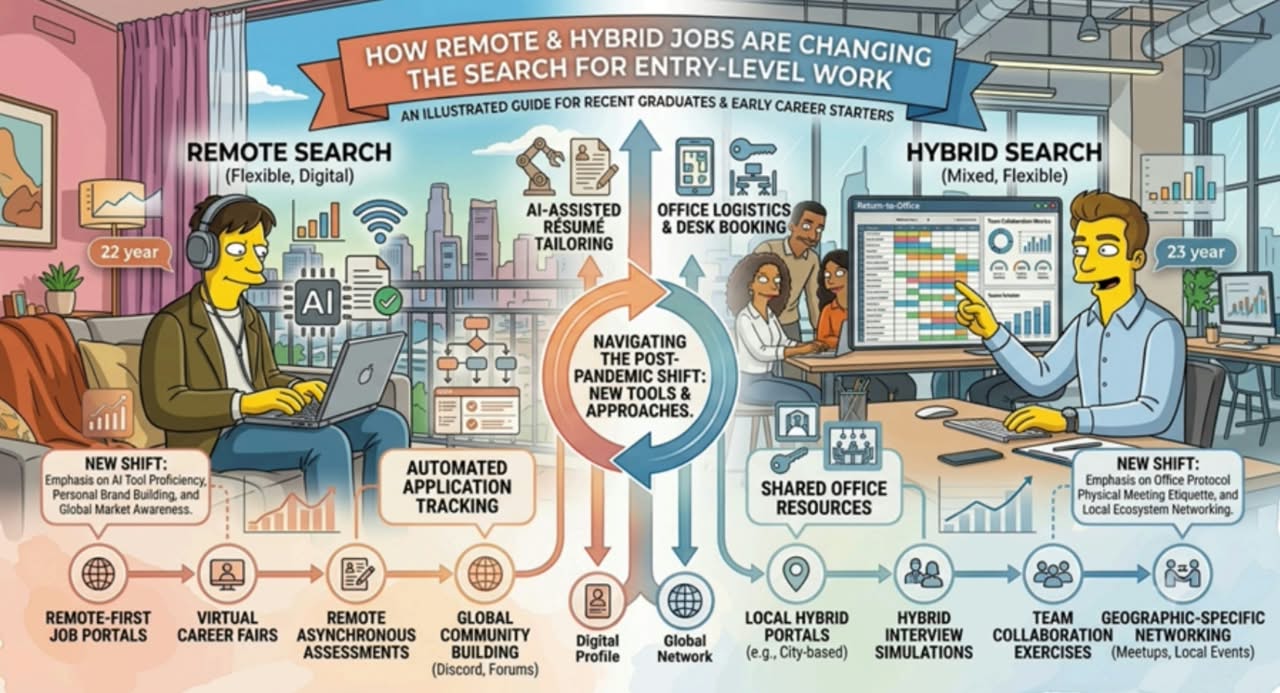
Starting your first job search after leaving school can be exhausting. You update your resume for the fortieth time, practice the same answer to “Tell me about yourself,” and check job boards before going to bed, hoping a new opportunity has appeared.
For years, there was an unwritten rule about starting a career: flexible work was mainly available to experienced professionals, while entry-level employees were expected to work in an office five days a week. Remote jobs often seemed like an option reserved for people who had already spent years building their careers.
That expectation is slowly changing. As companies adopt more flexible working arrangements, remote and hybrid opportunities are becoming increasingly visible to early-career workers. For new graduates, this creates new possibilities—but also more competition for the positions that offer flexibility.
The numbers tell a more complicated story than the headlines
If you’ve been looking at anything recently about the job market, you’ll have come across two opposing statements. One asserts that remote work is booming while the other claims it’s retreating towards the levels it was at before the pandemic. Both of these statements are true in their own way—it all just depends on which part of the job market you’re considering.
Overall hiring flexibility is still real and still growing in some corners of the economy. Robert Half’s analysis of job postings found that hybrid arrangements now show up meaningfully across nearly every professional field, from marketing to finance to technology, even if the fully-remote share of postings has cooled from its 2022 peak. Flex Jobs, which tracks tens of thousands of employers, reported that remote job postings actually grew by double digits in a recent quarter, driven largely by fields like engineering, product, and business development.
But here’s the part that matters most if you’re new to the workforce: entry-level remote listings remain a small slice of that pie. Multiple industry trackers put entry-level roles at somewhere around 6 to 7 percent of all remote postings, with the bulk of flexible openings still going to experienced hires, managers, and senior specialists. Current early-career listings show substantial remote and hybrid availability in absolute terms — there are simply more such postings now than there were five years ago — but they remain concentrated in specific fields and often more competitive than their in-office counterparts, precisely because so many people are chasing the same flexibility.
That is to say, the door is now wider, but all people can see that it’s open and are all attempting to go through it at the same time.
Why companies are rethinking who gets to work flexibly
It is worth asking why this shift is happening, especially since companies once preferred to keep entry-level employees close, provide in-person mentorship, and help them become part of the workplace culture. The growing availability of remote jobs has encouraged employers to find new ways to train, support, and communicate with early-career employees without requiring them to work in an office every day.
Part of the answer is generational. Surveys of early-career workers, particularly Gen Z employees who are remote-capable, show a strong and consistent preference for hybrid arrangements over either extreme — not fully remote, and not fully in-office, but something in between that offers autonomy without total isolation. Companies competing for talent have had to notice that preference, especially in fields where skilled young workers have options.
Another practical reason is the wider reach that remote hiring provides. When companies advertise remote jobs or hybrid positions, they can attract candidates from a much larger geographic area instead of limiting applications to people who live nearby. Virtual interviews can also be easier to schedule, helping employers connect with qualified entry-level candidates more efficiently.
And part of it is that entry-level work itself has changed in character. A lot of early-career roles today are digital by nature — data analysis, digital marketing, customer support, junior software development, technical writing. If the actual output of your job is a spreadsheet, a campaign, a pull request, or a resolved support ticket, the question of whether you produce it from a downtown office or a home desk starts to feel less urgent to employers than it once did.
Where the real opportunities are concentrated
If you are starting your career and looking for flexible work, it is important to recognize that the availability of remote jobs varies across industries. Technology, finance, and professional services generally offer more remote and hybrid opportunities, while fields such as data analysis, cloud infrastructure, and CRM administration can provide strong options for candidates with relevant technical skills and certifications.
On the other hand, healthcare, construction, hospitality, and administrative support are still almost entirely based on face-to-face interaction, since it’s obvious that you can’t give care to a patient or pour concrete during a video call. If your line of work belongs to one of these areas, the discussion about flexible working will be different and it’s important to adjust your expectations accordingly rather than simply assume that remote work isn’t available to you.
There’s also a quieter trend worth knowing about: some of the most oversaturated corners of the entry-level remote market are the ones that look easiest to break into on paper — basic data entry, generic content writing, entry-level customer service. Because these roles require little specialized training, they attract enormous volumes of applicants, which can make them surprisingly hard to land despite their apparent accessibility. Meanwhile, roles that require even a modest technical skill — a certification, a portfolio, some demonstrated fluency with a tool — tend to face far less competition for the flexibility they offer.
What this actually means if you’re job hunting right now
The fact that remote or hybrid entry-level jobs are easy to find is not being implied at all; in fact, they aren’t easy. However, it is more feasible now than it was a decade ago, and it’s important to understand the nature of that feasibility rather than merely guessing at it.
A number of factors actually have a real impact on early-career candidates. Nowadays, having a noticeable portfolio or obtaining a particular technical qualification is more important than it used to be, since employers are more likely to rely on skills and evidence of competence rather than on years of experience which they cannot yet request. It is better to be specific about the industries and job functions that still value flexibility rather than to apply broadly in the hope of finding a suitable position. And it is worth taking an impartial look at the “remote” filters on job boards; sometimes the term is used loosely or as a way of attracting applicants, even though the real requirement may be to eventually relocate or to work on a hybrid schedule that isn’t clearly stated.
There’s another point that should be made simply: it’s perfectly all right if the first job you get isn’t the ideal fully remote position. Many people work their way towards more flexibility rather than beginning in such a role—they gain experience in a hybrid or office-based position for a year or two before asking for greater autonomy once they have built up trust and a proven record. This is not a failure nor is it a consolation prize. For most of the working population throughout history, “start where you can and move towards what you want” has been the usual pattern of a career, not an unfortunate one.
From the very beginning, the quest for entry-level jobs has required young workers to demonstrate their capabilities before anyone is willing to fully trust them with independent responsibilities. Although remote and hybrid work arrangements have not eliminated this kind of tension, they have begun to alter its nature by providing, in certain fields and positions where it applies, a means of proving oneself without having to do so while based in a particular building. This does represent a significant change, even though the experience of navigating it remains uneven and at times frustrating.
If you are starting your career and looking for flexible work, it is important to recognize that the availability of remote jobs varies across industries. Technology, finance, and professional services generally offer more remote and hybrid opportunities, while fields such as data analysis, cloud infrastructure, and CRM administration can provide strong options for candidates with relevant technical skills and certifications.
According to the U.S. Bureau of Labor Statistics, employment trends and job opportunities vary considerably across occupations. Research from the Stanford Institute for Economic Policy Research also provides useful insights into remote and hybrid work patterns.
Key Strategy Takeaways : –
Target relevant remote jobs: Focus on remote jobs that match your skills, education, and career goals instead of applying randomly.
Build a strong portfolio: Use projects, case studies, certifications, and practical work to demonstrate your ability to succeed in remote jobs.
Develop in-demand skills: Strengthen skills in areas such as data analysis, software development, SEO, digital marketing, and CRM to become more competitive for remote jobs.
Optimize your resume: Tailor your resume to each remote job description and highlight relevant skills and measurable achievements.
Consider hybrid opportunities: Hybrid positions can provide experience that may help you qualify for future remote jobs.
FAQs
What are remote jobs?
Remote jobs are positions that allow employees to work outside a traditional office, often from home. Depending on the employer, remote work may be fully remote or may include occasional office visits.
Are remote jobs available for entry-level candidates?
Yes. Entry-level remote jobs are available in areas such as software development, digital marketing, customer support, data analysis, sales, and technical writing. However, these positions can be highly competitive.
Citations & References
Robert Half, Remote Work Statistics and Trends for 2026 — analysis of U.S. job postings via TalentNeuron across 450+ job titles
FlexJobs, Q2 2026 Remote Work Index — analysis of postings from 60,000+ companies
FlexOS, 100+ Hybrid and Remote Work Statistics and Trends in 2026 — citing Flex Index (Q3 2025) and Stanford’s Survey of Working Arrangements (SWAA, 2026)
DailyRemote, Remote Work Statistics: 50+ Data Points for 2026 — citing Bureau of Labor Statistics and FlexJobs Remote Work Economy Index data
Staywise, Remote Job Market Statistics 2026: The Hiring Gap — citing Indeed Hiring Lab, Robert Half, and MBO Partners
🚀 Share this Insight
Connect Your Brand with Gen-Z
Unlock high-impact youth marketing strategies with EvePaper.
Book Strategy Call