
How Mega-Fests Like Rendezvous Run on Student-Fest Committee Managing Crowds in the Lakhs
Published: October 9, 2026
Key Strategy Takeaways
- 1. Student-led committees play a crucial role in managing mega-fests like Rendezvous, where large crowds require careful planning and coordination.
- 2, Strong Leadership: Assign experienced student leaders to supervise different festival teams and make quick decisions.
- 3. Clear Committee Structure: Divide responsibilities among teams handling logistics, security, marketing, hospitality, finance, and stage management.
- 4. Volunteer Coordination: Recruit and train volunteers to manage registrations, guide attendees, and provide information.
- 5. Crowd Management Planning: Create entry and exit routes, designated waiting areas, and clear movement pathways to reduce congestion.
- 6. Safety and Security: Coordinate with professional security personnel, medical teams, and local authorities to maintain a safe environment.
- 7. Smart Registration Systems: Use online registrations, digital passes, and QR-code scanning to improve entry management.
- 8. Effective Communication: Establish communication channels between committee heads, volunteers, security teams, and event organizers.
- 9. Emergency Preparedness: Prepare evacuation procedures, emergency contacts, first-aid arrangements, and contingency plans.
- 10. Sponsorship Management: Build relationships with brands and sponsors to secure funding, resources, and promotional support.
- 11. Budget Control: Track expenses, allocate funds carefully, and maintain transparent financial records.
- 12. Technology Integration: Use digital dashboards, live announcements, and real-time updates to monitor event operations.
- 13. Marketing and Promotion: Promote the festival through social media, student communities, campus ambassadors, and digital campaigns.
- 14. Attendee Experience: Provide clear signage, information desks, accessible facilities, food areas, and comfortable waiting spaces.
- 15. Teamwork and Collaboration: Encourage coordination between student clubs, college administration, vendors, performers, and external partners.
- 16. Performance Evaluation: Collect attendee feedback and review attendance, safety, participation, and sponsor satisfaction to improve future festivals.
- 17. Crisis Management: Train committee members to respond calmly to unexpected crowd surges, technical problems, weather disruptions, and schedule changes.
- 18. Learning Through Experience: Help students develop leadership, communication, decision-making, teamwork, and event-management skills through practical responsibilities.
- 19. Continuous Improvement: Document successful strategies and challenges after each event to make future editions more efficient and memorable.
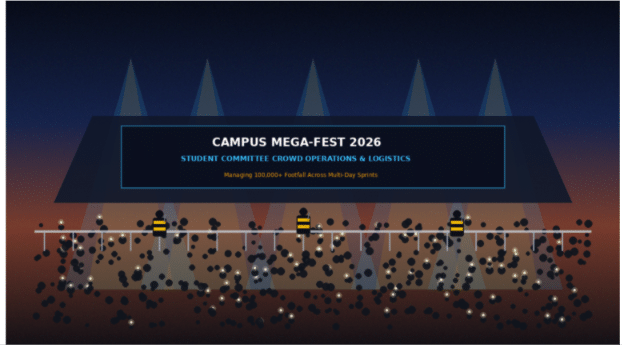
The fest committee is the backbone of every successful mega-fest, bringing together student leaders, volunteers, and organizers to manage events, coordinate activities, and handle large crowds. At festivals like Rendezvous at IIT Delhi, student-led committees take responsibility for planning performances, managing registrations, coordinating sponsors, arranging logistics, and maintaining crowd safety. When thousands of students and visitors gather for celebrations, effective teamwork and clear communication become essential. Each committee member contributes to creating a well-organized and memorable festival experience. From the initial planning stages to the final event, these student teams demonstrate how leadership, coordination, and smart decision-making can help manage large-scale college festivals successfully.
Key Strategy Takeaways
- 1. Student-led committees play a crucial role in managing mega-fests like Rendezvous, where large crowds require careful planning and coordination.
- 2, Strong Leadership: Assign experienced student leaders to supervise different festival teams and make quick decisions.
- 3. Clear Committee Structure: Divide responsibilities among teams handling logistics, security, marketing, hospitality, finance, and stage management.
- 4. Volunteer Coordination: Recruit and train volunteers to manage registrations, guide attendees, and provide information.
- 5. Crowd Management Planning: Create entry and exit routes, designated waiting areas, and clear movement pathways to reduce congestion.
- 6. Safety and Security: Coordinate with professional security personnel, medical teams, and local authorities to maintain a safe environment.
- 7. Smart Registration Systems: Use online registrations, digital passes, and QR-code scanning to improve entry management.
- 8. Effective Communication: Establish communication channels between committee heads, volunteers, security teams, and event organizers.
- 9. Emergency Preparedness: Prepare evacuation procedures, emergency contacts, first-aid arrangements, and contingency plans.
- 10. Sponsorship Management: Build relationships with brands and sponsors to secure funding, resources, and promotional support.
- 11. Budget Control: Track expenses, allocate funds carefully, and maintain transparent financial records.
- 12. Technology Integration: Use digital dashboards, live announcements, and real-time updates to monitor event operations.
- 13. Marketing and Promotion: Promote the festival through social media, student communities, campus ambassadors, and digital campaigns.
- 14. Attendee Experience: Provide clear signage, information desks, accessible facilities, food areas, and comfortable waiting spaces.
- 15. Teamwork and Collaboration: Encourage coordination between student clubs, college administration, vendors, performers, and external partners.
- 16. Performance Evaluation: Collect attendee feedback and review attendance, safety, participation, and sponsor satisfaction to improve future festivals.
- 17. Crisis Management: Train committee members to respond calmly to unexpected crowd surges, technical problems, weather disruptions, and schedule changes.
- 18. Learning Through Experience: Help students develop leadership, communication, decision-making, teamwork, and event-management skills through practical responsibilities.
- 19. Continuous Improvement: Document successful strategies and challenges after each event to make future editions more efficient and memorable.
Abstract
Every autumn, premier university campuses like IIT Delhi transform into self-contained miniature cities, welcoming over one to two lakh visitors across four breathless days. While visiting crowds see pulsating concert lights, flawless celebrity pro-shows, and high-stakes competitive stages, the real miracle unfolds behind the barricades. These sprawling gatherings are planned, budgeted, and executed entirely by undergraduate student teams. A core fest committee carries the responsibility of seasoned municipal administrators: negotiating multi-tiered security cordons with local police, managing massive gate surges, laying emergency vehicle thoroughfares, and balancing volatile operational ledgers under immense public pressure. This article unpacks the operational machinery behind large-scale event management on Indian campuses, analyzing how young student organizers master crowd psychology, incident command protocols, and crisis logistics to pull off some of the largest youth festivals in Asia without institutional failure.
Keywords: fest committee, large-scale event management, Campus Mega-Fests, Rendezvous Operations, Crowd Control Protocols, Student Union Logistics.
- Introduction
To the average college student in Delhi, Rendezvous at IIT Delhi or Mood Indigo at IIT Bombay represents four days of pure escapism. It is a whirlwind of headbanging at rock band competitions, jostling for front-row spots at Bollywood star nights, and grabbing midnight rolls at campus food courtyards. What few outside visitors ever realize is that the entire spectacle—handling footfalls that regularly cross 1,50,000 people—is directed by a handful of twenty-year-old undergraduates running on black coffee and adrenaline.
Running a festival of this magnitude is not an exaggerated student club exercise; it is an unforgiving trial in large-scale event management. A single wrong calculation at an entry gate can trigger dangerous crowd crushes, a delayed sound check can invite steep municipal police fines, and a glitchy digital pass portal can leave thousands of frustrated attendees stranded outside perimeter barricades. The student fest committee operates essentially as a temporary city council, managing transportation grids, medical triage tents, electrical generator farms, and media press boxes. Examining how these student-led teams coordinate massive logistics reveals profound lessons in leadership, crisis composure, and high-stakes operations that no corporate management degree can teach in a classroom.
- Research Analysis
- The Command Structure of a Core Fest Committee
Managing crowds in the lakhs requires military-grade organizational clarity. A premier fest committee is not an informal democracy where decisions are endlessly debated by committee; it is a structured, hierarchical incident command system.
At the top sit overall student coordinators and convenors who interface directly with the university dean of student affairs, municipal police commissioners, and fire department officials. Beneath them, the team fractures into specialized verticals: Security & Crowd Management, Stage Infrastructure, Corporate Sponsorships, Competitions, Artist Hospitality, and Media PR. Each vertical lead commands teams of department coordinators and ground volunteers, ensuring that an instruction issued over the radio network reaches hundred-meter gate checkpoints in seconds.
- Gate Staging, Queue Dynamics, and Perimeter Defense
The most vulnerable point of failure in any campus mega-fest is the physical perimeter. Between 4:00 PM and 7:00 PM on celebrity pro-show evenings, tens of thousands of external ticket holders, college students, and unregistered crowds descend upon campus access gates simultaneously.
Experienced student teams counter gate crushes by engineering layered ‘holding pens’ and serpentine cattle-barricades hundreds of meters outside the main boundary wall. By breaking massive, surging crowds into controlled trickles of fifty people at a time, pressure on the actual turnstiles and security metal detectors is eliminated. RFID wristband scanners and offline barcode readers are deployed to ensure that gate bottlenecks never back up into arterial city traffic, keeping local police authorities satisfied.
- The Engineering of Multi-Tiered Arena Barricades
Inside the open-air theater or sports stadium grounds, crowd physics becomes dangerously volatile during high-energy musical acts. A sudden surge toward the front stage barrier can generate lethal lateral crushing pressures in seconds.
To prevent mosh-pit compression, the fest committee builds heavy-duty aluminum Mojo-barricade grids dividing the spectator lawn into distinct, compartmentalized zones: VIP pass-holders, internal university students, general attendees, and technical console towers. Crucially, wide, sterile ‘sterile corridors’ run down the center and sides of the field, guarded by student volunteers. These empty channels allow security personnel and paramedics to spot fainting attendees immediately and pull them out over the barriers into medical tents within thirty seconds.
- Multi-Channel Radio Grids and Real-Time Surveillance
When cellular towers collapse under the weight of eighty thousand smartphones recording 4K videos at an evening concert, mobile messaging apps become completely useless. Professional large-scale event management cannot depend on cellular connectivity.
Student committees operate on closed, multi-frequency walkie-talkie radio bands. Channel 1 handles emergency medical dispatch, Channel 2 is dedicated to artist hospitality and convoy movement, Channel 3 runs perimeter security, and Channel 4 connects the central stage console. Sitting inside an air-conditioned command trailer, senior student controllers monitor live high-definition CCTV feeds covering all major bottlenecks, cross-referencing crowd densities with ground volunteers to redirect pedestrian flows before dangerous choke points develop.
- Crisis De-escalation and Working with Law Enforcement
Inevitably, tension runs high when unregistered crowds or aggressive groups try to crash campus walls after passes sell out. Dealing with angry crowds demands emotional poise, clear communication, and de-escalation skills from young student leads.
Trained student volunteers learn that physical confrontation only worsens crowd agitation. By maintaining a firm, polite, and coordinated perimeter presence alongside state police and private bouncer battalions, student organizers defuse heated arguments before they boil over. Ensuring that perimeter floodlighting stays blindingly bright, public address systems broadcast clear instructions, and rapid-response volunteer squads remain visible deters gate-crashing attempts effectively.
- Managing Infrastructure Redundancy and Power Failures
A concert pulling 400 kilowatts of sound and light rig power cannot run on standard municipal campus wiring without tripping regional transformers. A sudden blackout during a headlining artist’s performance can spark immediate mass confusion and stadium panic.
The logistics vertical on a mega-fest committee designs absolute operational redundancy. Massive industrial diesel generators are synchronized in parallel: if the primary generator bank drops frequency, secondary units pick up the entire electrical load in milliseconds without a single audio pop on stage. Dedicated fuel-delivery corridors are mapped out to keep generators topped up around the clock without ever crossing pedestrian pathways.
III. Conclusion
When the final pro-show ends at 10:30 PM and ninety thousand attendees file peacefully out of campus gates humming their favorite songs, the triumph belongs entirely to the student volunteers cleaning empty soda cans off the lawn and coiling heavy sound cables. Mega-fests like Rendezvous are living proof that undergraduate student teams possess the operational maturity, emotional discipline, and leadership grit to deliver world-class civic management.
By mastering the principles of large-scale event management—compartmentalized arena barricades, radio network discipline, calm crisis de-escalation, and mechanical redundancy—a student fest committee turns what could easily become a public safety hazard into an extraordinary celebration of youth culture. These young convenors do not simply organize parties; they run full-scale municipal operations, forging leadership muscle that stays with them for the rest of their professional lives.
- Key Takeaways
- Premier campus festivals operate with crowd numbers rivaling major international sporting events, demanding strict operational planning.
- A successful fest committee uses a structured, incident-command hierarchy to communicate across specialized logistics verticals.
- Serpentine holding pens and layered outer perimeters prevent sudden crowd rushes from overwhelming security turnstiles.
- Compartmentalized arena barricades and central sterile corridors ensure immediate paramedic access to spectators during high-energy pro-shows.
- Dedicated multi-frequency walkie-talkie networks bypass local cellular blackouts to maintain reliable communication across campus.
- Parallel diesel generator synchronization guarantees total power redundancy, preventing concert blackouts and stadium panic.
- Calm de-escalation, coordinated teamwork with state police, and clear crowd communication prevent friction at packed campus checkpoints.
Frequently Asked Questions
1. What is Rendezvous?
Rendezvous is the annual cultural festival of IIT Delhi, featuring music, dance, competitions, performances, and other activities that attract students and visitors.
2. How do student-led committees manage mega-fests?
Student-led committees divide responsibilities among teams handling logistics, security, marketing, sponsorships, hospitality, and stage management.
3. Why are student volunteers important for large college festivals?
Volunteers help with registrations, guide attendees, coordinate activities, share information, and support the smooth operation of festival events.
4. How do organizers manage large crowds at mega-fests?
Organizers use planned entry and exit routes, trained security personnel, crowd-flow monitoring, clear signage, and emergency response procedures.
5. What responsibilities do student committee members have?
Committee members plan events, coordinate volunteers, manage budgets, communicate with sponsors, oversee logistics, and solve operational problems.
6. How do college festivals attract brand sponsors?
Festivals attract sponsors by offering brand visibility, promotional stalls, digital marketing opportunities, product demonstrations, and direct engagement with students.
7. What role does technology play in managing mega-fests?
Online registrations, QR-code passes, digital announcements, communication platforms, and real-time monitoring tools can improve event coordination.
8. How do student committees prepare for emergencies?
They coordinate with professional security teams, medical personnel, and college authorities while preparing evacuation plans and emergency communication procedures.
9. What challenges do student organizers face during mega-fests?
Common challenges include crowd congestion, schedule changes, budget limitations, volunteer coordination, technical failures, and unexpected emergencies.
10. How do student-led committees manage festival budgets?
They estimate expenses, allocate funds, monitor spending, maintain financial records, and coordinate sponsorship income to keep activities within budget.
11. How does organizing a mega-fest benefit students?
Students develop leadership, teamwork, communication, problem-solving, negotiation, and event-management skills through practical experience.
12. How do organizers ensure a better attendee experience?
They provide clear directions, organized registration, accessible facilities, helpful volunteers, suitable amenities, and timely event updates.
13. How do student committees coordinate with performers and vendors?
Dedicated teams manage schedules, contracts, technical requirements, equipment, vendor arrangements, and communication with performers.
14. How can social media help promote college mega-fests?
Social media helps organizers announce schedules, promote performances, engage students, share updates, attract sponsors, and encourage audience participation.
15. What can future college fest organizers learn from Rendezvous?
They can learn the importance of structured committees, early planning, effective communication, crowd safety, financial management, teamwork, and continuous improvement.
Connect Your Brand with Gen-Z
Unlock high-impact youth marketing strategies with EvePaper.
Book Strategy Call