
Youth Trends
👁 8 READS
Why Some Companies Are Hiring for Skills Instead of Specific Degrees
Published: September 22, 2026
Key Strategy Takeaways
- Focus on skills, not just degrees — Show what candidates can actually do through projects, portfolios, certifications, and practical experience.
- Adopt skills hiring — Companies can expand their talent pool by evaluating candidates based on relevant skills rather than automatically filtering by degree.
- Use practical assessments — Case studies, coding tests, work samples, and skill-based interviews can provide stronger evidence of job readiness.
- Recognize alternative credentials — Bootcamps, certifications, digital badges, and online courses can help candidates demonstrate specific skills.
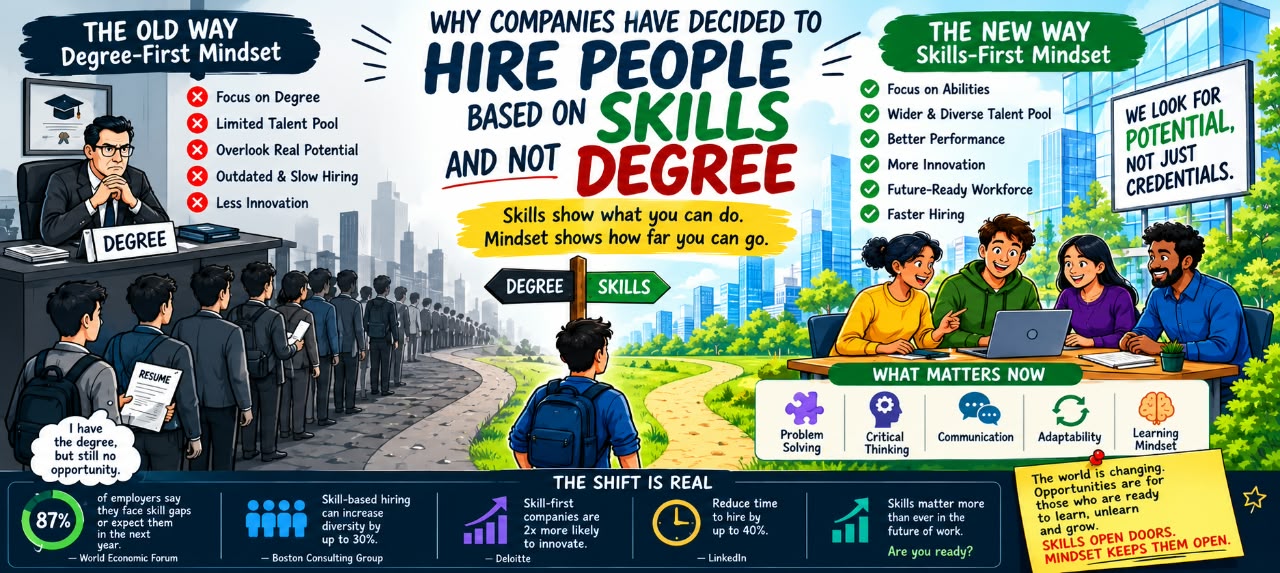
Skills hiring is changing the way companies find and evaluate talent. Instead of relying primarily on college degrees, more employers are focusing on practical abilities, relevant experience, certifications, portfolios, and proven results. This shift is creating new opportunities for skilled candidates who may not have a traditional four-year degree.
Why are companies moving toward skills hiring? What benefits does this approach offer employers and job seekers? And does this mean degrees are becoming less important? Let’s explore how skills hiring is reshaping modern recruitment and what it means for the future of work.A few years ago, a candidate who didn’t have a bachelor’s degree simply didn’t get a job interview; period. No one asked whether that candidate could actually do the job. The resume went straight to the trash because of “degree required” stated in the job description. But things have changed. Yes, they aren’t all over the place, and yes, it happens more slowly than the news headlines show, but they have changed. Go to a modern HR meeting and hear such concepts as “skill hiring”, “competency-based recruitment” and “talent over pedigree”. They are not entirely new, but the enthusiasm behind this shift is real. IBM, Delta Air Lines, and even Bank of America rewrote their hiring rules, and the rationale behind it is interesting in light of changes in the labour market.
And why did this happen? Why are the employers leaving behind the old degree requirement-based approach and developing something new based on competence? We’ll look at this in detail below.
Old System Was Not About Ability
The old practice of making hiring decisions based on a bachelor’s degree was a quick way to sift through hundreds of resumes. But it was far from perfect. Many people who could easily do a job well just couldn’t obtain a four-year education for various reasons (money, family responsibilities, personal reasons, etc.). Moreover, many candidates completed college but were then assigned to jobs that required different competencies. But eventually, employers realised that someone with a marketing degree and no industry experience is a worse candidate than someone without a degree but with three years of experience successfully launching ad campaigns. And somewhere down the road, employers realised one important thing.
The New Skills-Based Recruiting Trend That’s Starting Now
This is where things are truly getting moving fast. As reported in 2026, a substantial proportion of employers (according to surveys ranging from 70% to 85%) say they have shifted from evaluating candidates’ educational background to skills assessment, with adoption reaching 70% in 2026 compared to 65% last year. Requirements for a bachelor’s degree in job postings have been declining for many years, and in 2026 the trend continues across the vast majority of sectors measured by labour market researchers.
Many well-known firms have taken the lead. IBM, Google, Delta Air Lines, and Bank of America have removed the four-year degree requirement for many positions, and the practice that began in the technology sector has since spread into the financial, aviation, and retail sectors. IBM in particular developed its own “New Collar” program that included hiring and training technicians without four-year degrees.
But here comes the truth, which many positive stories about the subject omit. Announcing a shift and implementing it are not the same thing. A study by Harvard Business School and the Burning Glass Institute found little change in who companies hire, even though many have announced dropping the four-year degree requirement: the share of new hires without a four-year degree at firms that announced dropping it grew only marginally. That is, the former is easy, but the latter requires changing the habits of HR managers who read resumes. The good news is that some percentage of firms (researchers believe it is one-third of those that announced a change) went through with changes to screening processes and skills evaluations and have thus obtained tangible results.
Reasons Why Employers Are Doing This
It’s not charity. There are practical, tangible benefits. More people become available. By lowering the degree threshold, companies may increase the number of eligible candidates who apply for a position several times, because some highly skilled and competent candidates had not been considered before.
Skills hiring allows employers to focus on what candidates can actually do rather than relying only on a degree. Instead of simply presenting an academic qualification, candidates can demonstrate their abilities through completed projects, code samples, portfolios, case studies, certifications, or practical assessments.
With skills hiring, employers can evaluate candidates based on the specific skills required for a role. This helps companies match people with positions where their abilities are directly relevant. Many employer surveys suggest that organizations using skills-based hiring can improve talent matching and retention among high-performing employees.
It allows to hire hidden talent. It is known that degree requirements used to filter out some potential employees coming from low-income families or some specific racial/ethnic groups, as it was difficult for them to get such a degree. Companies that rebuilt their hiring process around skills see significant diversity growth as a result.
Digital badges and bootcamps have gained traction. Ten years ago, it wouldn’t have meant much if someone said they completed an online course. But now, many candidates use micro-credentials to demonstrate their skills to employers. Certifications, digital badges, boot camps, and similar methods are increasingly recognised by hiring managers, especially in IT, healthcare support positions, and skilled trades.
AI-assisted matching helps improve the success rate. Some employers that use AI to match candidates to positions based on skills rather than keywords in a resume report an impressive improvement in offer acceptance rates.
Implications of Lack of a Degree
For individuals without a four-year degree, skills hiring is creating new opportunities, although the approach is not yet common across every industry. Some companies are rebuilding their recruitment processes around skills hiring, practical assessments, and relevant experience rather than using a degree as the primary screening requirement.
However, removing a degree requirement from a job posting does not always mean that the entire recruitment process has changed. Effective skills hiring requires employers to update screening methods, assessments, interviews, and evaluation criteria so candidates are genuinely judged on their relevant skills and ability to perform the role.
In practice, it comes down to creating a portfolio of evidence, which has never been more important. A portfolio, a certificate, past experience of completed projects, solid results in a technical interview — these are your new resume. Traditional jobs based on degrees haven’t disappeared yet, and some disciplines such as medicine, law, and engineering will always require formal qualifications. However, in an increasing number of careers, in particular technology, sales, marketing, design, and craftwork, the ability to deliver results has started to matter more than where and if you learned it.
The Big Picture
None of this suggests that degrees are suddenly becoming completely irrelevant overnight. Many employers, in fact, still suggest they will continue to value a college degree as much, or even more than, they do today over the next five years. Higher education is here to stay, and for some occupations, it will always be the clearest path. However, something else is happening beneath the surface. The idea of valuing a candidate’s employability based on one credential is slowly but surely loosening its hold. And, despite its imperfections, it’s creating a new window of opportunity for those individuals who have always been capable but lacked a certificate to show for it.
The Opportunities and Challenges of Skills Hiring
For individuals without a four-year degree, skills hiring can create a promising opportunity to demonstrate their abilities and compete for roles based on practical skills. This approach can make recruitment more accessible, especially for talented candidates who have gained valuable experience through projects, certifications, bootcamps, or work experience.
However, skills hiring also has some challenges. The approach is not yet consistent across every industry, and some employers may still consider a degree an important qualification. Simply removing a degree requirement from a job posting does not guarantee a fairer hiring process. Companies need effective assessments and clear evaluation methods to avoid overlooking qualified candidates or creating new barriers.
Overall, skills hiring offers an encouraging path toward a more flexible recruitment system, but its success depends on how consistently employers put skills-based practices into action.
Key Strategy Takeaways : –
Focus on skills, not just degrees — Show what candidates can actually do through projects, portfolios, certifications, and practical experience.
Adopt skills hiring — Companies can expand their talent pool by evaluating candidates based on relevant skills rather than automatically filtering by degree.
Use practical assessments — Case studies, coding tests, work samples, and skill-based interviews can provide stronger evidence of job readiness.
Recognize alternative credentials — Bootcamps, certifications, digital badges, and online courses can help candidates demonstrate specific skills.
Improve hiring with technology — AI-powered talent matching can help recruiters identify candidates based on competencies and job requirements.
FAQs
What is skills hiring?
Skills hiring is a recruitment approach that focuses on a candidate’s practical skills, experience, and ability to perform a job rather than relying primarily on their academic degree.
Why are companies adopting skills hiring?
Companies are adopting skills hiring to access a wider talent pool, identify qualified candidates more effectively, and focus recruitment on the capabilities required for specific roles.
Citations & References
iMocha. Top 50 Skills-Based Hiring Trends and Statistics for 2026. Link
IdealTraits. Skill-Based Hiring: Why It’s Becoming the New Standard Across All Industries. Link
Ardent Workshop. Skills-Based Hiring in 2026. Link
NextinHR. Skills-Based vs. Degree-Based Hiring: The Global Data. Link
Hirelytica. Skills-Based Hiring Overtakes Degrees in 2026. Link
🚀 Share this Insight
Connect Your Brand with Gen-Z
Unlock high-impact youth marketing strategies with EvePaper.
Book Strategy Call