
Invest in Your Idea Today : The Art of Startup Funding
Published: June 23, 2026
Key Strategy Takeaways
- Know your stage before you know your ask. Different funding sources suit different stages of a startup's life.
- Investors have always valued evidence over ideas. Any proof — that actually people will pay for what you are building is worth more in a pitch than a compelling story
- The best investor conversations happen between people who already know and trust each other.
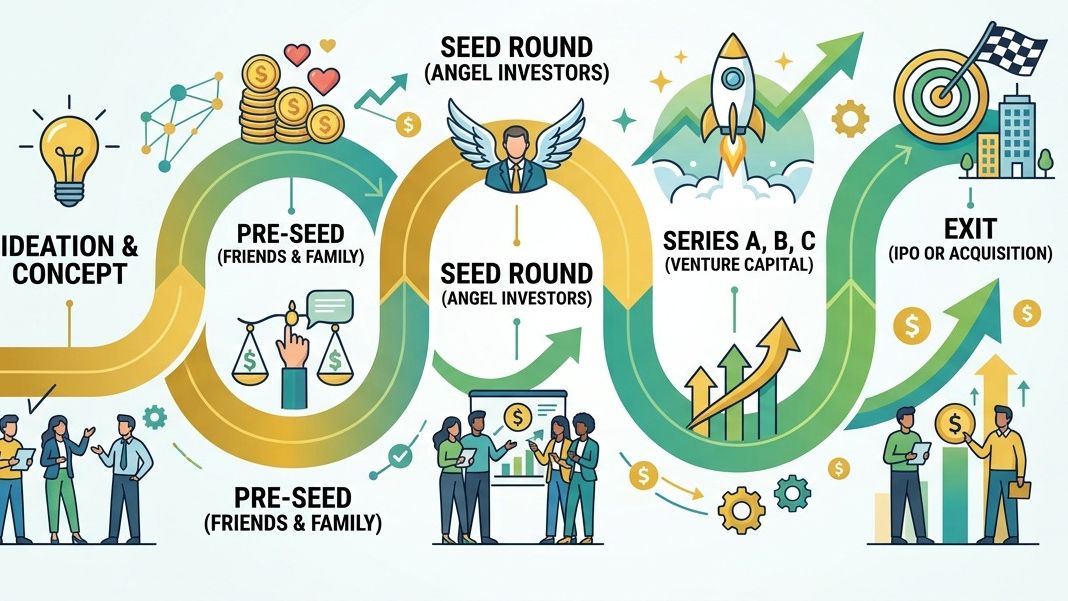
“Startup Funding”. Sounds familiar?
Almost every founder remembers the moment their idea felt real enough to need money. Maybe it was a conversation that validated the concept, a prototype that actually worked, or simply the realization that building this thing properly was going to cost more than a personal savings account could cover. Whatever the trigger, the transition from idea to funded startup is one of the most misunderstood journeys in business. And this article introduces us to the art of startup funding!
There is no shortage of advice about fundraising. There is, however, a significant shortage of honest advice — the kind that acknowledges how hard it actually is, how much of it depends on timing and relationships, and why a great idea alone has never been sufficient to get a cheque written.
Start With What You Actually Need
The first mistake most first-time founders make is thinking about startup funding before they have thought clearly about what the money is for. Investors notice this immediately. A founder who can say precisely what they need, why they need that specific amount, and what it will allow them to achieve is fundamentally more convincing than one who has picked a round size based on what they have heard other startups raise.
Are you a pre-product, trying to build a first version? Or post-product, trying to acquire your first customers? Each stage has a different startup funding logic, a different type of appropriate investor, and a different set of things you need to demonstrate before anyone takes the conversation seriously.
The Startup Funding Landscape
Startup funding moves through many stages, and understanding which stage you are in reveals everything about your approach. At the beginning, most founders use their own savings, money from family and friends. This is sometimes called pre-seed funding which is also a kind of startup funding, though the label matters less than the reality.The job at this stage is to build something — a prototype.
Once there is something to show, angel investors become relevant in the landscape of startup funding. Angels are typically individuals — often former entrepreneurs or senior executives — who invest their own money in early-stage companies.
Venture capital enters the picture once a startup has demonstrated clearer traction — typically some combination of revenue, user growth, and evidence that the market is larger than the early results suggest. Venture Capital firms invest other people’s money and operate under their own return pressures, which means they are looking for businesses with the potential to grow very large, very fast.
What Investors Are Really Evaluating
Most investors will tell you they back great founders, large markets, and differentiated products. That is true but incomplete. In practice, the evaluation is more textured than any checklist suggests.The founder question is central at every stage. Investors are trying to assess whether this person — or this team — has the combination of domain knowledge, resilience, commercial instinct, and self-awareness to navigate what is almost certainly going to be a difficult journey.
A founder who knows their weaknesses and has thought about how to address them is more reassuring than one who projects unshakeable confidence about everything. An investor backing a startup in a small, slow-growing market knows the upside is limited.This is why many investors pass on businesses they personally find interesting — the market simply is not large enough to justify the risk.
The Pitch Is Not The Product
A lot of founder energy goes into perfecting the pitch deck, and it is not entirely wasted. But the deck is a door-opener, not a deal-closer. Most investment decisions are made on the basis of conversations, reference checks, due diligence, and the accumulated impression a founder.
What the deck needs to do is clear and limited:Establish the problem clearly enough that the investor immediately understands
They suggest a founder who understands their own business well enough to explain it simply, which is a different and rarer thing than knowing it in detail.
Relationships Before Rounds
The most consistent piece of advice from founders ,about startup funding, who have raised successfully is that build relationships with investors before you need their money. An investor who has been watching a founder’s progress for six months is in a fundamentally different position when a round opens than one receiving a cold email.This does not mean troubling the investors with updates they did not ask for.
It means being visible in the right places, sharing genuine progress when there is progress to share, and treating the investor relationship as something that builds over time. For startup funding, the network matters enormously, and building it is something that needs to start well before any fundraising process does.
Conclusion
Startup funding was never just about money — it has always been about finding the right people to bet on your vision at the right time. The founders who raise well are rarely the ones with the most polished decks. They are the ones who showed up consistently, built trust early, and understood that every investor conversation — whether it leads to a cheque or not — is a relationship worth keeping.Frequently Asked Questions
Why isn’t a great business idea enough to secure startup funding?
While a great idea is a starting point, it is never sufficient on its own. Investors do not just back concepts; they back the timing, relationships, a deep understanding of the market, and—most importantly—the team’s ability to execute that idea under pressure.
What is the most common mistake first-time founders make when seeking capital?
The primary mistake is focusing on funding before clearly defining what the money is actually for. Founders often pick a round size based on what other startups are raising rather than calculating the precise amount they need and the specific milestones it will allow them to achieve.
What are the primary characteristics of angel investors?
Angel investors are typically individual investors—often former entrepreneurs or senior executives. They invest their own personal capital into early-stage companies, usually once the founder has a tangible prototype or something concrete to show.
Why do VC firms have stricter growth requirements than other investors?
Unlike angel investors, VC firms invest other people’s money. Because they operate under intense pressure to deliver specific returns to their own investors, they strictly look for high-risk, high-reward businesses capable of growing incredibly large, incredibly fast.
What personal qualities are investors looking for in a founder?
Beyond basic checklist items, investors evaluate a founder’s domain knowledge, resilience, and commercial instinct. They heavily favor self-awareness over blind arrogance; a founder who openly recognizes their weaknesses and has a plan to address them is far more reassuring than one who projects unshakeable confidence about everything.
Citations & References
[1] K. Griffith, “What investors look for in early-stage startups,” Harvard Business Review, Mar. 2023.
[2] “Startup Funding Stages Explained,” Investopedia, 2024.
[3] “Startup India: Funding Support and Incentives,” Startup India, 2025.
Transform Your Brand’s Engagement with India’s Youth
Drive massive brand engagement with 10 million+ college students across 3,000+ premier institutions, both online and offline. EvePaper is India’s leading youth marketing consultancy, connecting brands with the next generation of consumers through innovative, engagement-driven campaigns. Know More.
Mail us at [email protected]
Connect Your Brand with Gen-Z
Unlock high-impact youth marketing strategies with EvePaper.
Book Strategy Call