7 Important Things To Know About AI Content Disclosure Rules: The Keyword Disclosure Rules Explained Simply
Published: August 14, 2026
Key Strategy Takeaways
- Prioritize Prominent Disclosures: Disclosures must be obvious and easy to understand using terms like "AI-generated," "AI-enhanced," or "Synthetically created". Hiding notices in tiny text fails regulatory standards.
- A Label Does Not Grant Immunity: Simply adding an "AI-generated" tag does not make deceptive content legal. Advertisements—including fake AI customer reviews or endorsements—must remain truthful and non-misleading.
- Establish an Internal AI Policy: Brands should create clear operational governance, including defining which content requires labeling, setting approval workflows, tracking tools/prompts/outputs, and embedding technical metadata/provenance.
- Ensure Dual Disclosure for Influencers: Influencer marketing involving AI voices, edited avatars, or digital personas requires disclosing both the commercial endorsement nature and the use of AI. Leverage Transparency for Trust: Being open about AI usage helps differentiate authentic marketing from misleading claims, turning legal compliance into a brand trust factor.
AI is for Disclosure rules everywhere in marketing now.
Navigating AI content disclosure rules requires understanding that transparency is no longer optional—it is a legal and regulatory requirement. Major international frameworks, including the EU AI Act, the US Federal Trade Commission guidelines, and emerging digital policies worldwide, mandate that synthetic, deepfake, or heavily AI-assisted media must be clearly labeled for public consumption. These guidelines aim to protect users from misinformed consumption, requiring creators to clearly disclose when text, images, video, or audio are machine-generated. For sponsored or commercial content, creators face double-disclosure requirements, where both the paid partnership and the AI tools used must be stated explicitly. Failure to comply can result in severe financial penalties, immediate content takedowns, or permanent bans across major digital platforms.Implementing these rules correctly relies on clear placement, standard technical practices, and understanding key platform expectations. A compliant disclosure cannot be buried at the end of a long caption or hidden in fine print; it must appear prominently at the beginning of a post, within the first few seconds of a video, or directly overlaid on visual media using recognizable terms like #AIGenerated. Beyond manual text tags, platforms increasingly rely on embedded metadata and digital watermarking to automatically detect and verify machine-made material. Furthermore, social media channels are integrating automated detection algorithms alongside self-reporting mandates, meaning creators who omit disclosures risk losing algorithmic reach or monetization privileges if the platform identifies synthetic elements independently.
Despite the strict rules, regulations distinguish between purely synthetic outputs and human-guided workflows. When AI is used simply for brainstorming, grammar correction, or minor stylistic tweaks under substantial human editorial oversight, explicit public labeling is usually unnecessary. However, as generated media becomes more photorealistic and convincing, the burden of proof remains on content creators to maintain honest communication with their audiences. Ultimately, staying compliant with keyword disclosure rules is less about jumping through legal hoops and more about maintaining audience trust, establishing content authenticity, and protecting your brand against rapidly evolving digital advertising regulations.
Ads, Instagram posts, product photos, videos, even customer replies — brands can make all of it in minutes with AI toolsBut here’s the problem regulators are worried about: if content looks 100% real but was made by AI, people can get disclosure rules confused.That’s why “AI content disclosure” is becoming a real rule, not just a nice-to-have. Countries are now telling companies: if you use AI in a way that disclosure rules could mislead people, you need to say so.
Navigating the modern digital landscape requires a clear understanding of current AI disclosure rules, especially as search engines and regulatory bodies disclosure rules prioritize user transparency.At its core, adhering to these guidelines centers on the Keyword Disclosure Rule, a principle dictating how, where, and which exact terms must be used to signal disclosure rules synthetic content. To satisfy regulatory disclosure rules, creators must use explicit, unambiguous phrasing like AI rather than vague descriptors. Furthermore, placement is critical: compliance standards require positioning these terms above the fold at the very start of a post or article, as hiding terms at the end of a long caption violates established disclosure rules.
For commercial or sponsored content, a double-disclosure approach is enforced, meaning creators must simultaneously state both the brand partnership disclosure rules and the AI usage to comply with advertising disclosure rules. It is also essential to recognize that these guidelines apply across all media types; text posts, synthetic images, cloned audio, and AI video overlays must all integrate standard keyword tags to align with multi-modal disclosure rules.
While minor edits like basic spell-checking do not trigger requirements, generating full text blocks or altered visuals strictly demands compliance. Ultimately, staying disclosure rules up to date with evolving AI disclosure rules protects creators and businesses from search penalty flags, account suspensions, and civil enforcement action for deceptive practices.
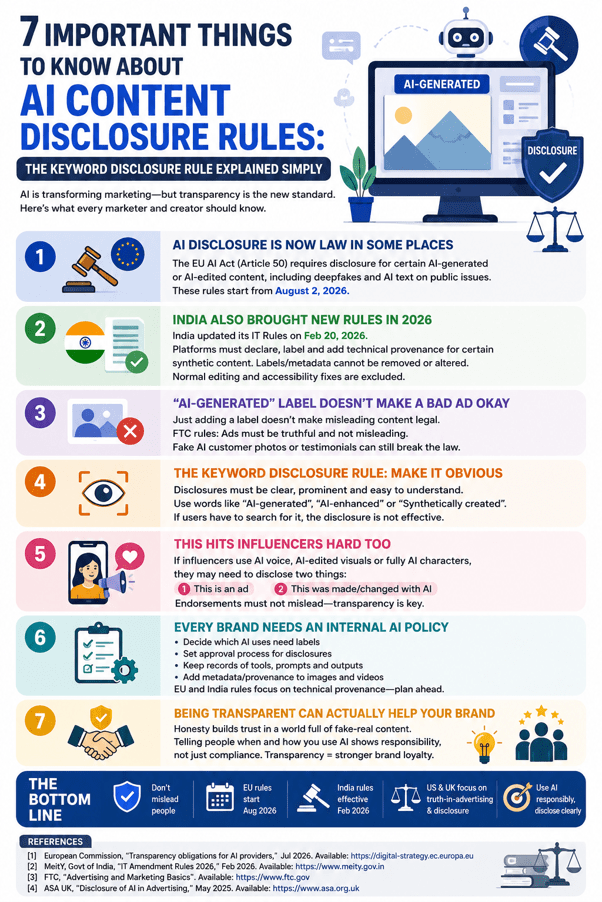
Here are 7 things every marketer and creator should understand right now.
1. AI Disclosure Is Now Law in Some Places
This isn’t just about ethics anymore.The EU AI Act is a big example. Article 50 says companies have to mark certain AI-generated or AI-edited content. For deepfakes and AI-generated text concerning matters of public interest, they need clear disclosure.These rules start from August 2, 2026.That means “AI-generated” won’t just be a suggestion in Europe. It will be a compliance requirement.- India Also Brought New Rules in 2026
India updated its IT Rules on February 20, 2026.Now, “synthetic content” means certain audio, video, or image material made or edited with computers so it appears real and is difficult to distinguish from reality.For covered platforms, the rules include requirements around declaring and labelling certain synthetic content, along with technical information and provenance mechanisms.But don’t panic. The rules also distinguish between material synthetic content and certain routine editing, accessibility-related changes and other activities that do not materially mislead viewers.
- “AI-Generated” Label Doesn’t Make a Bad Ad Okay
This is where people get it wrong.Just slapping “AI-generated” on a post doesn’t make it legal.In the US, the FTC still says ads must be truthful and not misleading.Example: If you use AI to make a fake photo of a “customer” using your product, adding “AI-generated” doesn’t fix it if people think a real customer endorsed it.The same applies to fake AI testimonials. The FTC’s rules target deceptive fake reviews and testimonials.So think of AI disclosure as layer 1. Truthful advertising is still layer 2.
- The Keyword Disclosure Rule: Make It Obvious
A tiny “AI” text hidden at the bottom can fail to communicate the message effectively.Regulators want disclosures people can actually see and understand. Depending on the situation, wording such as “AI-generated”, “AI-enhanced”, or “synthetically created” may help make the nature of the content clearer.The UK’s advertising regulator, ASA, has also highlighted the importance of transparency where AI use is not obvious to consumers.Bottom line: If someone has to squint to find your disclosure, you’re doing it wrong.
- This Hits Influencers Hard Too
Influencer marketing already has disclosure rules. AI adds another layer.If an influencer uses:
- Every Brand Needs an Internal AI Policy
Don’t wait for a government notice.Smart companies are making their own rules now:
- Being Transparent Can Actually Help Your Brand
Compliance isn’t just about avoiding fines.People are seeing tons of fake-real AI photos and videos. When a brand says, “Hey, this image was AI-generated, but the product specifications are real,” it gives customers more context.It tells customers that the company is not trying to hide how the content was produced.In the long run, brands that are open about AI use can build stronger trust. It separates creative use of AI from making misleading factual claims.
The Bottom Line The goal of all these emerging rules is simple: don’t mislead people.The EU is bringing formal transparency obligations into application in August 2026. India has already strengthened its framework for certain synthetic content. The US and UK continue to apply broader truth-in-advertising and transparency principles.
For marketers, the practical move is:
AI isn’t going away. But brands that use it responsibly — and communicate honestly about how it is used — can build greater consumer trust.
Frequently Asked Questions
What is the core purpose of AI content disclosure rules?
The primary goal is to prevent consumers from being misled or confused by AI-generated content that looks real.
When do the EU AI Act disclosure requirements take effect?
The transparency obligations under Article 50 of the EU AI Act start on August 2, 2026.
What updates did India make regarding synthetic content?
India updated its IT Rules on February 20, 2026, requiring platforms to declare, label, and include technical provenance/metadata for certain synthetic content without removing or altering those markers.
Are routine photo edits or accessibility changes subject to labeling in India?
No. The rules distinguish between material synthetic content and routine editing, accessibility adjustments, or minor changes that do not mislead viewers.
Does placing an “AI-generated” tag on a fake customer testimonial make it legal in the US?
No. The FTC requires all advertising to be truthful; generating fake customer photos or testimonials remains illegal regardless of disclosure.
What keywords are recommended for clear AI disclosures?
Regulators suggest clear phrasing such as “AI-generated”, “AI-enhanced”, or “Synthetically created”.
What makes an AI content disclosure “ineffective”?
A disclosure is ineffective if it is hidden, placed in tiny text, or requires the user to hunt for it. Disclosures must be immediately clear and prominent.
How do AI disclosure rules impact influencer marketing?
Influencers using AI tools (such as AI-generated voices, edited avatars, or digital characters) must disclose both that the post is a sponsored ad and that AI technology was used.
What regulatory body overseas UK advertising disclosures?
The Advertising Standards Authority (ASA) enforces transparency principles where AI usage is not obvious to consumers.
What is technical provenance in the context of AI marketing?
Technical provenance refers to embedded metadata, watermarks, or tracking data attached to images, audio, and videos to prove how and where the content was created or modified.
Citations & References
[1] European Commission, “Transparency obligations for AI providers,” Jul. 2026. [Online]. Available: https://digital-strategy.ec.europa.eu
[2] Ministry of Electronics and Information Technology, Government of India, “Information Technology Amendment Rules, 2026,” Feb. 2026. [Online]. Available: https://www.meity.gov.in
[3] Federal Trade Commission, “Advertising and Marketing Basics.” [Online]. Available: https://www.ftc.gov
[4] Advertising Standards Authority, “Disclosure of AI in Advertising,” May 2025. [Online]. Available: https://www.asa.org.uk
TRANSFORM YOUR BRAND’S ENGAGEMENT WITH INDIA’S YOUTH
Drive massive brand engagement with 10 million+ college students across 3,000+ premier institutions, both online and offline. EvePaper is India’s leading youth marketing consultancy, connecting brands with the next generation of consumers through innovative, engagement-driven campaigns. Know More.
Mail us at [email protected]
Connect Your Brand with Gen-Z
Unlock high-impact youth marketing strategies with EvePaper.
Book Strategy Call